
Begin With the Medium, Not an Online Caption
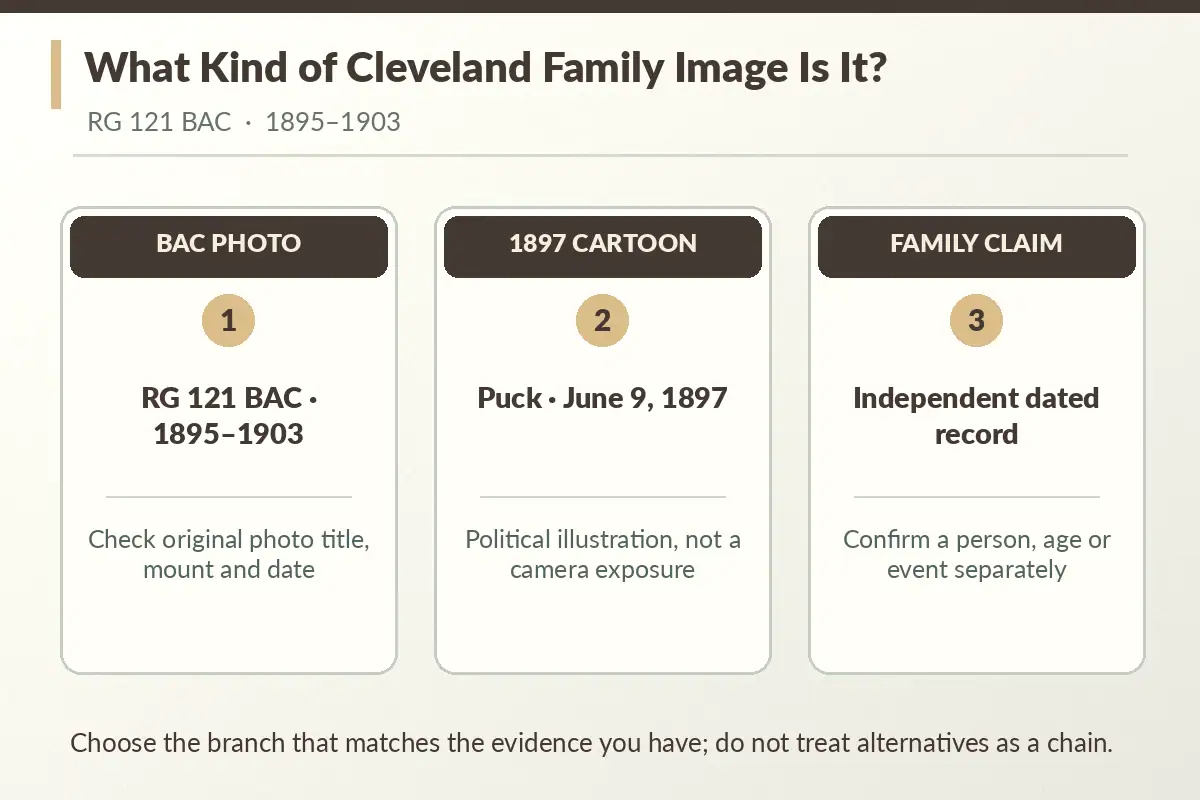
The National Archives identifies 16 photographs of the Grover Cleveland family and others in RG 121 series BAC, with a collection range of 1895–1903. This limited set offers a useful case study in presidential family photography. It must not be confused with every illustration of the Clevelands published in the same era. A photograph, wood engraving, halftone, newspaper cartoon and later reproduction may show familiar faces but answer different historical questions. Record what kind of object you have before trying to extract an event, age or place from it.
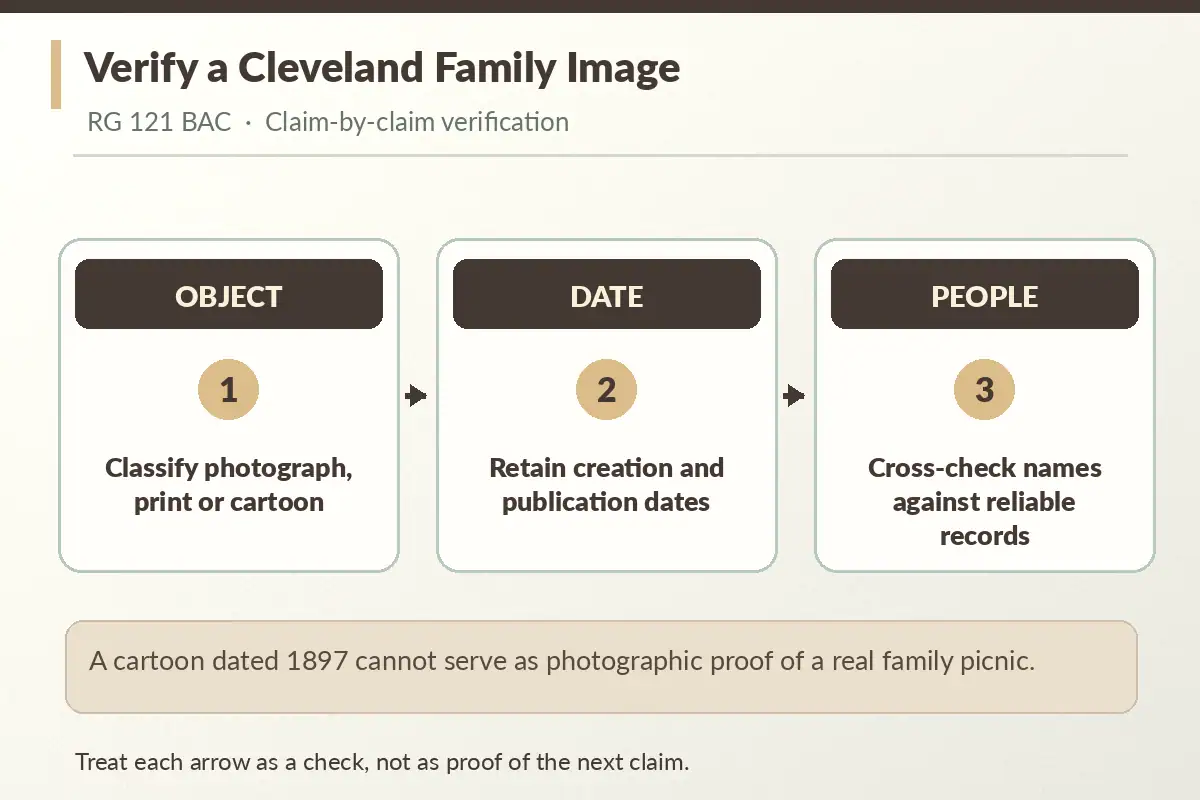
A BAC photograph is not automatically dated to one specific year within 1895–1903. A print may have been produced or collected later than the exposure, and the words “and others” warn against assuming that all sixteen images depict the same set of household members. Save the original NARA title, item or local identifier, whether a photographer or studio is credited, and the exact words of any family relationship supplied in the catalog. A person’s apparent age can generate a research question but is not reliable enough to invent a precise exposure date.
Do Not Turn an 1897 Cartoon Into a Family Photograph
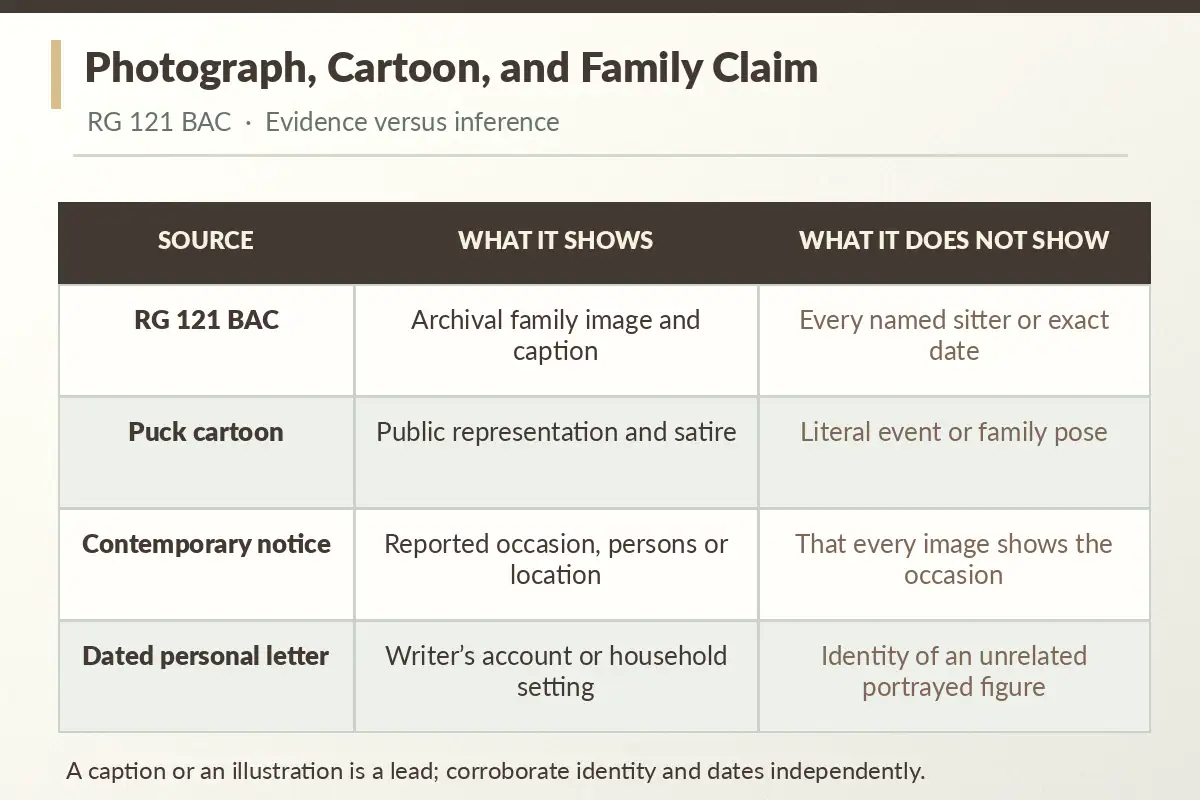
The White House Historical Association describes a Puck magazine cartoon by Charles Jay Taylor published on June 9, 1897. It depicts President and Mrs. Cleveland with their young children, with intrusive onlookers and reporters. Its intended subject is the public fascination with and invasion of privacy around the presidential family. That is evidence of how a contemporary artist portrayed celebrity and political domestic life, not a candid camera view of a documented picnic on the White House lawn. Label it clearly as a cartoon if using it beside BAC portraits.
Cartoonists employ rearranged figures, exaggeration and symbolic setting. The caption may identify recognizable people or circumstances, but the composition is not a measured record of who stood where on a given day. Likewise, a reprinted engraving based on a photograph should be described as a derived graphic, with its own publication date. When cataloging a family scrapbook, note the difference between the date the underlying portrait might have been taken and the date a newspaper illustrated it. A precise publication date does not transfer automatically to an earlier original photograph.
Identify Sitters With More Than Resemblance
The President, First Lady and their children are well known historical subjects, yet an identification of an unfamiliar sitter still needs item-level evidence. Begin with the contemporary caption and studio attribution. Compare a named portrait with independently dated family records, biographies, press notices and other authenticated photographs. Avoid using a modern face-search match or a similar hairstyle as sufficient proof. A sitter standing beside the President could be a relative, visitor, official, employee or photographer’s assistant; proximity does not prove kinship or employment.
Keep names and relationships separate. One reliable source may establish that a child belonged to the Cleveland household; another is required to establish that this particular child is the sitter in an ambiguously captioned frame. The household also appeared in public discussions across changing addresses and political terms, so a family name is not enough to place a scene in the Executive Mansion. When comparing two images, include their apparent setting, mount, clothing and reliably documented dates. Mark any matching identity as tentative until the provenance supports it.
Place the Family Scene Without Assuming the White House
The BAC series description identifies family photographs but does not assign every image to a specific residence. A richly furnished interior, garden or steps may feel familiar, but without an original caption it may not be the White House. Identify architecture and furnishings with dated photographs or property descriptions rather than with general expectations about presidential life. The collection runs beyond Cleveland’s second presidential term, so it is especially important not to assign every photograph to his years in office. A later family portrait can still be in a presidential subject series.
Use a location table: image identifier, stated place, visual clues, independent address evidence and confidence level. If the same family was photographed in multiple settings, do not construct a single uninterrupted household event from images in different folders. An early photograph may be placed beside a later print because an archivist organized them by person. File order is not a family timetable. If a third-party website has cropped an image, request the uncropped archival frame before making a confident location claim.
Write Public History Without Inventing Private Experience
The Puck cartoon’s discussion of privacy makes these images particularly suitable for teaching source purpose. Presidential family photographs were made, collected and circulated in a public environment, but that does not mean every portrayed domestic activity was intended as a public document. The distinction is analytic, not merely sentimental: a photo caption can name a sitter, whereas a cartoon’s speech or setting may be the artist’s criticism. Do not quote a character’s imagined remarks as something the historical person actually said. Cite the artwork and the portrait separately.
NARA’s still-picture reference page explains the need for a record group, series, box or divider where relevant, and unique item identifier. A useful final annotation reads: “RG 121 BAC photograph, cataloged within 1895–1903; sitter and original exposure date verified only to the degree supported by the item caption.” For the cartoon: “Puck illustration, published June 9, 1897, representing public attention to the Cleveland family.” If you cannot identify an exact sitter, keep the uncertainty visible. This is stronger family history than merging authentic names with an invented scene.
For a comparative display, place photographic portraits and political illustrations in different labeled columns even if their subjects overlap. Include the creator, original purpose, medium, publication or exposure date, and custodian. Ask whether the image was arranged for private remembrance, public promotion, artistic commentary or journalistic circulation. Those functions affect what a viewer can infer. An annotated family picture can establish someone was represented as a member of a household while still leaving the location or moment unknown. A political cartoon can establish a contemporary public debate about privacy while saying nothing literal about a child’s behavior. The same surname should not erase the evidence gap between the two objects.
More Family Story and Preservation Guides
How We Research This Evidence
This guide is based on the National Archives record-group description and a second official source, checked November 16, 2026. We checked the exact series labels and collection dates against the custodian rather than guessing from a generic subject search. For item-level inquiries, follow NARA’s still-picture reference guidance: retain the full local identifier, including series and divider information where applicable. The series description does not establish that every item is digitized, that an individual photograph has an exact date, or that any pictured person is identified. There are no paid links or unverified products in this guide; see our affiliate disclosure.
NARA describes sixteen photographs dated 1895–1903, including family subjects and others.
No. The White House Historical Association identifies it as an illustration by Charles Jay Taylor.
No. It is a series span; verify the individual photograph’s caption and provenance.
The guide does not establish that; research each scene’s location independently.
No. Use named contemporary captions and corroborating records for each identification.