
The National Archives guide for Record Group 33 lists two major sets of photographic negatives about rural life and Extension Service activities: S with 17,200 images and SC with 10,360, dated 1920–1954. It also mentions an accompanying SCX logbook. Many negatives were made by G. W. Ackerman and E. C. Hunter. This is an unusually promising set for investigating scenes of farms, household work and agricultural education, but a photograph of a farm does not establish its legal owner or occupants.
Search by image identifier, visible activity and location evidence before trying to connect a picture to a surname. A caption or logbook entry may supply place, date, photographer or an Extension program; each field has its own uncertainty. To establish a family connection, you still need deeds, censuses, local directories, Extension reports or another independent record that actually names a household or property.
Choose S or SC Before Searching the SCX Logbook
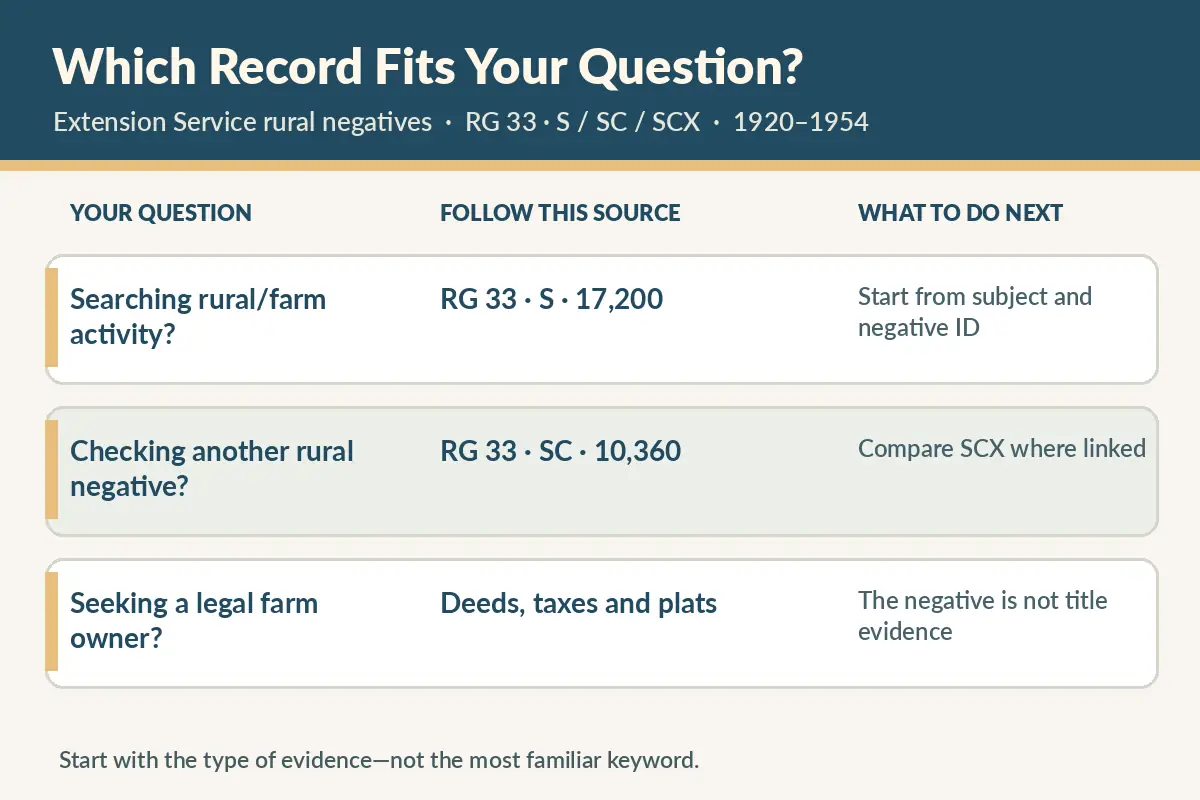
NARA describes S as 17,200 negatives and SC as 10,360; those counts total 27,560 rural and agricultural images. The same section separately lists 1,000 National 4-H Club Camp negatives under CC, accounting for the larger total of 28,560 negatives in its heading. Do not merge CC with S or SC just because they are listed together.
The guide associates SCX with an accompanying logbook, but it does not promise an entry or complete identification for each image. Search for the exact negative number, series arrangement and matching log information when available. If you do not yet have a usable identifier, start with the descriptive series and subject keywords rather than guessing what an SCX page should contain.
Distinguish an Original Negative From a Printed Reproduction
An archival negative may have been copied as a print, cropped for a publication or digitized decades later. Those versions can differ in framing, contrast and inscriptions. Note which physical or digital generation you examined. A print caption may be later than the original exposure, and a modern website may not reproduce the negative’s edge markings.
If an image shows a particular plow, kitchen demonstration or field activity, describe that visible subject without assigning a crop variety, county or farm until the caption supports it. Request the negative identifier and any surviving associated caption, log or publication reference. A second reproduction of the same image is not an independent witness to its location.
Use the Logbook as an Index, Not an Ownership Register
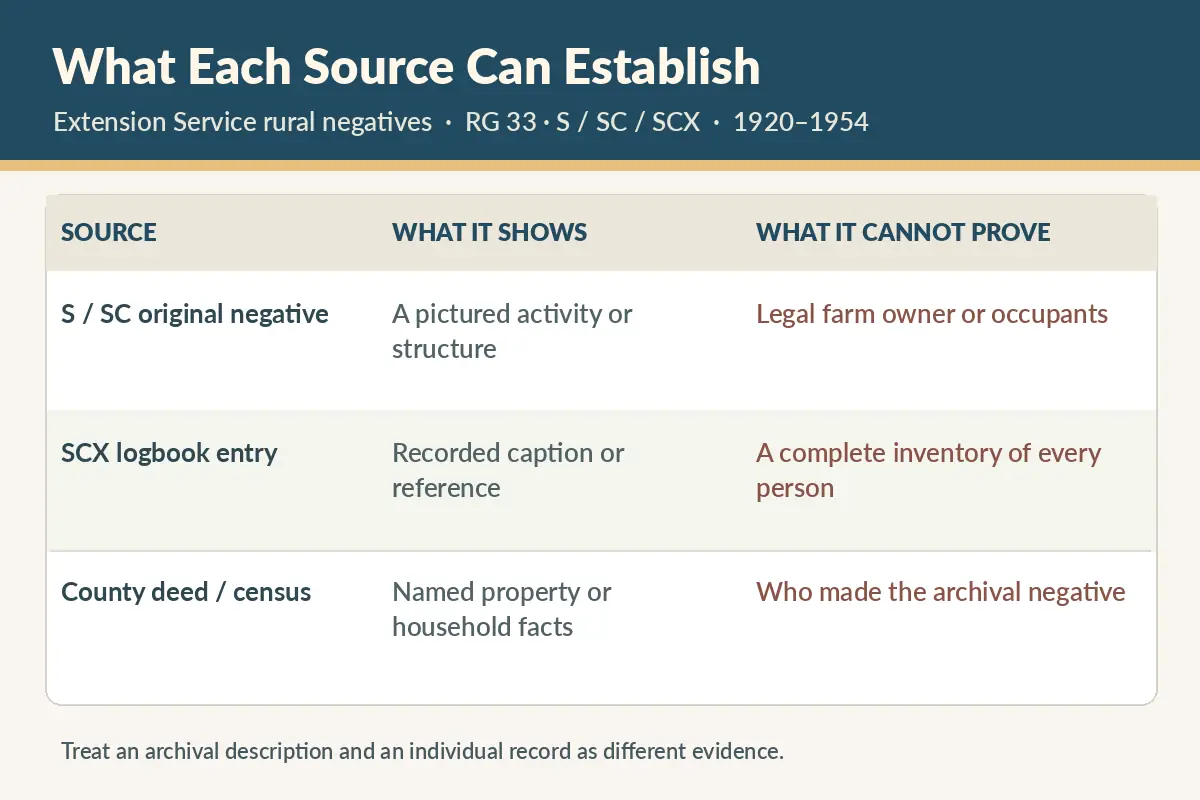
Where SCX includes a corresponding entry, transcribe all recorded fields and preserve abbreviations. A log might help establish a photographer, location or activity, but its precise contents must be checked rather than assumed from the word “logbook.” Separate what the entry states directly from an interpretation you build using maps and local research.
A person named as a demonstration leader or county agent is not necessarily the owner of the farm shown. Likewise, a place name may refer to the county where an Extension office operated rather than the precise address of a photographed home. Use an independent land or tax record to support property ownership and a dated census or directory to test household residence.
Treat Photographer Credits as Item-Level Evidence
The guide says many photographs were taken by G. W. Ackerman and E. C. Hunter; it does not assign every S or SC exposure to either person. An author credit in a later publication may be a useful lead, but do not fill the photographer field by copying the names from the series description. Look for a specific caption, negative sleeve or catalog record linking the creator to the item.
Sometimes a published image is cropped or credited to an agency rather than the individual camera operator. Record the difference between creator, agency publisher and custodian. If an original lacks a personal attribution, describe it as an Extension Service collection image with the photographer unknown, not as a confirmed Ackerman or Hunter photograph.
Identify a Farm Through Geography and Documentary Links
List landscape and architectural evidence such as barn shape, fences, road alignment, terrain, silo placement, irrigation features and crop patterns. Compare a candidate location with period county atlases, aerial views or historic topographic sheets. Regional farming practices can look similar across different states, so one matching barn style or field pattern is insufficient for an exact location.
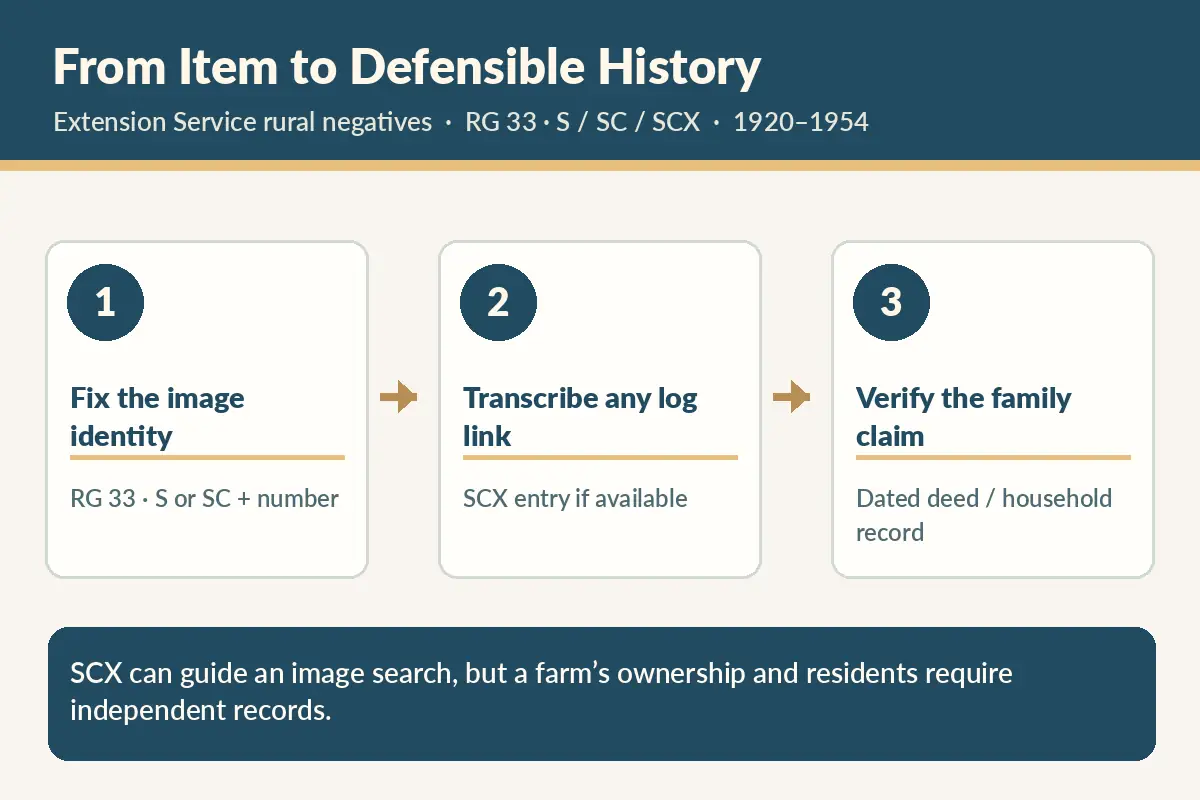
When a farm or community is named in a logbook, identify the contemporaneous civil jurisdiction and any boundary changes. Check deed chains, property tax assessments or plat maps for ownership, and household records for residents. A farm scene may depict a demonstration plot, an Extension visit or a tenant operation; the captioned subject is not automatically the property holder.
Interpret Agricultural Demonstrations Without Inventing Results
An image may document an Extension Service method, public demonstration, home economics lesson or rural activity. It does not tell you whether a practice increased yields, who attended a meeting, or how widely a program was adopted. The presence of equipment can demonstrate that it was photographed, not that every nearby farm used it.
To make a claim about program results, consult dated Extension annual reports, field correspondence or contemporaneous published studies, and distinguish reported outcomes from measured local evidence. A negative that illustrates an agency publication may have been chosen for clarity and representativeness rather than to document an entire district. Describe the pictured act before generalizing.
Prepare a Source-Transparent Image Citation
Record RG 33, S or SC, negative number when known, exact title or original log wording, date, repository and digital item identifier. Keep SCX as a linked finding aid only after verifying the connection to the particular negative. Where two copies have different dates or captions, cite both and explain the discrepancy instead of picking the more convenient one.
For family-history publication, pair the archival image with an independent, dated document naming the family or property. If no such link survives, the photograph can still illustrate historically documented rural work without representing a particular ancestor’s farm. Check whether access and rights information applies to the specific reproduction and label any restored or colorized treatment accurately.
More House and Local History Guides
How We Research the Archival Trail and Its Limits
Our method begins with the NARA record-group description and records the exact subject, group code, medium, year span, and stated holdings before interpreting a particular item. We distinguish what the published guide confirms from what a caption or original image would have to establish. The Catalog guidance explains why a series description is not the same as a digitized item.
For specific claims about people, places or property, we compare at least one independent dated record and retain negative or ambiguous results instead of filling gaps with plausible stories. We do not assume that all items are online, that an illustration is a faithful facsimile, or that a proposal was completed. NARA’s copy-request guidance explains why a precise citation matters. Our affiliate disclosure explains the site’s policies; no affiliate relationship is asserted by these archival links.
S has 17,200 and SC has 10,360, for 27,560 rural and agricultural negatives.
It is the accompanying logbook named in NARA’s still-picture description; check entries and coverage before using it.
No. The NARA guide says many photographs were theirs, not all.
No. Use deeds, taxes or other dated land evidence to test ownership.
The section also includes 1,000 CC National 4-H Club Camp negatives, a separate subject group.