
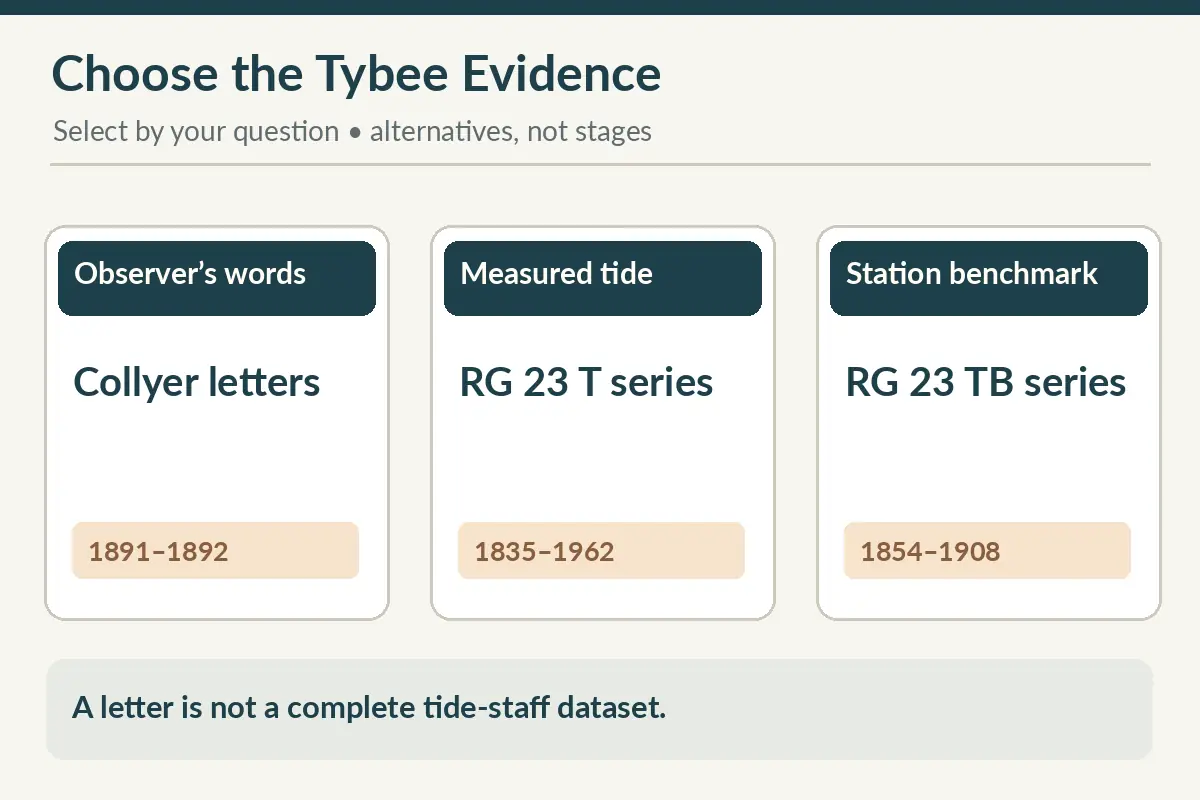
A short but precise historical source survives for Georgia’s coast: National Archives Record Group 23 describes letters sent by Arthur J. Collyer, a tidal observer at Tybee Island, in 1891–1892. Those letters can document observations, administrative reporting or the running of a station if the individual item says so. They do not automatically contain a continuous tide series, prove an extraordinary storm, or identify every worker at the shore. The first task is to locate the correspondence and determine the subject of each dated letter.
The Coast and Geodetic Survey guide, section 23.5.1, places Collyer’s outgoing letters with field-activity records and indicates an Atlanta holding location in its historic guide. A separate section describes tide-staff readings and tidal bench-mark records. The division between letters and measurements matters: a letter may discuss an instrument or forwarding procedure, while a tide-staff sheet records observations in its own format. Verify actual custody and request details in the present catalog.
Locate the Correspondence by Observer and Place
Search for Collyer’s name, Tybee Island and the 1891–1892 dates together, rather than searching every RG 23 Georgia coastal chart. Ask for the specific letters-sent series under section 23.5.1, and note that the record-group guide identifies those documents as field correspondence. Older guides can record former reference locations; confirm the current facility, boxes and access procedures rather than treating the historic “in Atlanta” designation as a present-day appointment guarantee.
A written letter might have a date, recipient, subject line, station context and signature. Record those parts separately. If a handwritten reference looks like a reading, determine whether it is an actual measurement, a summary, or an instruction about measurements. Do not invent a gauge number or a continuous daily series until a surviving page identifies it. If the letter references an enclosure, request that enclosure or note explicitly when it cannot be located.
Distinguish Tidal Letters From the T Series
RG 23 section 23.4.2 describes tide-staff readings in the T series covering 1835–1962, along with tidal bench-mark descriptions in the TB series for 1854–1908. Those broad date spans tell you such record types exist; they do not prove a particular Tybee 1891 record survives in each. Treat the field correspondence as one source and the scientific observation series as a separate potential follow-up. Search by location, instrument, date and archival series where finding aids permit.
A letter that reports a broken staff or changed observation schedule is valuable for interpreting gaps or unusual readings, but it is not an observation chart. Conversely, a table of water levels may need station history to explain a relocation or datum change. Do not combine measurements from different datums without reconciling them. Note the vertical reference, time basis, units and whether readings are original, computed or copied before constructing any plot or comparing two years.
Reconstruct Scientific Work Without Naming a Crew
A known observer’s signed correspondence can support a narrow statement about that person’s reporting role on a particular date. It does not name every assistant, boat operator or lighthouse worker unless the text identifies them. If a family story puts an ancestor at Tybee Island, seek local census, directories, federal payroll, a station personnel record or a signed letter that names the person. A coastal place name by itself is too broad to establish employment.

The Coast and Geodetic Survey had multiple functions, including hydrography, coastal mapping, geodesy and tide observation. A scientist shown on another Georgia survey document need not have worked on Collyer’s Tybee correspondence. Keep agency, office, location and role in separate notes. If a letter was sent from Tybee but addressed to a distant office, it proves communication, not that its recipient was physically present at the tide station.
Evaluate Weather and Storm References
A letter might mention a high tide, adverse conditions or station damage. Such wording is a primary description of what the author reported, but a modern claim that a particular hurricane struck the station requires additional contemporaneous meteorological records. Check the exact date and phrasing, then consult weather observations, newspapers or other independent accounts. Never infer a hurricane merely from a large water-level value; astronomical tide, surge, datum and local wind effects need to be distinguished.
Compare historical observations with NOAA Tides & Currents only after identifying a common station and datum or explicitly acknowledging differences. A current NOAA station page is not a transcript of the 1891–1892 letters. Station codes and locations may change over time. If no verified crosswalk exists, use the modern data as background on tidal measurement rather than evidence of the precise nineteenth-century event.
Turn the Letters Into a Citable Local History
A precise claim might read, “An outgoing letter dated [date] from Arthur J. Collyer at Tybee Island discussed [the documented subject].” Only fill those brackets after inspecting the document. A weaker claim would state that he recorded a famous storm or supervised a named family member, when the archive guide alone does not establish either statement. Keep exact quotations short and attach the record identifier, date and recipient to the note.

For property history, use a dated shoreline map or cadastral record when connecting station activity to a site. A letterhead naming Tybee Island does not specify a building’s coordinates. Shorelines and station facilities can change. Compare historical maps, landmarks and tide references with caution, especially where structures moved or landmarks disappeared. Document the spatial uncertainty separately from the archival certainty that a named observer wrote a letter.
How We Research a Tybee Tidal Report
We use a three-part ledger: correspondence facts, instrument and observation facts, and independent environmental context. For correspondence we record author, recipient, date, original words and archive citation. For measurements we require a named series, location, units, date and datum. For environmental interpretation we state whether the account is a contemporary observation, a later history or a modern inference. A missing observation sheet cannot be used to create a reconstructed daily tide table.
The RG 23 guide is a source locator, not the text of a particular Collyer letter. Verify an actual item in the current NARA catalog before making item-level claims, and preserve any ambiguous reading instead of silently standardizing it. The site’s affiliate disclosure explains commercial relationships if a linked service uses them. This article’s illustrations are interpretive, not authentic survey instrument records or images of the named observer.
More Place and Jurisdiction Guides
Frequently Asked Questions About the Records
The RG 23 guide identifies Arthur J. Collyer as the author of letters sent in 1891–1892.
The archival guide does not say so. Tide-staff readings are described separately in the T series.
It lists them with field records “in Atlanta”; confirm current custody and ordering arrangements.
No. Check dated independent meteorological sources before making a storm claim.
No. Modern data require careful station and datum comparison and do not replace historical readings.