
RG 70 holds General Register Office certificates concerning places of religious worship, associated with legislation of 1852 and 1855. These certificates can help identify a chapel and its recorded status; they are not a substitute for baptism, congregation membership or marriage registers. Start by separating registration of a building from evidence that a particular family actually worshiped or married there. This guide gives a precise source route, identifies what the archive can and cannot show, and names the independent documents needed before a personal or geographic conclusion becomes defensible.
Begin with the Chapel’s Historical Identity
Congregations often changed buildings, shared rooms, split, merged or adopted new names. Begin by recording the denomination if known, the chapel name, street or hamlet, historic parish, registration district and approximate years of activity. A name such as “Independent Chapel” may describe several institutions in the same county. Newspaper notices and local directories help establish whether the chapel was present at the time of the family event. Do not infer attendance merely because a building appears on a nearby street.
The RG 70 series title refers to certificates generated under the Places of Religious Worship Certifying Act 1852 and Places of Worship Registration Act 1855. These are administrative records: look for the building and certification context rather than a list of households. Building numbers, street renaming and replacement premises can create false matches. If two records use the same chapel name at different addresses, test whether they represent a move, two distinct chapels, or an incorrect modern transcription.
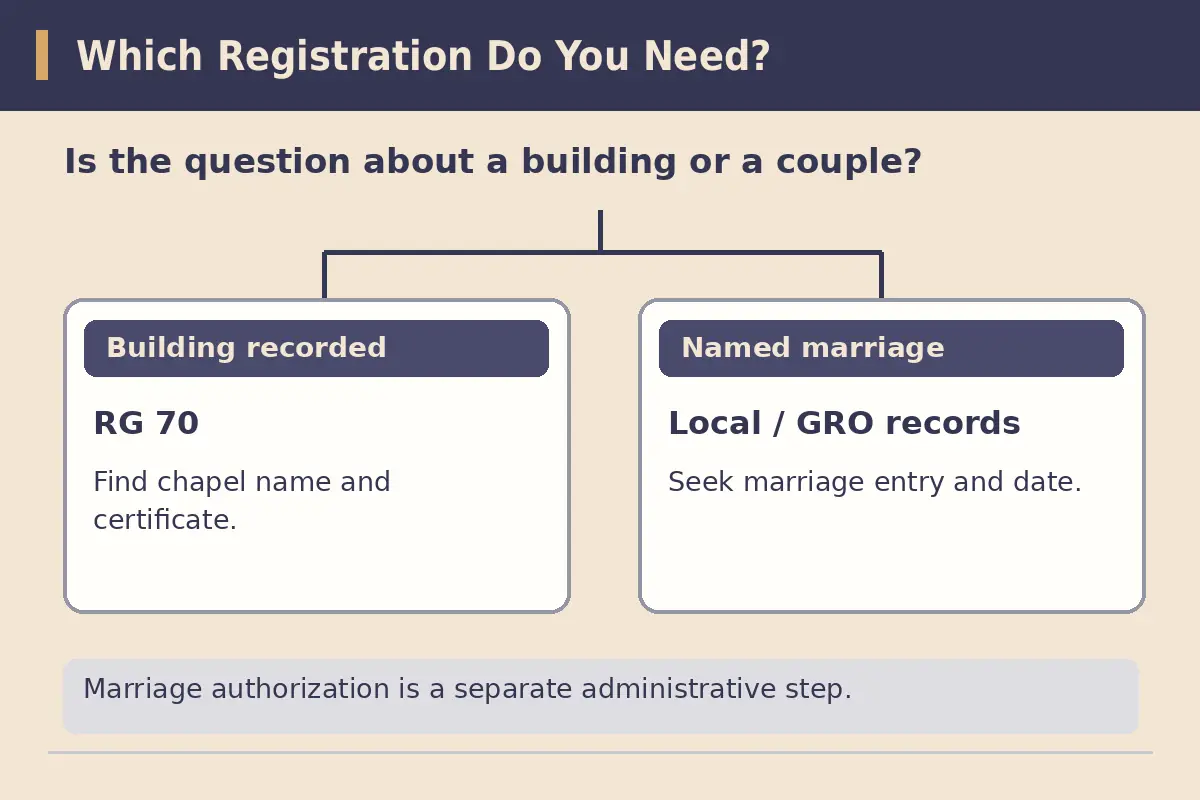
Separate Worship Certification From Marriage Registration
The General Register Office guidance distinguishes recording a building for religious worship from registering a certified building for the solemnization of marriages. It also states that congregations can worship in a building that has not been recorded under the 1855 legislation. Consequently, absence of a certificate does not mean religious services did not occur. A certificate is evidence of an administrative status, not an origin date of faith, congregation or chapel construction. Note the type of application and recorded date if the original document supplies them.
The Marriage Act 1949 provides a distinct legal route for marriage registration of certain places of worship. A registered building might later hold a ceremony, but that does not establish that one occurred or name its participants. Conversely the worship certificate alone does not demonstrate that the premises were legally registered for marriages. Keep three dated columns: worship recording, marriage-building registration, and individual marriage evidence. An empty column is an evidence gap, not proof of prohibition or absence.
Hypothetical worked case: a family story locates an 1895 wedding at “Hope Chapel,” but two chapels of that name appear in a county. Compare contemporary street directories and registration districts, then locate any RG 70 certificates for both. Only after fixing the building and applicable marriage status should you search named marriage entries for the couple. The chapel certificate does not itself select the correct bride or groom.

Find the Certificate Without Confusing an Index With an Original
Use the National Archives catalogue to identify RG 70 material, checking the record hierarchy and “Held by” field. Search variations of the chapel name, locality and historical administrative district, then browse the description of the relevant volume or piece. Do not expect a single keyword query to expose every chapel inside a bound set of certificates. Where item-level descriptions are incomplete, use the series structure, dates and archive advice to determine which physical record to consult.
When you obtain a certificate, transcribe only what it actually says: building or room, name, location, applicant or representative, type of certification, date and archival reference. A named applicant might be a trustee, minister or occupier, but that does not prove that person was a regular worshiper or related to another surname on the page. Preserve original spelling and give a modern address equivalent separately. If there are endorsements or later cancellations, date each one rather than compressing the sequence into a single “registered since” claim.
Move from the Chapel to Individual Records
To identify an ancestor’s ceremony, seek the appropriate marriage register, certified copy or civil registration evidence. If the question concerns baptism or burial, the archive route may run through church, nonconformist or local deposit collections instead. The National Archives’ guidance on nonconformists explains why records can be held by multiple repositories rather than one complete centralized series. Try a chapel archive, county record office, denomination repository and civil records according to the relevant period.
Different record classes support different levels of identity. A certificate locating a chapel establishes a search place. A register entry identifying a named bride and groom supports a particular ceremony, subject to verifying that they are the right people. A local church minute naming an officer supports a role, not necessarily a family connection. If a family lived near two chapels, build a dated table of each institution rather than choosing the nearest address as proof.

Interpret Missing Certificates and Building Changes Cautiously
A failed search can result from alternate naming, a chapel that was never recorded, incomplete item descriptions or a building registered under an older district. The official GRO guidance explicitly allows worship in some buildings without registration. For this reason, no-result searches should be documented as searches, not turned into historical conclusions. List the names, dates, districts and repositories you tried. Then consider nonconformist surveys, contemporary trade directories and local newspapers to confirm whether the meeting place existed.
For a family-history narrative, keep the wording modest: “RG 70 provides evidence about the recorded status of a named chapel” can be supported by a specific certificate. “My great-grandparents married there” requires a marriage entry with names and a date. Avoid placing a congregation, building owner and ceremonial authority into one category. This distinction also protects against mistaking a later replacement chapel for an earlier vanished meeting room.
For a reproducible citation, include RG 70 and the exact piece and certificate number where available, the historical chapel name and address, the document date, repository and whether the evidence came from the original or only a catalogue entry. Keep descriptions of worship status and marriage authority in separate research-log fields.
More Place and Jurisdiction Guides
How We Research This Archive Series
This guide starts with the documented evidence in an authoritative source, not a claim that we have inspected a particular person’s private file or a specific original piece. The archival statements here concern the series or research method. A hypothetical example is labelled as such; it is not a newly discovered historical event. We use the Discovery search guidance to distinguish keyword matches from archive holdings and document contents, because catalogue descriptions do not transcribe every word of an original.
For every real candidate, record its historical place or person’s name, the creator, document type, date, full RG 70 piece or item reference, access restrictions, and the exact claim being tested. The official citation guide explains how to document those references so another researcher can retrace them. An unread document remains a catalogue lead, never proof of imagined details. If a record is missing, preserve the searched terms and dates and examine survival and alternate custodians before interpreting the gap.
Before sharing a conclusion, audit the difference between original source wording and your interpretation. Require independent evidence for any further claim about an individual, property owner, legal effect, or completed action. Respect archival access limits and living people’s privacy. This website also provides an affiliate disclosure; no paid partnership or commercial access is implied by these archival references.
Certificates concerning recorded places of religious worship from the General Register Office and its predecessors.
No. Registration of a building and an individual marriage entry are different kinds of evidence.
No. Official GRO guidance says congregations could worship in unrecorded buildings.
It is not a membership register; seek local or denominational records for named worshipers.
Track each historical name, street address and registration district by date before matching a certificate.