
Office of Price Administration filmstrips were designed to explain wartime rationing and price controls, not to record every transaction at every store. The National Archives describes six filmstrips in Record Group 188, FS, dated 1942–1946, along with scripts, production files and related photographic material. A frame about price ceilings reveals a message the agency wanted people to understand. It is not by itself proof that your family’s shop obeyed the ceiling, violated it, or received a penalty.
Treat the filmstrip as one type of source in a sequence: agency message, contemporary policy text, local administration, and an independently documented event. Family stories about ration books, lineups, shortages or enforcement can be researched without turning an educational image into an eyewitness account. This guide shows how to find the correct FS frames and script, determine what kind of regulation was in force, and distinguish regional experience from nationally produced instructional materials.
Identify the Six FS Filmstrips and Their Scripts

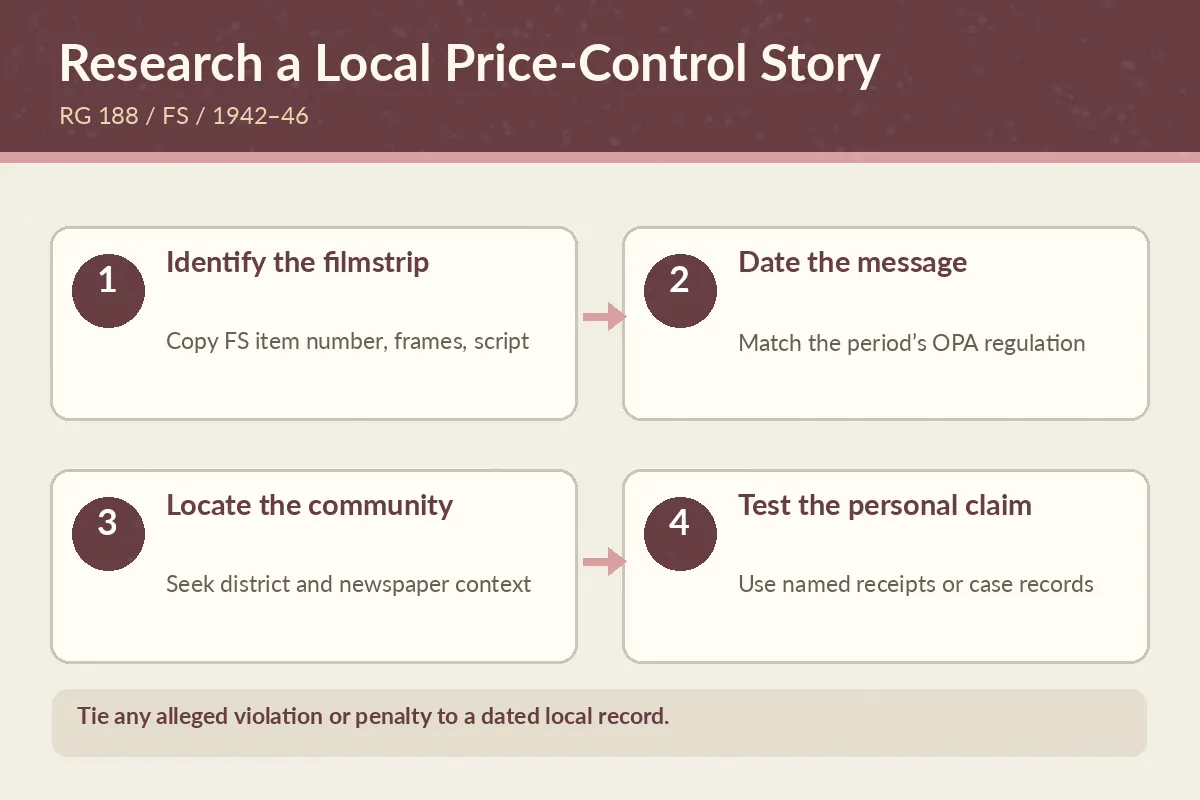
NARA places the filmstrips in the Visual Services Branch records and lists six items, 1942–1946. Request the precise FS item, frame sequence, title if present, accompanying script, and production date. The related 1,500 photographic prints and negatives are associated with filmstrips but are not 1,500 separate filmstrip titles. Keep the distinction clear in an inventory. When a digital copy has only selected frames, do not treat its sequence as complete without checking the archival finding aid.
A script can explain the intended narration, timing and instructional claim, but it may be a draft. Note revisions and whether the surviving filmstrip corresponds to the same script version. If frames and words differ, cite each witness separately. Do not attribute a quotation to the finished presentation solely because it appears in an unused production file. An official program’s educational goal is a fact about communication, not automatic evidence that the public received or believed the message.
Keep Posters, Lantern Slides, and Motion Pictures Separate
Record Group 188 holds more than FS filmstrips. NARA lists 69 images among posters, paintings and drawings of the Visual Services Branch, plus lantern slides for a 1942 lecture called “Price Ceiling and the Retailer.” It also lists agency motion pictures about rent control, rationing and other programs. These formats had different uses and audiences. The fact that two items express a similar rule does not prove that the same script, date, or campaign applied to both.
Use a source-choice table before writing a caption. If the object is a poster, cite PP, PPA or PPC when that is its actual series. If it is a lecture slide, identify LS or LSP. If it is an FS frame, retain the filmstrip identifier and sequence. This prevents a family album’s “wartime poster” from acquiring a made-up filmstrip provenance. Check production dates rather than assuming that all wartime messages were created in 1942.
Date the Actual Price or Ration Rule

The year span 1942–1946 identifies the described filmstrip records, not one regulation that remained unchanged throughout World War II. Locate the original policy, effective date, applicable commodity, permitted seller type, region and amendments before asserting the content of a local rule. A chart or dramatization in an educational filmstrip may simplify a complicated order. Preserve the text of the rule as a separate source if the distinction matters to a claimed family event.
For a store-history example, write three questions: what was the rule on the transaction date, what was the store’s location and business type, and what record documents the alleged action? A ration book or customer receipt has a narrower evidentiary function than an enforcement order. An announcement of a price ceiling is not a record that anyone exceeded it, and a complaint is not a proven offense. Do not merge a consumer’s grievance, an investigation and a judgment into one historical event.
Build Local Evidence Beyond the Federal Message
The RG 188 guide describes administrative, regional and field records alongside the educational media. Search the appropriate regional record descriptions for the community at issue, but do not presume that an individual merchant case survives or is indexed by surname. Local newspaper notices, municipal business records, personal correspondence and receipts may supply a dated view of practice. Annotate whether the source reports a rule, a proposed change, a complaint, or a final result.
Suppose a family remembers a grocery being “closed for breaking ration rules.” The filmstrip may illustrate what people were taught, but it cannot support the closure. Seek contemporary enforcement notices, a named proceeding, court or administrative findings, or a reliable newspaper report, and confirm the same address and operator. The absence of a case in one surviving series does not rule out a complaint or informal warning; it simply limits what can be documented.
Explain Propaganda and Everyday Life Without Stereotypes
Educational filmstrips can be studied as designed historical media: who the imagined audience was, how characters were drawn, which examples were emphasized and what terms were used. They may present idealized cooperation or simplified households. A family story from a particular neighborhood might describe a very different experience. Describe that divergence rather than dismissing the testimony or treating the agency’s portrayal as a literal photograph of daily life.
Credit each image by archive group, series, item and frame, and include any original creator and rights notes. Modern diagrams explaining the evidence should be clearly described as educational illustrations, not reconstructed government frames. A defensible conclusion could be: “An OPA filmstrip explained the intended rule; local behavior remains to be established.” That conclusion is historically useful because it does not invent a retailer, a household violation or a nationwide response.
More Family Story and Preservation Guides
How We Research This Evidence
This guide is anchored in the official archival description: NARA RG 188 section 188.7.4 lists six Visual Services Branch filmstrips, 1942–1946 (FS), with scripts and production files; 1,500 associated prints and negatives; and separate poster series. That supports the existence, arrangement and broad dates of records as described, not the accuracy of claims about an unseen individual item. Check a specific identifier, original caption or register line, date, creator and physical arrangement before using the material in a family or place history. Where archival descriptions conflict with an event timeline, preserve both and explain why they answer different questions. Each schematic image in this article is an original modern educational illustration, not an image of the record itself.
We checked the source information on 2026-11-14; that is an access-check date, not the historic creation date. Follow NARA’s Still Pictures guidance for image requests or research preparation guidance for questions about original holdings and access. Exact availability, digitization, use rights and individual identities must be established at item level. Consult the affiliate disclosure for site transparency; mentioning a repository does not imply a paid relationship. We use this method to identify a wartime OPA filmstrip and test local rationing stories against actual policy and case records, making explicit what remains uncertain.
Six filmstrips, dated 1942–1946, with scripts and production files.
No. They are related photographic prints and negatives, not 1,500 distinct filmstrip productions.
No. A family-level claim requires independent evidence.
Not unless an actual catalog link establishes that relationship; poster series are separate.
No. A complaint, investigation and final decision are distinct records.