
Choose the Mark Before Choosing the Catalog
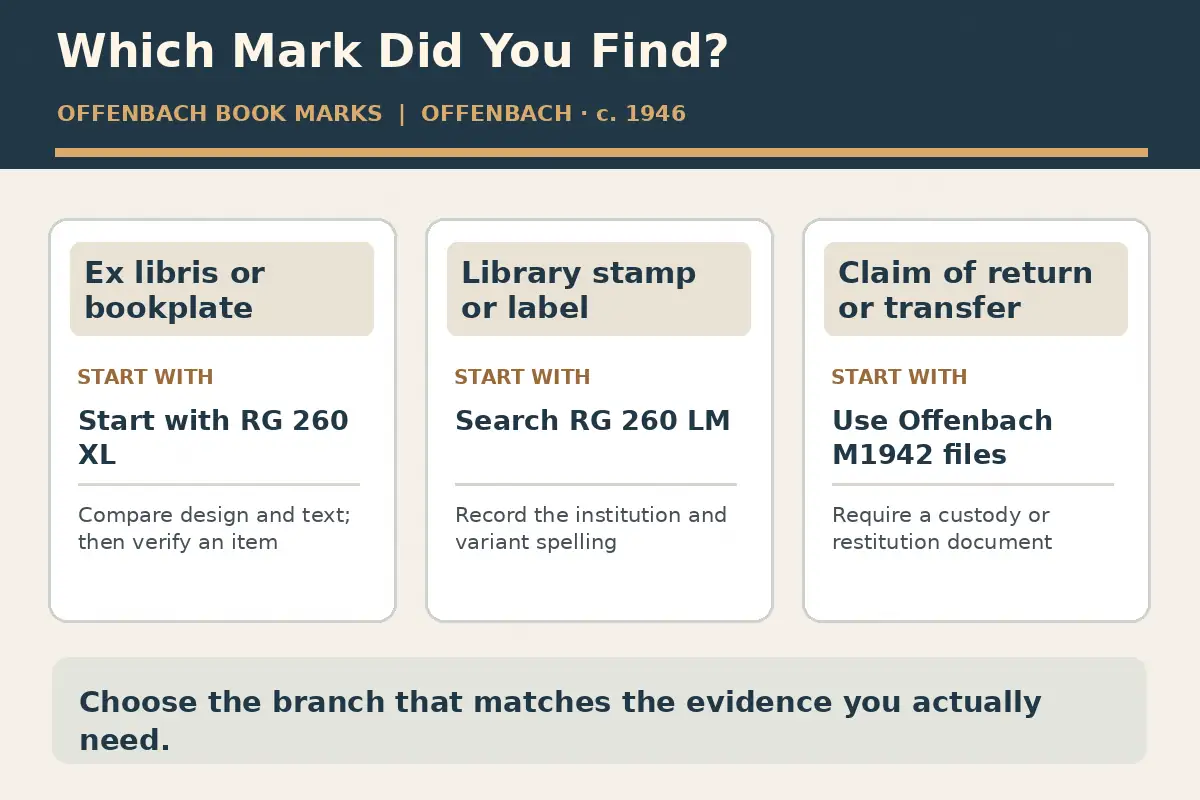
A bookplate photograph may identify a former library, collector, religious institution, or organization, but it does not independently tell the full travel history of the book. The National Archives groups photographs made at the Offenbach Archival Depot around 1946 in Record Group 260. Its still-picture guide distinguishes 478 ex libris images in series XL from 14,783 library markings in series LM. Start by deciding whether the evidence in your hands is an illustrated bookplate, a stamped name, a shelf label, or some combination. Those categories overlap in everyday speech but have different archival descriptions.
Transcribe an inscription exactly, preserving original language, accents and abbreviations. A stamp might use a library name that changed during the 1930s or 1940s, while an illustrated ex libris might bear a personal surname. Record whether a mark belongs to the photographic record, a family-held physical book, or a later scan circulating online. Never assume that a low-resolution copy of a stamp is the only variant. If the image includes a number, note where that number appears rather than declaring it a shelfmark or restitution number without source confirmation.
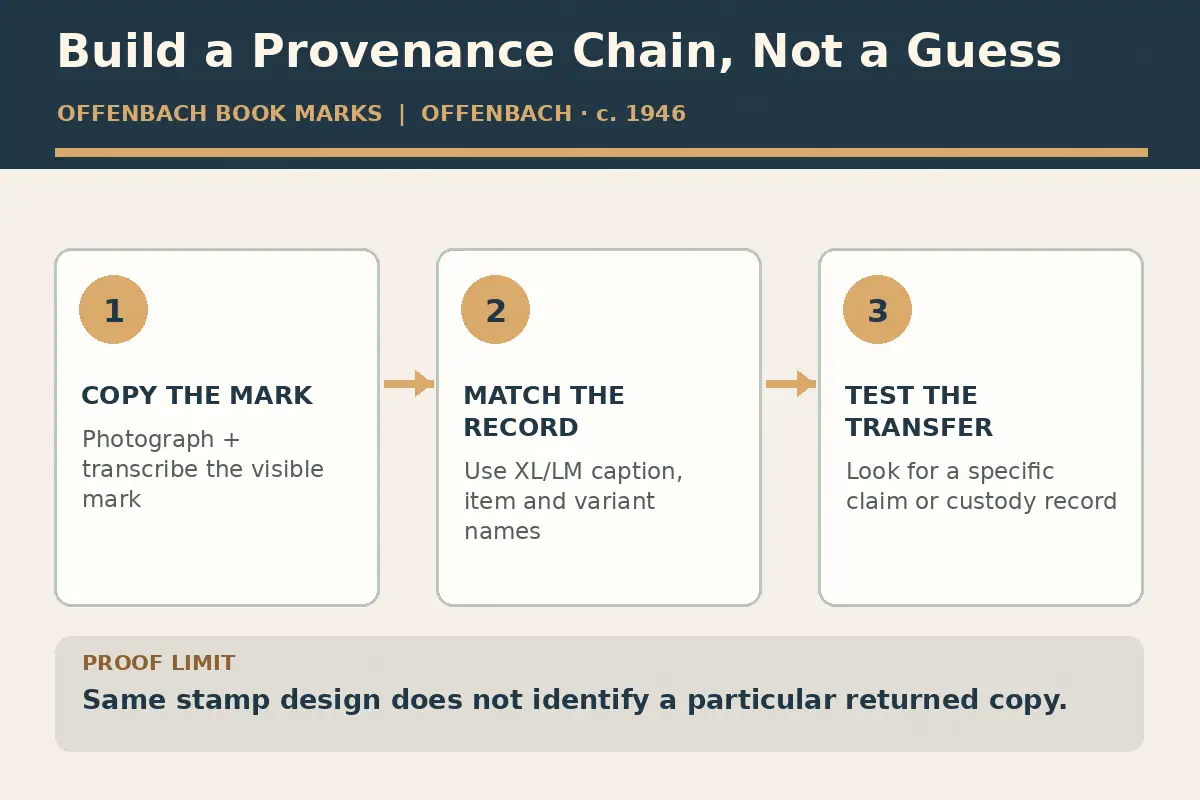
The key to research is to separate three identities: the mark itself, the particular photographed object on which it appears, and the original institution or person that used it. The first may be visible, the second may require an item description or custody entry, and the third may demand prewar catalogs, registers and institutional history. Two volumes can carry identical labels; one may have survived in a family collection and another entered postwar custody. A shared visual design establishes a possible association, not a proven match between copies.
Keep Photographic Series Separate From Claims Files
The XL and LM designations refer to photographic groupings in RG 260, not a single alphabetical roster of people who received their books. The NARA Guide to Federal Records lists both with an approximate 1946 date and states that they were photographed at Offenbach. The year describes the photographic context; it is not necessarily the acquisition date of the original volume, the date of confiscation, or the date it was handed back. Item-level descriptions may supply narrower information, but do not borrow a date from a neighboring image.
A different archival tool becomes relevant when the question changes from identification to restitution. NARA identifies microfilm publication M1942 as 13 rolls of records of the Offenbach Archival Depot, covering 1946–1951. It includes administrative documentation, custody material, correspondence and restitution claims, as well as photographs of bookplates and library marks. An M1942 finding is only evidence of a particular transaction if the corresponding record names the object, claimant, recipient or shipment with adequate specificity. Being pictured by the depot is not the same event as being restituted.
Use a provenance ledger rather than a narrative guess. For each suspected match, write the precise transcription of the mark, the series letters, caption, item or frame identifier, its language, and the reason you think the pictured mark corresponds to a named collection. Place claimed transfers in a separate field and attach their own documents. This helps prevent a familiar surname or city from silently becoming a statement of loss, confiscation or recovery. It also makes uncertain cases useful for later researchers without misrepresenting a family history.

Test Ownership and Transfer With Independent Evidence
Historical library catalogs, accession registers, surviving inventories, book-specific inscriptions and donor records can sometimes establish the prior institutional or individual connection of a mark. Even a detailed library stamp may only show that a book passed through that institution at some point. For a stronger claim, check for a title, edition, volume number or shelfmark that joins the photograph to a specific documented holding. A name on a bookplate should not be treated automatically as the author, donor, reader, Holocaust victim or later owner.
The Offenbach story also demands careful terminology. The depot processed displaced collections after Nazi-era looting and wartime disruption. A photograph of a marking is evidence of postwar identification work, not proof that every holding with that mark followed the same route. When writing about families, communities or institutions affected by persecution, state what the record actually demonstrates and do not infer a person’s fate from the presence of an organizational stamp. A name can be a lead for further research without proving an individual’s experience.
A useful comparison asks: does a custody file identify a specific book or a whole batch; does a claim refer to a collection rather than a particular copy; and does a receipt record delivery rather than a requested transfer? A list of crates, a photograph of a stamp and an administrative memorandum answer different questions. If the records conflict, retain both citations and describe the difference. Do not resolve a missing signature by imagining that an application was successful.
Write a Defensible Book-Provenance Caption
Start with a narrow caption: “Photograph of an institutional mark, recorded in RG 260, series LM, Offenbach Archival Depot, approximately 1946; the mark appears associated with [transcription].” Replace brackets only with supported text. If the image has a unique archive identifier, include it. If no relevant claim or receipt has been located, add that the photograph alone does not document the disposition of the book. An exact catalog citation is far more useful than saying “rescued from Germany” without a reference.
For someone holding a physical copy today, record binding, title page, edition, pagination, marks, annotations and repair history separately. Avoid removing labels or cleaning away traces to make them easier to photograph. Use raking light, a neutral background and multiple scale photographs to preserve evidence. Compare marks at the level of letterforms and layout, while allowing for stamps made with the same die. This approach can support a future archival inquiry even when the original postwar custody records cannot yet be matched.
Research may end with a cautious association rather than a complete chain of ownership. That is a valid finding. The critical difference is between “the photograph resembles a mark used by the library” and “the identifiable volume was recovered and returned to that library.” The latter statement requires object-level documentary support. Cite the RG 260 description and the M1942 guide alongside the specific photographic item when available.
More Family Story and Preservation Guides
How We Research This Archival Evidence
For this guide we compared the official series-level inventory with independent repository context and checked that the archive descriptions refer to the specific medium, record group and date range cited. Sources consulted on November 15, 2026: National Archives reference 1, National Archives reference 2, National Archives reference 3. The general guide does not substitute for a record-level inspection, so no individual identification or digitization claim is assumed here. We tested the subject and research intent against the supplied WordPress title inventory and the recent article batches, then kept the conclusions narrower than the source evidence. Editorial and commercial relationships: see the affiliate disclosure. This article does not assert any affiliate partnership.
No. The XL and LM series document marks photographed at Offenbach. A separate dated custody or transfer record is needed to show a book was returned.
No. NARA describes ex libris bookplates in XL and library markings in LM. Test both only when the physical mark or description justifies it.
NARA describes the Offenbach microfilm publication as 1946–1951; the still-picture guide dates many bookplate and marking photographs to approximately 1946.
Not alone. It may identify a prior association, but a date-specific inventory, registration or other object-level record is needed for a wartime ownership claim.
Record RG 260, XL or LM, exact transcription, any item identifier and a clear note that the institutional identification or transfer is unconfirmed.