
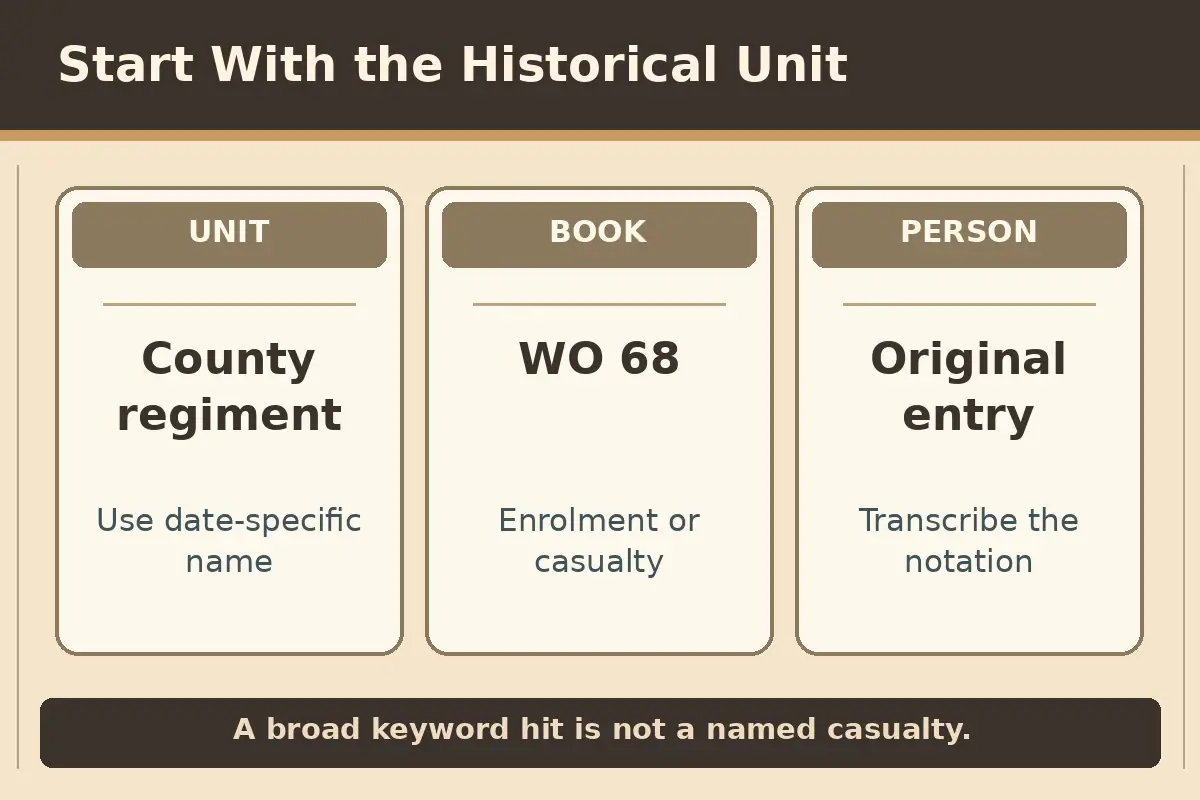
WO 68 contains records of militia regiments, including enrolment and casualty books dating broadly from 1759 to 1925. A “casualty” notation in military administration needs to be read in its original column context: it cannot simply be translated as a soldier killed in action. For genealogists the best strategy is to identify the contemporary county regiment, locate the correct book and transcribe the dated change or entry. Compare it with attestation and muster evidence only where the record dates and identities align. Missing records are a survival problem, not proof that a person never joined.
Identify the Regiment Before Searching a Man
The National Archives recommends searching WO 68 by the regiment’s name and notes that this series contains exclusively militia records. County designations and affiliations changed, particularly after the 1881 regular Army reorganization. Record the form of the unit name used at the date of the alleged service, not merely the modern county regiment. An entry in a local family history that gives only “militia” and a surname is too imprecise for a reliable personal-name match.
Gather a county, likely decade and at least one independent clue such as a baptism, occupation or later pension note. A man may have served in a reserve organization, volunteer company or regular regiment with a similar designation. The National Archives has separate guides for the militia and the Territorial volunteers. Start with the right institutional category; otherwise a plausible surname entry in a neighboring unit can create an entirely false family story.
Read the Personnel Book’s Original Purpose
WO 68 includes enrolment books and casualty books from 1759–1925, but the volumes are not guaranteed to have identical columns or completeness. Inspect the opening pages and headings to understand what the clerk meant by enrolment, posting, transfer and casualty. A note of an administrative removal may require a separate explanation from the book itself or adjacent entries. Do not treat an unfamiliar abbreviation as a medical diagnosis or reported death without corroboration.
Record each entry with full piece number, page, soldier name, unit, event date and exact annotation. If there is a stated service number or company, preserve it separately from the man’s name. Identify overwritten entries and added marginal dates rather than silently choosing one. The book’s purpose was military administration; it is not a substitute for a birth certificate, probate file or a household census. A surname or locality mentioned in passing is a research clue, not proof of kinship.
Compare Enrolment Against Attestation and Paylists
WO 96 contains many militia attestations, often with later annotations; WO 13 contains musters and paylists for the militia between 1780 and 1878. Those sources answer related but different questions from a WO 68 personnel-book entry. Compare dates, units, descriptions and ranks where actually supplied. An attestation can support entry into service; a muster can support presence or payment within a defined period. Neither necessarily explains an ambiguous casualty-book mark without checking its original context.
If one source says an individual transferred and another lists a similar name at a second unit, test whether these refer to the same man. A unit name can change across 1881 without an individual moving. Maintain a crosswalk of contemporary and later regimental names, then compare original dates rather than mixing the names into one modern label. Missing paylists after 1878 do not cancel later WO 68 personnel entries; their nominal coverage differs.

Do Not Turn a Casualty Line Into a Death
The archival guide explicitly lists “casualty lists” within WO 68 and recommends searching the keyword casualty. That is a description of a record class, not confirmation that a particular entry indicates someone died. Read the abbreviation key, any cause column, and related unit notes where surviving. A medical discharge, transfer, desertion allegation or death needs its own evidentiary support; never fill such facts from the broad English word “casualty” alone.
When the family story claims a man died during a campaign, search for a contemporary death record or named military return relevant to that date and place. A regimental history may describe losses, but should not be assigned to the man simply because he was enrolled. Record whether the evidence proves a change in army administration, a reported fate, or a corroborated civil event. If the exact interpretation cannot be verified, quote the entry and mark the outcome unresolved.
Trace Local Parishes and Uneven Survival
Historical militia ballot and enrolment lists were produced locally between 1758 and 1831 and survive in incomplete patterns across county archives. The National Archives notes that parish militia lists may provide family circumstances and differ from central WO 68 books. Search the correct local record office once the man’s parish and the service date are independently supported. Do not equate a name on a parish list of eligible men with a man actually enlisted in a militia unit.
Save negative searches as bounded tests: series or piece, book dates, surname variants and portions of the roll read. Catalogue indexing may reflect regiments rather than every name. If the target does not appear in a particular 1810s book, check whether it covers the expected unit and dates before concluding non-service. A local name match or contemporary newspaper notice can be a next lead, but should be labeled independent evidence, not a replacement for the absent record.

More Records and Archives Guides
How We Research a WO 68 Entry
We start with the historic militia regiment and approximate date, retrieve the relevant WO 68 enrolment or casualty book, and transcribe its headings before interpreting a single notation. Cross-checks use WO 96 for attestation and WO 13 for dated pay or muster where coverage makes them relevant. Separate fields record enrolment, later administrative event, independent identity and any genuinely documented death. Where the administrative meaning remains uncertain, our conclusion reports that uncertainty rather than supplying a dramatic outcome.
The official militia guide gives WO 68 date coverage and a regiment-first search, while Volunteers and Territorials clarifies the differences between reserve organizations. Check an original book before claiming personal service details, and cite piece and page, not an uncited database snippet. Read our affiliate disclosure for the site’s linking policy.
No. Interpret the particular record’s column headings and annotations; confirm any death separately.
The National Archives describes militia regimental records including enrolment and casualty books, 1759–1925.
Many records require a regiment-first or piece-level search rather than a comprehensive personal index.
WO 68 contains unit personnel books; WO 96 primarily contains militia attestation papers.
Surviving parish militia and ballot lists are generally in local archives, with incomplete coverage.