
The National Archives RG 75 guide names financial statements for the Menominee Indian sawmill at Neopit, Wisconsin, dated 1926–1961 among the Forestry Division records. It separately describes Menominee Indian Mills correspondence, production, financial and employee-account records in section 75.21.9. The distinction is essential: a mill financial statement may document aggregate operations, while a named employee account may address a person. One must not convert a company total into a worker’s wage, employment duration, or family history.
A useful search has two lanes. For economic or local history, track the date, reporting period, line item and mill organization. For genealogy, begin with an independently identified person and seek a record that actually names them. Respect the Menominee community’s history and use the creator and original wording in citations without assuming that every worker, accountant or customer had the same citizenship, tribal enrollment, or relationship to the community.
Separate Forestry Statements From Mill Accounts
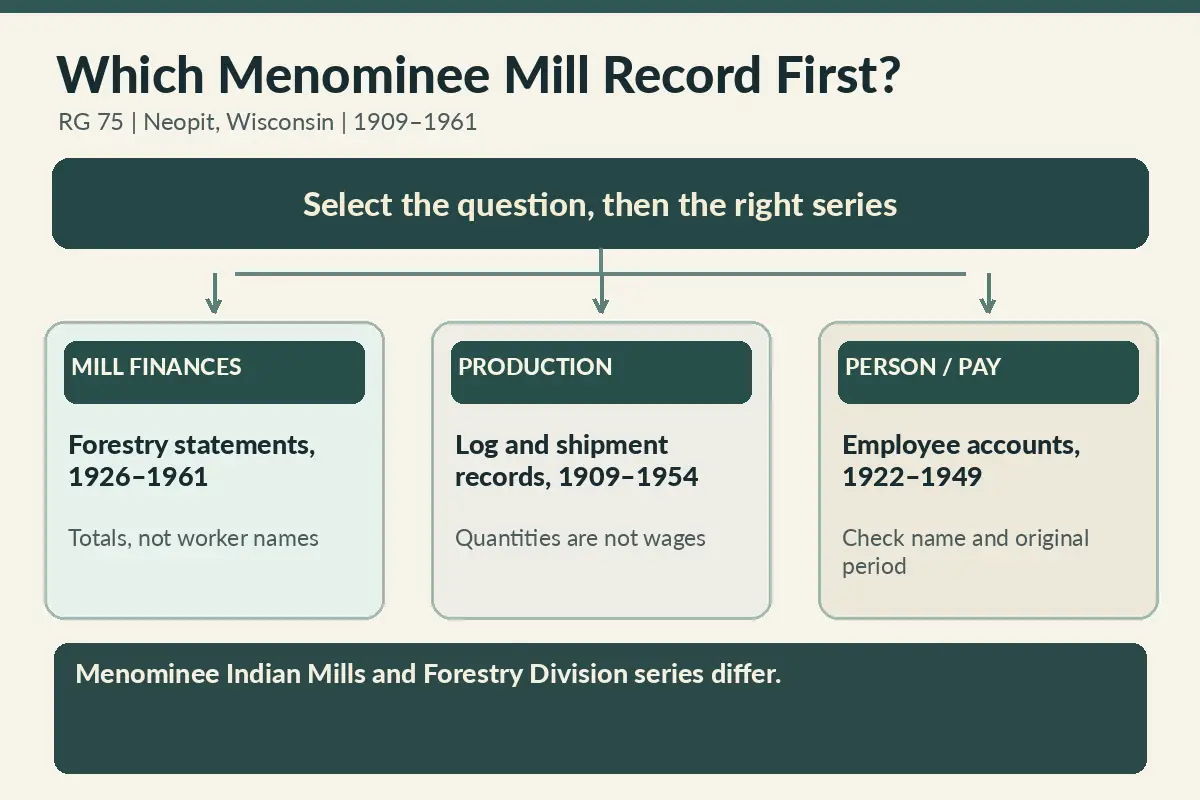
RG 75 is large, and neighboring series do not serve the same purpose. Section 75.9 lists Forestry Division financial statements for the Neopit sawmill for 1926–1961. Section 75.21.9 identifies records of Menominee Indian Mills: correspondence, forest supervisor records, accounting, inventories, logs received, production and shipments, and more. Its financial records include operating and financial statements for 1926–1955, voucher files, and employee accounts for 1922–1949. These overlapping years do not mean the records are duplicates or that every annual figure corresponds item for item.
Write down the creating office, series title, physical custodian and year when requesting a volume. Distinguish “Forestry Division statement” from “Menominee Indian Mills voucher.” One is a reporting channel and the other may document a transaction. The guide describes Menominee Indian Mills records as held in Chicago, while other records in RG 75 are distributed across repositories. Check present custody with NARA instead of assuming the entire record group can be consulted in a single location.
Decode Period Totals Without Inventing Wages
A financial statement may give receipts, operating expenses, net results, inventories or other headings, depending on the actual page. Do not presume the fields before viewing it. If an amount is reported for payroll or labor, that line is an aggregate accounting category unless an associated schedule identifies individuals. Distinguish calendar year, fiscal year and statement period. A comparison of two statements is only meaningful when the accounting unit, valuation basis and reporting span are sufficiently consistent.
For a chart of historical business activity, transcribe the exact printed labels and amounts, preserve original units, and mark missing periods. Do not fill gaps by interpolation or treat a fluctuating lumber sales total as a measure of local family prosperity. Mill accounting also may involve inventories and transfers between accounts, not just cash received. If a record is a later summary of an earlier year, cite both its preparation date and the period it reports.
Find Person-Level Evidence in a Different Series

The RG 75 guide separately lists Menominee Indian Mills employee accounts for 1922–1949. If your goal is a named worker, ask whether those records contain a relevant name and pay period, then compare any entries against payroll vouchers, personnel records, contemporary directories or family documents. The mere survival of employee accounts does not mean every person who ever worked at Neopit appears or can be identified by a keyword search. Initials, spelling and changes of name need evidence-based resolution.
A transaction may show compensation, advances or an accounting balance without proving the full employment relationship. Employee accounts can also record adjustments or settlements. Avoid assuming that a person named in a mill record was a tribal member, owner of land or lifelong Neopit resident. If an identity claim matters, compare it with the appropriate enrollment, census, residence or family records, while respecting access limitations and the community’s own authority over identity.
Connect Production, Inventory and Sales Evidence
Section 75.21.9 lists registers and other records of log deliveries, production and shipments for 1909–1954, plus timber estimates, property inventories, purchase order files and sales records. These can explain why a financial line changes, but they are independent record sets requiring exact date and unit comparisons. A shipment quantity is not automatically a sale, and a sales invoice does not establish when timber was felled. Distinguish logs received, wood products manufactured, goods shipped, and amounts invoiced or collected.
For a business-history timeline, enter each observation in a ledger: original series, year or period, product or cost category, amount or unit, and the source’s stated purpose. Include an uncertainty column for corrected accounts, differing valuation bases or missing months. A photograph of the mill can help show equipment and site arrangement, but it is not evidence of the accounting numbers or of a particular worker’s name unless independently labeled.
Cite Menominee Records With Proper Custody

Use the Catalog’s record-group and series hierarchy to find the correct part of RG 75, and cite the exact series as well as the page or voucher. State whether you saw an original record or a later transcript. If requesting a specific year, supply “Menominee Indian sawmill, Neopit, financial statements, 1926–1961, Forestry Division” or “Menominee Indian Mills employee accounts, 1922–1949,” as applicable. These phrases locate different materials.
The final account should use careful language: “A statement records this operating amount for this period,” not “the sawmill paid my grandfather this much,” unless a named person-level entry supports that connection. Likewise, RG 75 custody reflects federal administrative recordkeeping, not an assertion that federal files tell the whole story of Menominee economic life. Local and community sources may provide different perspectives and should be credited distinctly when used.
More Records and Archives Guides
How We Research This Archive Series
We compared the RG 75 Forestry Division statement description with the separate Menominee Indian Mills record inventory and NARA discovery guidance. We kept community context, financial aggregates, production, payroll and individual identity separate. We did not infer tribal enrollment, employment or wages from a general statement. See our affiliate disclosure; these archive references do not imply a paid relationship.
Yes. RG 75 lists Menominee sawmill financial statements for 1926–1961.
Not necessarily. Employee accounts and voucher files are separately described in Menominee Indian Mills records.
No. Financial categories and person-level compensation require different records.
NARA identifies Menominee Indian Mills records under section 75.21.9, with records described as held in Chicago.
No. Tribal or community identity requires separate and appropriately interpreted evidence.