
The National Archives guide to Record Group 75 describes 148 glass negatives in series SEI: studio portraits of unidentified Indigenous people from southeastern Idaho reservations, dated 1897. The word “unidentified” matters. A portrait may preserve a person’s appearance and some studio context, but the series-wide description supplies no verified names. Researchers should not turn facial resemblance or an assumed tribal affiliation into a published identification without independent provenance and, where appropriate, consultation with the relevant community.
This series is different from named school rolls, agency correspondence, censuses or family letters. Its strongest immediate value is visual and historical: the presence of a documented studio-portrait collection connected with a region and year. Start with the precise SEI item identifier and the original caption, if one exists. Ask what the source actually says before deciding whether the image belongs in a family narrative. No genealogical relationship follows automatically from a matching age, hairstyle, clothing style or studio pose.
Understand What the SEI Inventory Actually Says
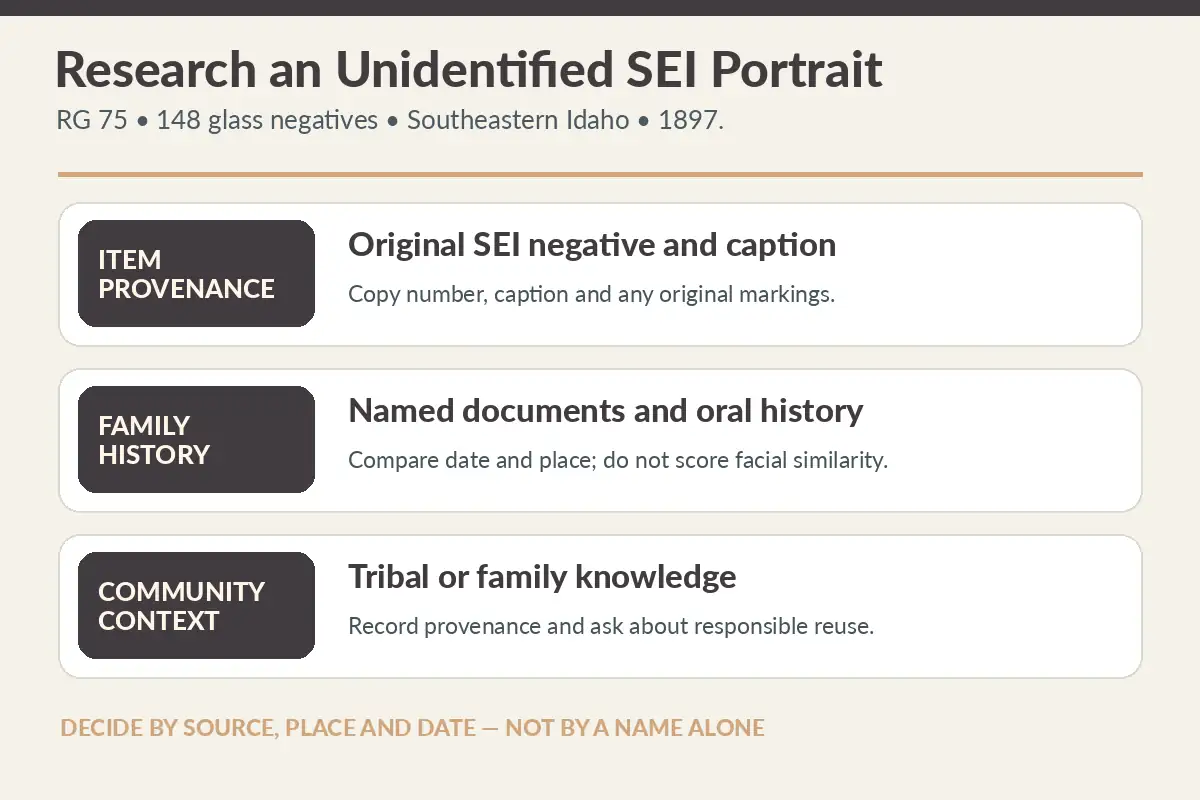
NARA’s guide identifies a set of 148 glass negatives, a year—1897—and a broad regional description. It calls the sitters unidentified. It does not state that all portraits came from a single reservation, tribe, family, photographic session or named school. Treat every such claim as a question for the original negative, any surviving caption list and archival accession documentation. A series code is a finding aid, not a person’s name or enrollment number.
Before proposing an identity, record the exact collection and item description, any original negative number, inscription, photographer attribution and evidence of later edits to the catalog record. Original captions may reflect old terminology; cite them precisely while providing respectful modern context. When a digital scan is cropped, the full negative or surrounding envelope may hold more information than the visible head-and-shoulders view. An absent digital thumbnail does not prove an original negative has been lost.
Distinguish Geographic Origin From Tribal Identity
“Southeastern Idaho reservations” is a regional archival description, not a person-level tribal identification. A portrait’s clothing or material culture cannot by itself establish enrollment, language, kinship or citizenship. Begin instead with the original place or agency as documented on the item. If that location is broad or absent, keep the geographic attribution broad. Do not replace it with a specific nation because a modern map places a reservation somewhere within the historical region.
Historic reservation boundaries, agency jurisdictions and community names changed. Use dated land or agency maps to understand where an original caption might refer; consult appropriate tribal historical resources and community experts rather than relying only on outside labels. Some families retain knowledge about ancestors and photographs that does not appear in federal indexes. A proposed identification should record who supplied it, the evidence reviewed and any permission or restrictions on reuse, without treating community knowledge as decorative trivia.
Compare Portraits Without Facial-Recognition Guesswork

If a family owns a labeled 1890s portrait, compare physical image provenance first: studio imprint, photographer, mount, negative number, location and date. Apparent facial resemblance is vulnerable to lighting, pose, photographic copying and the viewer’s expectations. Do not use face-matching software or unsupported visual scoring to announce the identity of an Indigenous sitter. Only a reliable labeled original or other strong contemporaneous documentation can elevate a resemblance into a defensible working hypothesis.
Keep a comparison table listing the evidence for and against each candidate. A census may establish that a named relative lived in an appropriate area in 1897, but it does not place the individual in the portrait studio. Agency enrollment documents may be sensitive and have their own administrative limitations. A known name in a neighboring file is not necessarily the name of the person pictured. The best result may remain “unidentified studio portrait, SEI, 1897,” which is an accurate and respectful description.
Move From a Regional Photograph to Named Records
For genealogy, begin from a securely identified family member and reconstruct the person’s residence, age and known relationships using family records, contemporary census or agency documentation, and, where suitable, tribal records. Ask whether any existing SEI item description independently links the person to a portrait. A portrait cannot fill gaps in ancestry simply because the family believes an ancestor lived in southeast Idaho. The agency records and the still-picture series may have different archival paths.
If a document uses variant names, spellings or translation conventions, retain each original form with its date and source. Avoid merging people with similar recorded names. Historical recordkeeping often reflected officials’ categories rather than individuals’ preferred identities, so explain the provenance of a label before reusing it. Family oral histories and tribal knowledge can guide the search, but a published identity assertion should be transparent about its source, degree of certainty and community context.
Handle Reproduction, Attribution and Community Concerns
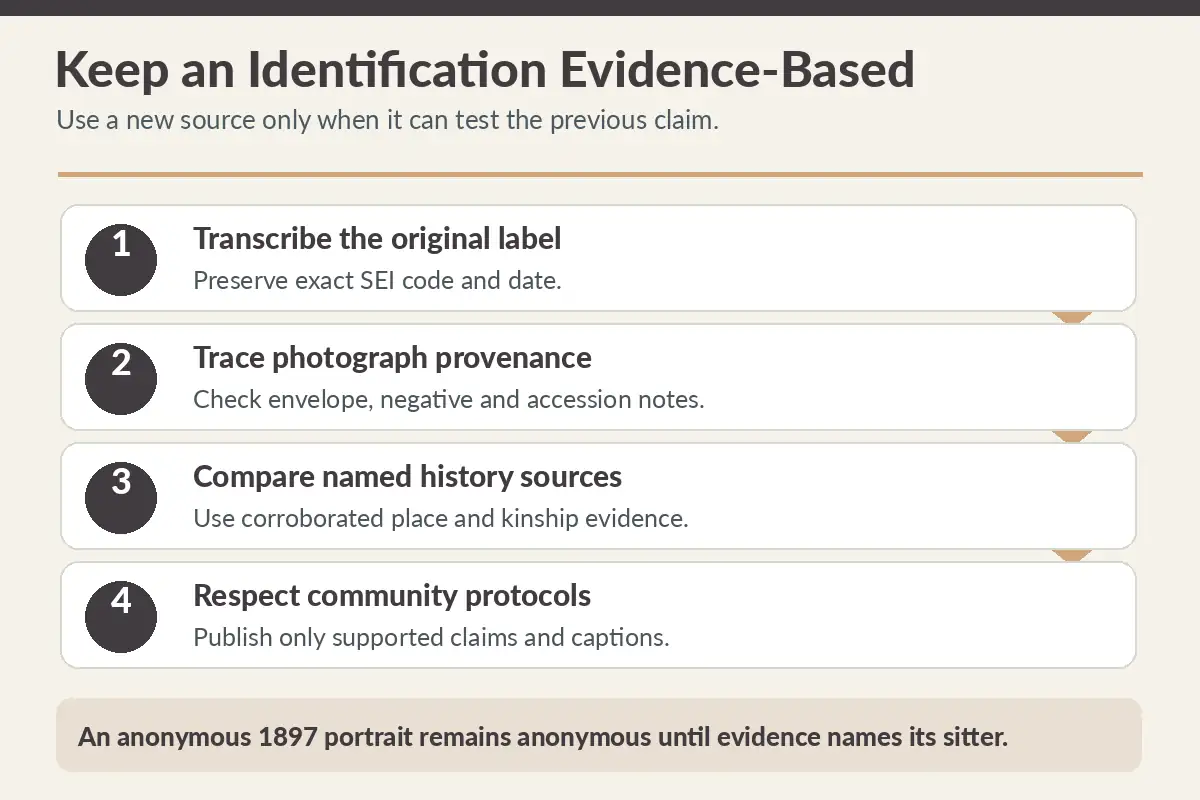
Original federal custody is not an automatic declaration that all reproduction and cultural use concerns disappear. Consult NARA’s item-level rights and access notes, and consider community protocols for photographs of ancestors. Attribution should identify the SEI series and repository, distinguish a modern digital copy from the nineteenth-century negative, and preserve the uncertainty about the sitter. Do not publish speculative family trees beneath anonymous portraits as though the individuals had consented to identification.
When the research remains inconclusive, create a caption that is informative without overclaiming: “Unidentified sitter, studio portrait, southeastern Idaho reservation area, 1897; RG 75, SEI, National Archives,” supplemented by the exact item number when verified. For a modern cover illustration, say that it is an interpretive illustration, not an image of any person in the actual series. Explain that the historical label is taken from the repository and may not be a community-preferred form.
Worked Search: A Family Portrait From the Same Period
Suppose an 1897 family photograph, inherited with a written name on the back, resembles one of the SEI studio portraits. First document the provenance of the family image—when the inscription was added, who kept it, where the photograph was found and whether the original mount survives. Then inspect the complete SEI item and its original archival notes. An 1897 region-wide inventory is compatible with many possible sitters; the resemblance does not close the case.
Use named family and community records to assess the candidate’s location and age. If a trustworthy original studio record or community-supported identification explicitly ties the SEI negative to the same person, document that chain with careful attribution. Otherwise describe the photographs as visually comparable and the SEI sitter as unidentified. This hypothetical example does not identify any actual individual and does not suggest that appearance alone reveals tribal belonging.
More Family Story and Preservation Guides
How We Research and Verify the Archive
We verified that the official RG 75 still-picture description identifies SEI as 148 glass negatives of unidentified sitters dated 1897. We do not infer a tribe, photographer, family or named reservation from that general entry. A more specific claim requires item-level provenance and appropriate independent documentation. We also distinguish archive terminology from preferred descriptions supplied by Indigenous communities.
Our editorial method prioritizes verifiable original captions, transparent uncertainty and respectful community-informed use. NARA’s still-picture guide and copying rules do not license speculative identities. Families may choose not to publish sensitive ancestral images. See our affiliate disclosure.
No. NARA explicitly describes the group as portraits of unidentified people.
No. Clothing, appearance and regional origin do not establish legal or community membership.
Not on its own. Use reliable captions, documentary provenance and appropriate community knowledge.
The series description does not make that claim. Inspect individual records and date-specific jurisdiction sources.
Check the exact item’s access and rights information and consider community or family protocols before reuse.