
Find Flood Rock Inside the Mixed RG 233 M Prints
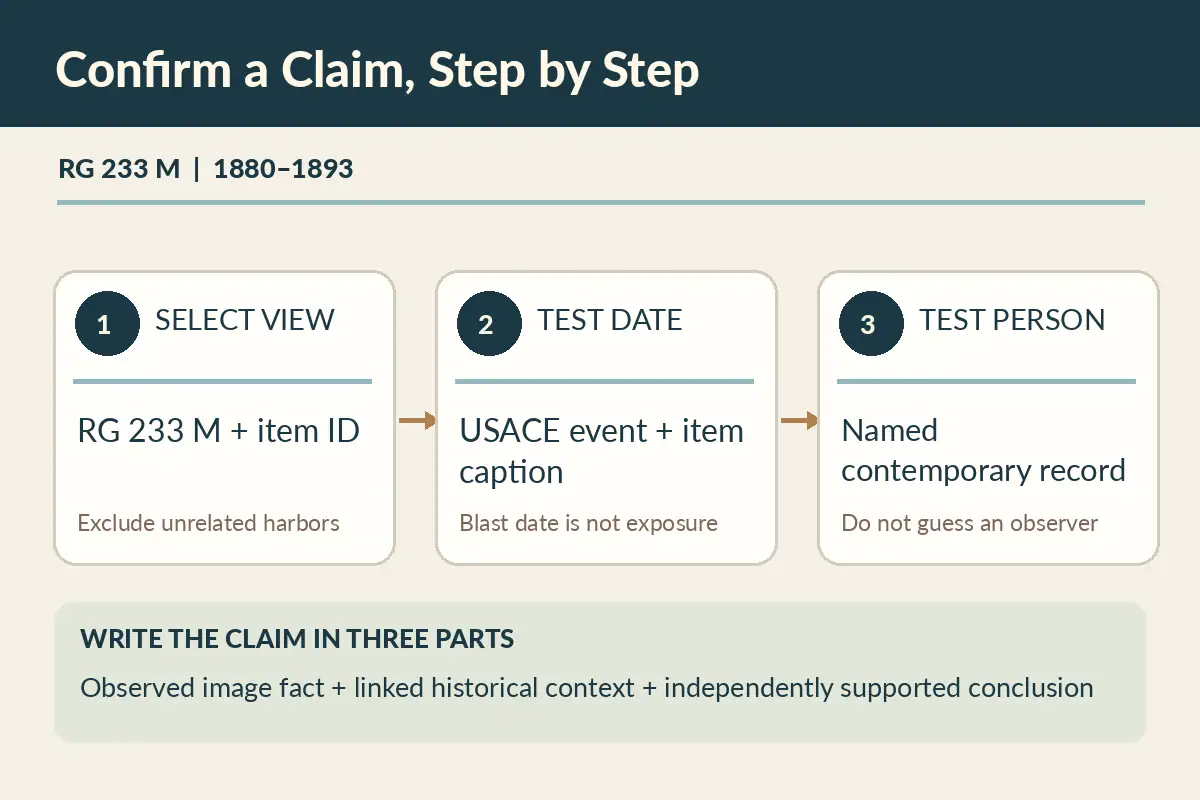
The National Archives describes a small group of eight photographic prints in RG 233, series M, dated 1880–1893. Its subjects include the Hell Gate channel in New York, the demolition of Flood Rock, a Bridgeport harbor scene and a vessel incident on the St. Marys River. The grouping is heterogeneous: not all eight images depict Flood Rock. Begin by identifying which specific print relates to Hell Gate, then transcribe its original caption and item number before assigning a scene or event date.
Hell Gate is the turbulent East River strait between Manhattan, Queens and the Bronx, historically a difficult navigation passage. The U.S. Army Corps of Engineers documents an extended program to remove hazardous submerged rock formations from the channel. A picture of a vessel in the general New York harbor region cannot be attributed to Hell Gate without independent geographic support. Likewise, a photograph near a waterway may show preparation, surveying or aftermath rather than the decisive demolition event.
The Corps dates the major Flood Rock blast to October 10, 1885. This is a well-supported event date, but it should not be copied automatically into the date field of every RG 233 M print. The series range extends from 1880 to 1893 and includes unrelated places. Ask whether the actual print or original archival description explicitly ties it to the October event, and whether it depicts the rock, the shoreline, boats, preparations or conditions after the operation.

Distinguish the 1885 Event From a Photograph’s Exposure
Choose a branch based on the visible subject: Hell Gate and Flood Rock; wharves and harbor at Bridgeport, Connecticut; or the separate St. Marys River vessel view. An image cannot move between these places simply because all belong to the same NARA series. If a catalog label is ambiguous, ask a reference archivist to check the full print and mount notes. Make a geographic ledger with waterway, city, state, year attribution, item identifier and supporting source.
A historical engineering narrative may mention specific officials, work crews and public observers. Their appearance in a narrative does not prove that any of them can be identified in a surviving photograph. A shoreline crowd shot is not an eyewitness attendance list. Keep the engineering chronology in one column and the photographic observations in another. Link a named figure to a visual subject only when a caption or credible independent record makes the connection.
The Army Corps’ published history gives an account of navigational hazards and planned underwater works, providing crucial context for why the changes were undertaken. Yet the engineering institution’s description and the House of Representatives print group have different provenance. The Army Corps is a context source for the waterway, not automatically the custodian of each RG 233 M item. Cite the Corps for its event dates and NARA for the particular photograph.

Use Engineering Context Without Inventing an Eyewitness
The demolition date is a historical fact, but photographs can portray a long process. Preparatory work may predate the blast; views of changed navigation channels may be later; commemorative prints can be made from an older negative. Compare the visible shoreline, vessels and infrastructure with contemporary maps or reliable dated accounts. Do not conclude a view was captured during the explosion merely because a web image is captioned “Flood Rock demolition” without item-level dating.
A place-name check should distinguish Hell Gate, Hallet’s Point and Flood Rock. They are related in the history of New York harbor engineering but are not interchangeable labels for one feature. Historic maps may use different spelling and shoreline descriptions. Preserve any original place name and record why a modern map uses another designation. A river crossing, wharf or island seen on a print needs positive matching features before you attach precise coordinates.
For an individual linked to the project, follow a person-level paper trail. A family story might name a contractor, crew member, engineer or spectator. Search employment, contracts, local directories, newspapers or other suitable contemporaneous records. A newspaper report may confirm that someone worked on the project but not that they were standing in the photographed crowd. Treat a claimed presence in one image as a separate question from participation in the larger enterprise.
Document the Waterway and Cite an Original Image
RG 233 M belongs to congressional records, not to the original creator’s complete personal photo archive. The presence of a print among House records may reflect its use as an exhibit or supporting document, but a researcher must not assign a particular committee purpose without an item-level record. Consider any related House report or exhibit only when its citation actually connects. A late reproduction and the historic photograph it reproduces can have different archival histories.
Small collections require close attention to grouping. The eight-print count describes the listed series, not eight shots of the same blast or eight sequential moments. You may encounter an engraving or newspaper illustration of the explosion that is visually similar but not an RG 233 M photographic print. Different media have distinct evidentiary status. Do not call a stylized historic illustration an untouched camera negative, and label editorial illustrations as reconstructions rather than authentic archival images.
To make a request, give NARA RG 233, series M, the full item identifier and any caption words that distinguish the Hell Gate view from the Bridgeport or St. Marys subjects. Ask whether the original print verso has a date, photographer credit or source publication. Keep any response with your research notes. If the answer is uncertain, record that uncertainty in the caption instead of inventing an exact vantage point.
An accurate caption might read: “Photographic print connected to Flood Rock demolition at Hell Gate, New York, RG 233 M, series dated 1880–1893; exposure date and unidentified observers not confirmed.” The Corps independently dates the principal Flood Rock blast to October 10, 1885, and that event can be noted separately. This is a clear and useful way to publish the history without pretending the photograph itself proves when it was made or who watched.
More Place and Jurisdiction Guides
How We Research This Evidence
We started with the exact National Archives record-group guide and verified the series code, format, described quantity and date span. We compared its historical framing with an official contextual source and a second archival or institutional reference. NARA’s still-picture reference instructions explain why the complete local identifier matters. A general archival guide does not establish that every item is digitized, individually named or correctly dated in a third-party reproduction. For every claim, we separate observable content, original archival wording and independent documentation. The historical and source review was completed November 15, 2026. No sponsored route or unverified product recommendation is implied; see our affiliate disclosure.
NARA describes eight prints in the whole M grouping, including unrelated places; the number actually depicting Flood Rock must be checked item by item.
The Army Corps of Engineers dates the demolition to October 10, 1885.
No. The series includes views dated 1880–1893 and the image itself needs a supported exposure date.
No. NARA also lists Bridgeport, Connecticut, and St. Marys River subjects.
Use a named original caption or independently documented person-level evidence; a scene alone is not a roster.