
A Gold Star mother or widow can appear on a government list of women eligible to visit World War I graves in Europe without necessarily having made the journey. To prove a trip during the federally supported 1930–1933 pilgrimages, search the name of the deceased service member first, locate the family’s Graves Registration Service materials in Record Group 92, and distinguish an invitation or questionnaire from a dated travel assignment, ship departure, or completed itinerary. Those records answer different questions.
The National Archives guide to pilgrimage records explains that GRS files are arranged under the soldier rather than the woman. The original printed eligibility list, the individual case file and subsequent travel documentation should not be collapsed into a single passenger list. NARA also documents racial segregation in the program: an itinerary or ship assignment must be read in that historical context, not treated as evidence that every eligible woman received identical arrangements.
Start With the Deceased Service Member and the Correct Folder
Begin with the service member’s full name, unit, rank, approximate date of death and home locality. NARA describes the Graves Registration Service files as alphabetized by the deceased individual, with the mother’s or widow’s pilgrimage papers placed in that individual’s folder. Search under the woman’s surname alone only as a supplementary strategy: remarriage, spelling changes and married-name variants can obscure the path to the actual file. Note whose name the archive uses as the filing key.

Build a small identity grid before ordering material: soldier; associated mother or widow; relationship; unit; death date; cemetery or known burial status; contemporary address. A match of surname and state is not enough for a common name. If the soldier died overseas but remains were repatriated, the family’s eligibility circumstances may differ from those of a soldier buried in Europe. Verify the actual case, rather than expanding the published program rules beyond the documents you have inspected.
Use the 1930 Eligibility List Without Assuming Participation
A government publication titled List of Mothers and Widows of American Soldiers, Sailors, and Marines Entitled to Make a Pilgrimage to the War Cemeteries in Europe appeared as House Document 140 of the 71st Congress, second session. NARA describes its arrangement by state and county and its entries relating women to deceased service members and cemeteries. It is a practical starting point for discovering a potential participant and linking a woman to a particular soldier.
Eligibility is a classification, not a boarding event. A woman may have declined, deferred, been unable to travel, or had a change in circumstances. Record separately the list’s statement of whether a woman desired an early or later trip, if that field appears in the inspected entry. Do not translate that preference into a confirmed departure. If an entry seems missing, check spelling, county boundaries and the soldier’s identity before interpreting absence as proof that a family was never contacted.
Read a Questionnaire, Assignment, and Departure as Different Events
NARA’s historical articles describe an eligibility questionnaire, detailed travel instructions and the organization of groups called parties. An answered questionnaire may establish the woman’s response and information supplied at the time. A party assignment may show that travel was planned. The strongest claim of actual travel requires later dated evidence such as a departure record, passenger manifest, passport notation or correspondence reporting arrival or return. Build a timeline with source and date for each step.

Treat the parties as administrative travel groups rather than military formations. A vessel name in a general itinerary does not place a specific woman aboard that vessel. Conversely, a travel receipt may document payment or a reservation but not completion. Distinguish the port of departure from the European cemetery destination and do not mistake a visit to the cemetery for evidence of a new burial. Cite the exact form, folder and original handwriting if consulted.
Preserve the Record of Segregation Without Rewriting a Family Story
The program operated under racially segregated travel arrangements; NARA documents different ships and accommodations for African American mothers and widows. That fact matters when matching a listed person to a voyage or party. Do not interpret separate itineraries as evidence of a different legal relationship to the deceased. If a woman’s party designation is visible, transcribe it exactly and use NARA’s account of the administrative system to understand its significance.
An illustrative research scenario might begin with a woman on the eligibility list and a family photograph labeled “France.” The label cannot by itself prove attendance at a specific graveside ceremony. Compare her individual travel file, departure date and known party, and assess whether the photograph’s geography and date fit. If the documents disagree, report the disagreement. The historic treatment of participants should be stated clearly, rather than made invisible by a modernized narrative.
Compare Family Sources With Military and Cemetery Evidence
The soldier’s death and burial are separate from the widow’s or mother’s trip. Graves Registration files may document disinterment and reburial, but a report of reburial does not automatically confirm a surviving relative visited the site years later. Search relevant service documentation, cemetery records, local newspapers and family letters to clarify the soldier’s identity and the survivor’s address. Keep the soldier’s chronological record in its own column.
When a family remembers a “Gold Star trip,” search for contemporaneous passports, passenger arrival records, newspaper notices or letters written from Europe. A local news report may describe a planned departure or a completed return; retain the exact verb and reporting date. If another woman with the same name appears in travel lists, require agreement on soldier, residence and party before attributing the journey. Do not publish unverified personal stories as if they came directly from federal files.
How We Research These Pilgrimage Files
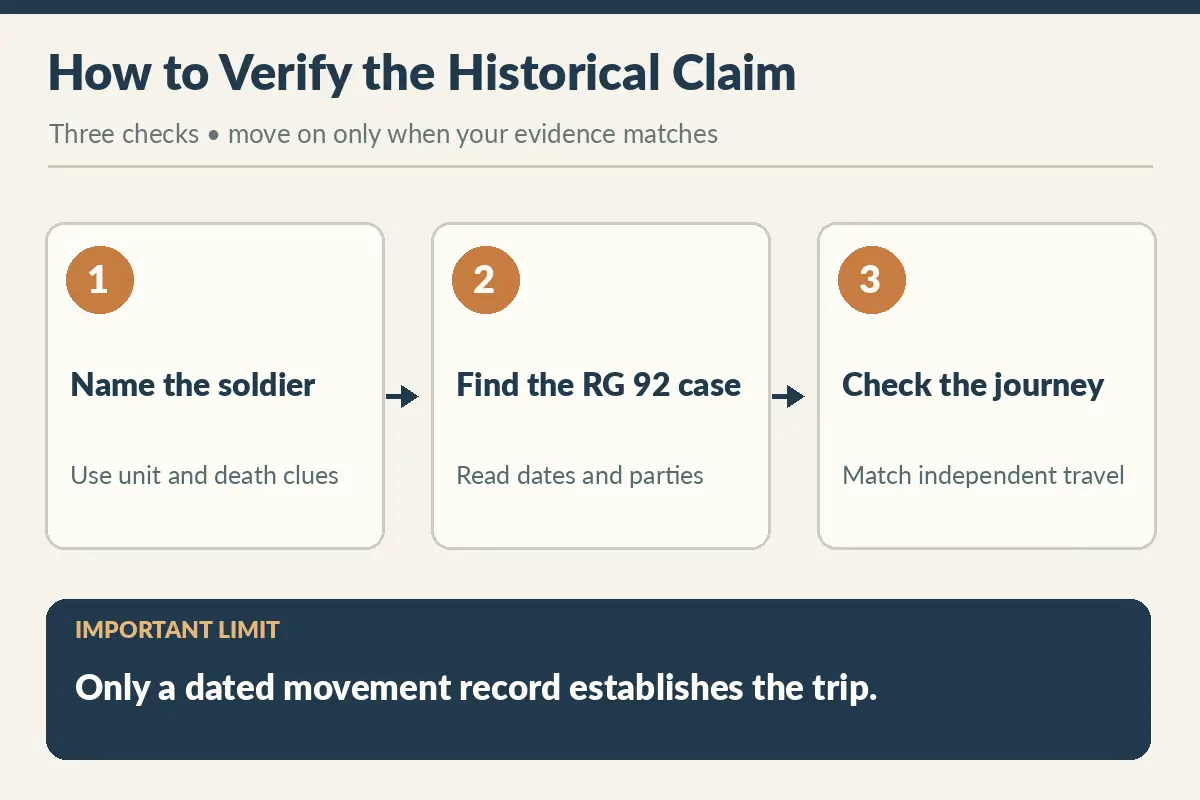
We classify evidence in three stages: eligibility, preparation and verified movement. First obtain the printed 1930 list and a correct soldier identity. Then locate the soldier-centered RG 92 Graves Registration case, identifying any questionnaire and correspondence with their dates. Finally cross-check any reported departure, arrival or completed visit against distinct travel evidence. A citation must identify the case and document; citing the RG number alone is not enough for a repeatable family history.
The NARA genealogy article gives the administrative context while the NARA travel-document explanation distinguishes lists from passports. Check current archival descriptions and access options rather than assuming a 1999 reference address remains the best route. Our graphics explain research logic, not actual family files. See the affiliate disclosure.
More Records and Archives Guides
Frequently Asked Questions About These Records
NARA explains that pilgrimage records are often in the RG 92 Graves Registration Service folder for her deceased son or husband.
No. The document establishes eligibility and possibly stated preference, not completion of a journey.
Compare the individual case correspondence and party assignment with a dated passenger, passport, departure or arrival record.
Parties organized travel, including under racially segregated arrangements. A party label must be interpreted in context.
No. Burial or reburial evidence concerns the deceased service member, not the later trip of a relative.