
A familiar picture of Gettysburg does not automatically show Gettysburg in July 1863. The National Archives describes 1,750 glass negatives associated with photographer W. H. Tipton and labeled T and TM within Record Group 79. The collection depicts Gettysburg and other Civil War sites during the period 1868–1925. Such photographs can be excellent evidence of monuments, roads and later battlefield views, but they are not eyewitness pictures of fighting that occurred before the images were made.
Begin with the NPS records guide, which identifies the T and TM material and notes shelf lists for it. Use the NARA Still Picture Branch guide to understand why image subject dates differ from later records handling. Before linking a relative to a scene, separate three questions: what place appears, when the image was exposed, and what independent wartime evidence places the person there.
Separate the Battle Date From the Camera Date
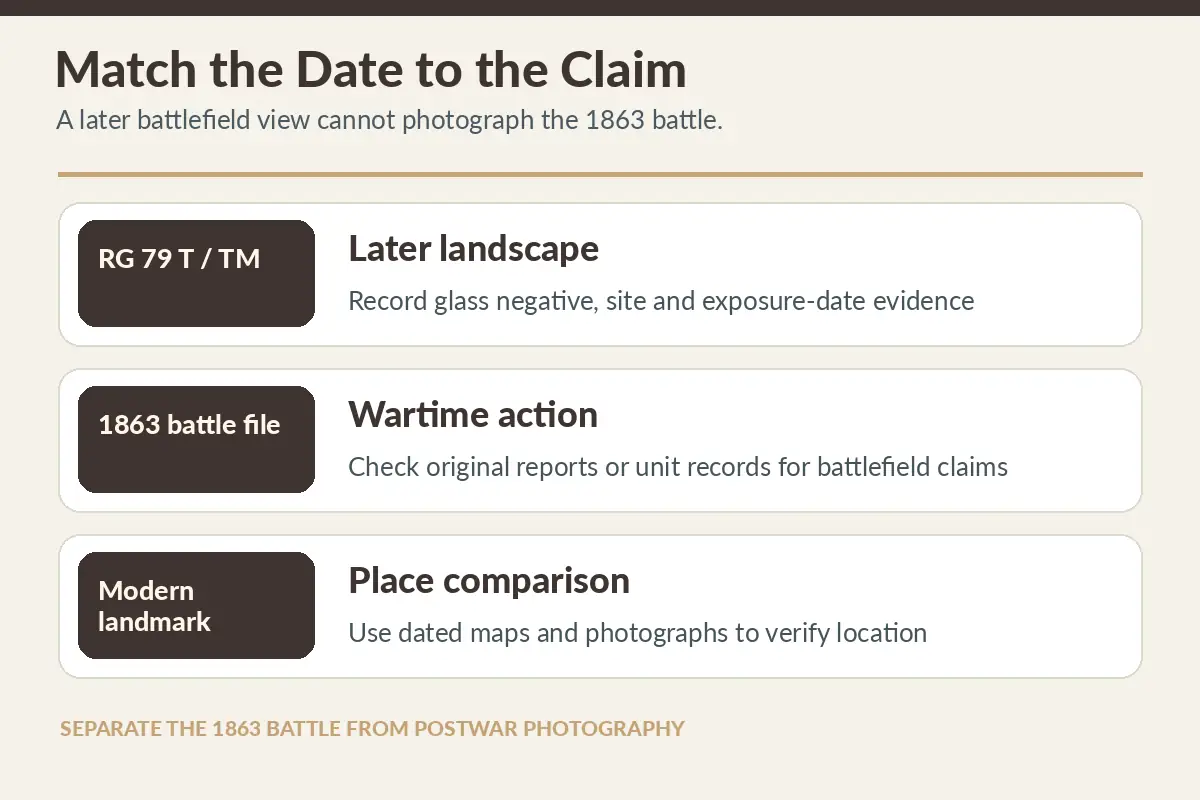
The Battle of Gettysburg took place in 1863, while the Tipton T/TM negatives described by NARA are dated 1868 through 1925. An image from this group may show a field or building associated with the battle, but it was made in a later landscape. If a family keeps a photographic postcard titled “The line our grandfather held,” ask when the original negative was made before using the picture as a representation of the wartime scene.
Physical reproductions can be even later than their negatives. A postcard cancellation, picture mount or printed caption may date the reproduction, not the exposure. Keep separate entries for the original scene date, photographic negative date and print or postcard date. If a caption was added years later, record its provenance rather than silently assigning it to the photographer.
Check the T and TM Glass-Negative Identifiers
NARA describes T and TM as the glass-negative series connected with W. H. Tipton and notes shelf lists for those groups. Start with the exact designator and item identifier. Some internet captions omit the original negative number, merge similar views or attribute any early Gettysburg image to one photographer. Avoid carrying forward an attribution unless the archival item supports it.
A glass negative may preserve fine landscape detail that a small newspaper reproduction loses. If comparing versions, look for changed crop, orientation, overprinted labels and image defects. Do not infer that a reversed print records a different battlefield location. If only a finding-aid description is available, do not claim to have inspected a negative or its handwritten sleeve.
Identify the Battlefield Landmark Before the Regiment
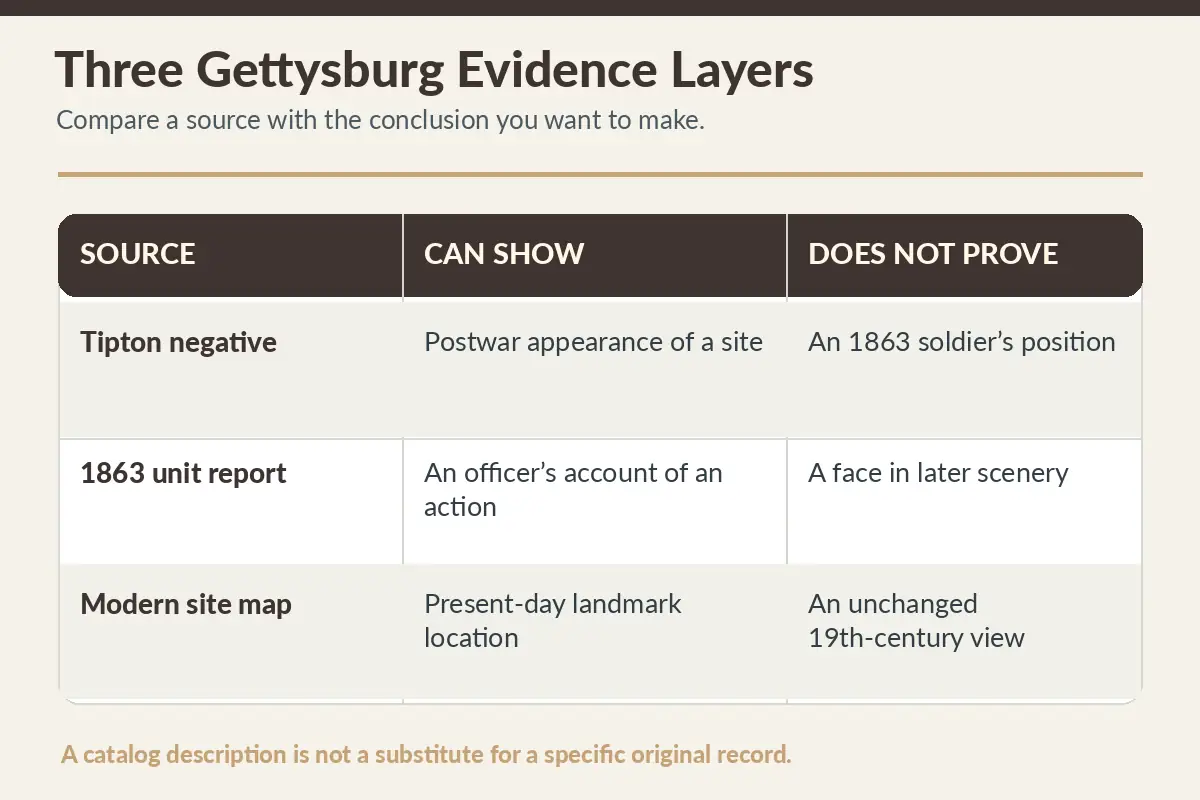
Gettysburg is a landscape of ridges, roads, farms, fields and memorials whose names may shift across eras. A family story using a modern landmark might describe a different administrative or geographic feature in 1863. Map the original caption’s feature against period battle maps and known directions. Note that monuments added after the battle can appear prominently in a photograph while offering no evidence about how the same ground looked during the fighting.
When comparing two images, consider the photographer’s vantage, season, later vegetation, road alterations and monument installations. A convincing landscape match can identify where the camera stood, but it still cannot say which soldier passed that location in July 1863. Treat the place finding as a separate accomplishment; then open the military documentation.
Test a Soldier Claim Against Wartime Sources
If the goal is to place a particular ancestor at Gettysburg, determine the unit and company from service records, pension evidence, contemporary letters or other named sources. Then check contemporaneous military reports and the unit’s documented movements for the relevant days. A regimental position described in a later secondary source should be checked against its cited evidence. A family surname appearing in a modern battlefield story is not a substitute for identification of the actual soldier.
Distinguish the location of a regiment from the whereabouts of an individual. A man could be absent, detached, ill or assigned elsewhere; surviving records vary in precision. The strongest narrative may say that a soldier is documented in the unit and the unit fought in the area, while the precise position of the individual is unknown. The Tipton image can illustrate the location with the proper later-photo date.
Describe and Cite the Photograph Without Overclaiming

Cite NARA, RG 79, T or TM, the specific negative number if available, original descriptive wording, exposure date or range and how the image was viewed. If you reproduce a later print, note its source separately. Where a label is ambiguous, use a qualified location rather than a confident modern address. Preservation of negative identifiers will help another researcher check whether a better scan or finding aid exists.
Explain in a caption that the image depicts a postwar view of a site associated with a Civil War action. Do not write that it shows an ancestor standing on the battlefield unless a separate named identification actually proves that statement. The same practice improves public history articles: the reader should be able to tell when a photograph illustrates later memory and when it directly documents an event.
Worked Example: A Postcard Said to Show a Grandfather’s Position
Suppose a family postcard shows a stone wall and carries a handwritten reference to a great-grandfather’s regiment. First identify its photograph or negative and distinguish the original exposure from the postcard printing. Find the wall on a dated map and verify whether its present name and location correspond to contemporary accounts. If the original image belongs to T or TM, record the negative’s full citation.
Next establish the relative’s unit with a named service source and compare the unit’s movements with contemporary reports. A successful match can justify a caption such as “later view of the battlefield area where the unit served,” with qualifiers. It does not justify saying the image captures the soldier, the 1863 action or an exact personal position. The constraint makes the story more credible.
More Family Story and Preservation Guides
How We Research the Historical Sources
We begin with the RG 79 inventory and NARA’s still-picture description, which establish the Tipton T/TM collections and their post-1863 date range. Our method treats the photo, historic site and named soldier as three evidence problems. We do not infer military service from landscape resemblance or a later monument.
Digitization and negative-level dating vary by item and must be checked individually. Read the affiliate disclosure for site transparency; government research links are not presented as paid affiliations.
No. NARA dates this group from 1868 through 1925, after the battle.
NARA lists 1,750 T and TM negatives of Gettysburg and other Civil War sites.
A later monument or view is useful context but must be checked against wartime evidence.
Use named service or pension records and compare them with unit documentation.
Not necessarily. A postcard or print may be produced long after the original photograph.