
A laboratory test of imported sugar, alcohol, a drug, or a patent medicine in 1884 or 1885 is evidence that customs officers investigated a material. It is not proof that the product was contraband, that a merchant committed fraud, or that a court convicted anyone. NARA lists records of laboratory tests of those four commodity categories under the Special Agents Division in Record Group 36. The same archive section identifies separate seizure reports for 1875–1887 and case files with different date ranges. The route from a sample to a penalty therefore needs to be documented, not assumed.
This distinction is especially important when an old label, business advertisement, or apothecary ledger prompts a family-history search. A company name could be an importer, manufacturer, seller, or party mentioned in correspondence; the test itself might not identify any individual. Before connecting a sample to an ancestor’s business, identify the actual creating office, the test’s date and purpose, and whether a second record references the same transaction. The high-level guide does not disclose the fields, methods, or scientific results in each laboratory volume.
Locate the Special Agents Office, Not a Modern Agency
NARA places the 1884–1885 tests under section 36.2.2, the Special Agents Division of the U.S. Customs Service. The division operated within the Treasury customs structure long before modern product-safety regulators emerged. Use that creator name when searching. Do not assume every substance tested in 1885 was examined under later twentieth-century food, drug, or chemical standards. Contemporary laboratory categories and enforcement authority must be established from contemporary sources, not modern labels.
Begin a request with RG 36, Special Agents Division, laboratory tests, 1884–1885, and the commodity class if known. Ask whether the record is arranged chronologically, by sample number, or by incoming office; the NARA summary does not say. Where a series-level Catalog entry exists, capture its identifier and present custodian. A reference to a “drug” in an 1880s office record should be transcribed as historical terminology, without supplying an invented diagnosis, formula, modern ingredient name, or regulatory classification.
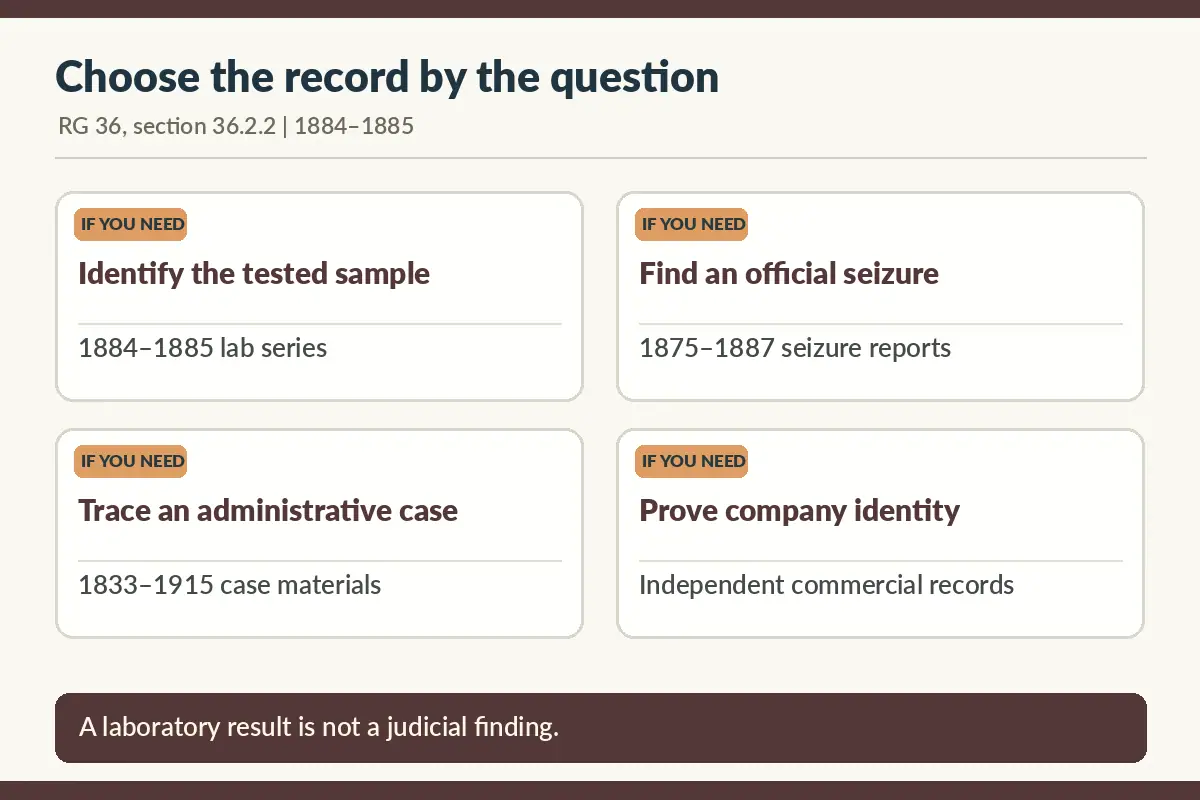
Keep the Sample, Report, and Enforcement File Apart
A lab report may contain a date, physical description, analysis, conclusions, or internal reference number, but none of those fields should be presumed from the high-level finding aid alone. Read the original headings to decide what was actually recorded. Capture units and methods as printed, and flag any ambiguous abbreviation. If an old test uses a chemical measure unfamiliar to a present-day reader, do not translate it into a modern food-safety judgment without qualified historical and technical context.
The same RG 36 subsection lists reports of seizures, 1875–1887, and broader case files and correspondence, 1833–1915. These are potential independent paths, not mandatory later stages in the life of every sample. A laboratory test might have informed classification, tariffs, research, or investigation; do not state the purpose if the document is silent. To verify an enforcement outcome, look for a connected seizure or case identifier and a dated decision. No linked record should be assumed to exist merely because both series survive.
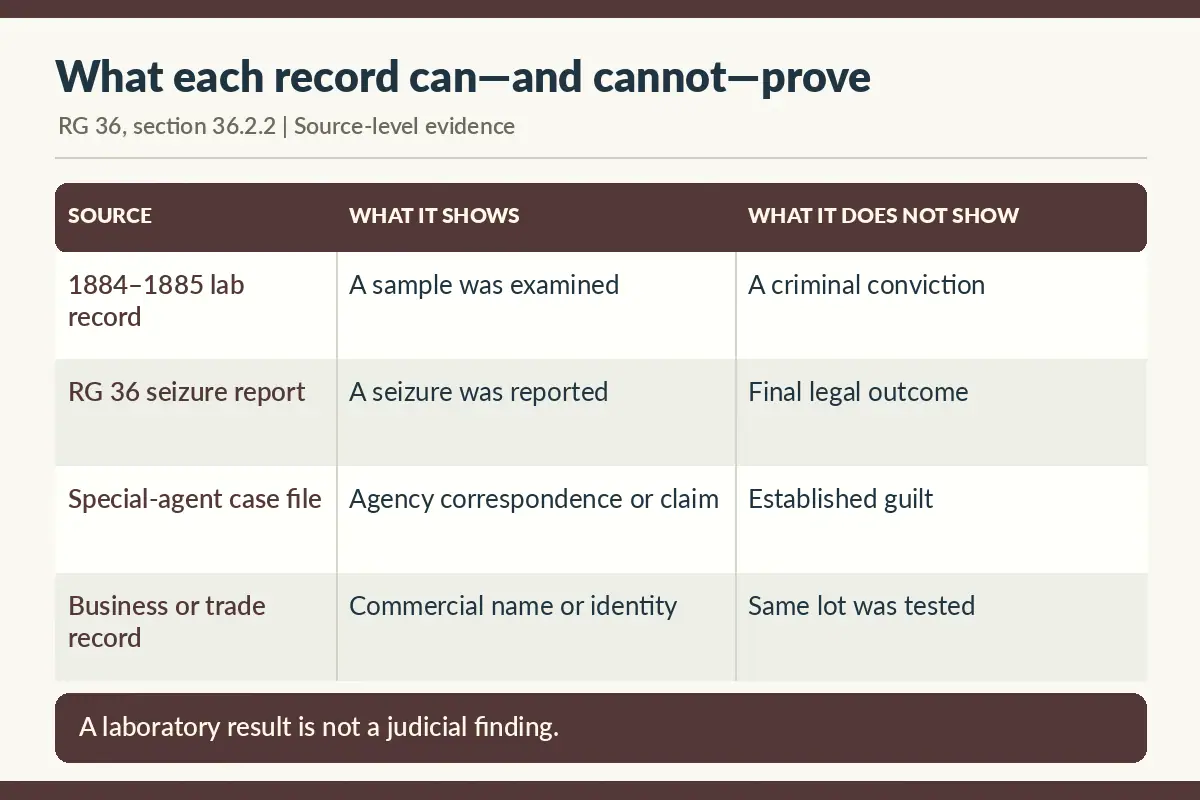
Identify a Product Without Misidentifying a Business
Historical commodity names can be generic. A “patent medicine” description may indicate a product category, not a registered patent or a trademark belonging to the person named in a modern family tree. Record the exact product spelling, shipment or sample number, container description, and any named importer only if the document provides them. If a street address is mentioned, establish whether it belonged to the sender, laboratory, consignment agent, retailer, or manufacturer.
For business identity, search commercial directories, period trade advertisements, customs entries, partnership records, and company correspondence from roughly the same year. Comparing these sources may reveal renamed firms or several businesses trading under similar names. A product appearing in an advertisement does not prove that the advertised batch was the tested sample. Keep evidence for product identity separate from evidence for the people associated with it; the shared brand is only one possible clue.
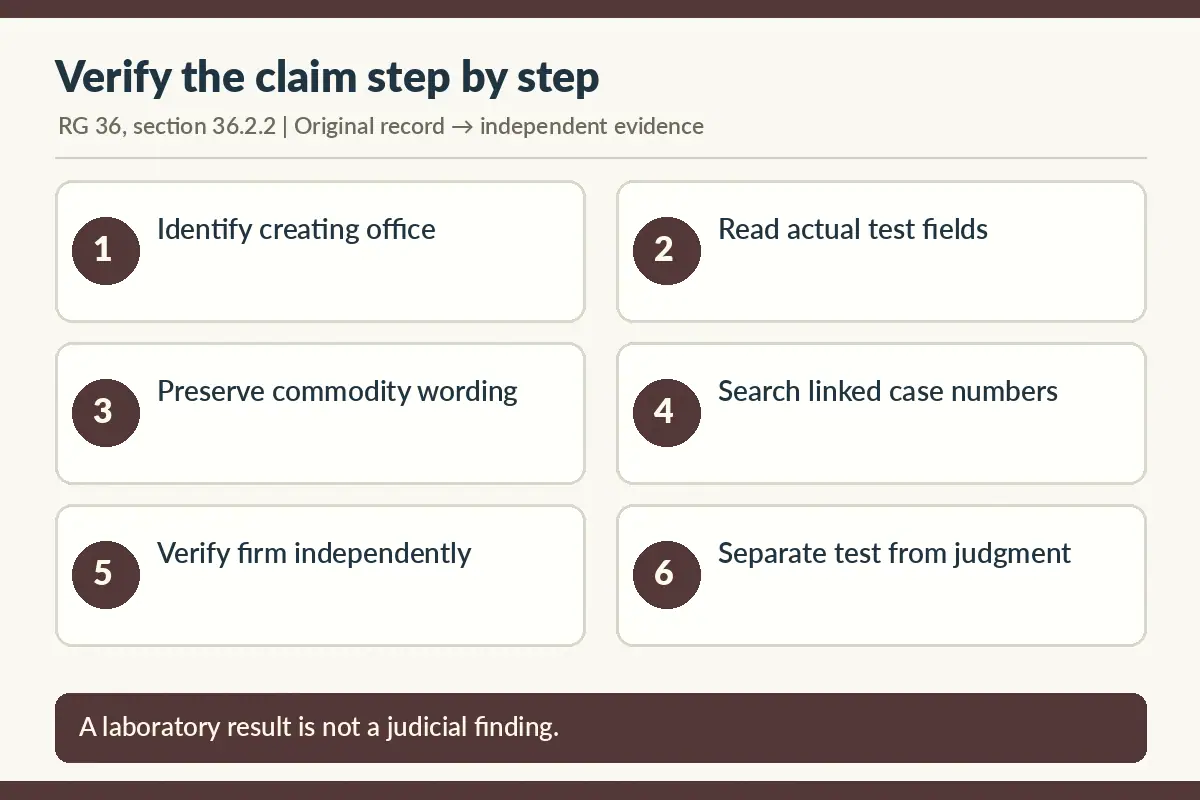
Consider an advertisement for a branded remedy in 1885 and a Customs laboratory series covering patent medicines that year. The advertisement and the existence of the series do not prove the advertised product was tested. Even if a name matches a laboratory entry, confirm whether the entry names the item, its importer, a shipment, or simply a sample category. A common trade name can circulate through many dealers. The strongest result is a clearly documented match between a sample identifier and another original transaction; otherwise write the narrower statement that the archives contain potentially relevant tests for that commodity class.
Make a Defensible Finding From an Old Test
Create an audit table with separate cells for archival citation, sample identifier, original test date, recorded commodity, reported result, test method if stated, and subsequent action evidenced elsewhere. Use “not stated” rather than guessing. For any technical conclusion, quote the original standard or threshold if the source provides it; do not translate an old qualitative observation into a present-day health claim or product warning. The purpose is archival interpretation, not a recommendation on safety or consumption.
If you discover a linked customs case, cite both items with their different creating functions. A seizure report can document administrative action but may still not prove criminal culpability. A case file can preserve an accusation without a final decision. The safest published family-history conclusion may be that an 1885 sample bearing a particular trade label was examined by customs officers, with any legal outcome unknown. That is meaningful evidence and more reliable than an unsupported story of fraud or prosecution.
The same caution applies to later accounts of regulatory wrongdoing. A magazine may describe a company as “exposed” and a family story may repeat that as a conviction. Return to contemporary records and distinguish rumor, an administrative allegation, laboratory analysis, seizure, forfeiture, and final court judgment. The evidentiary threshold rises at each step. If a named importer is recorded in a test, that may connect a business to a sample; it does not establish the importer personally manufactured the product or knew the contents. Document the exact capacity in which every name appears.
More Records and Archives Guides
How We Research These Archival Claims
We checked the precise RG 36 Special Agents Division subsection for both the laboratory records and separate enforcement series. We did not infer that an examination was unlawful or that specific analytical values survive on any given page. We also checked NARA’s Catalog instructions for the distinction between archival inventory descriptions and inspected records.
Start with NARA RG 36, section 36.2.2 and NARA Catalog guidance, then confirm the current holding location using the Guide’s notice. Our affiliate disclosure explains relationships; no commercial testing service is endorsed.
The NARA guide names sugars, alcohols, drugs and patent medicines in the Special Agents Division laboratory records.
No. Seizure reports are a separately described series, and their link to a given test must be demonstrated.
The Guide identifies a record series, not a complete public name-indexed test database. Check Catalog and reference services.
Not necessarily. It is a historical product category; verify the meaning in the original document and contemporaneous trade sources.
No. A technical examination and a legal finding are distinct records and standards of evidence.