
PCOM 5 contains Home Office old captions—copies of court orders—and papers concerned with transferring convicts to government prisons, principally in 1843–1871. It is not a complete register of everyone convicted or transported. First use the appropriate index in PCOM 6, then read the named PCOM 5 bundle and test each claimed movement against separate prison, shipping or arrival evidence. A sentence authorizing transportation does not, by itself, establish that a person boarded a ship or reached a destination.
Identify the Convict Before Searching a Bundle
Start with one dated criminal case rather than a surname alone. Record the prison or court, the approximate date of trial, the stated offence, the sentence and any known age or alias. These details are necessary because the same name may recur in unrelated convictions. A newspaper story, a family recollection and a census line are useful leads, but each has its own information source and may contain errors. Make a small candidate grid before matching an archive item to your ancestor.
The National Archives describes PCOM 5 as Home Office old captions and transfer papers, 1843–1871. Its series information document describes original paper bundles, including court orders for imprisonment or transportation and transfers to government prisons. The material is not a continuous, modern searchable database with guaranteed names in every catalogue result. Some pieces contain tied folders for individual convicts; others have loose sheets. Plan for a bundle-level rather than keyword-only investigation.
A practical first entry in the research log is: candidate name and variants; court and session; trial and sentence dates; known prison; evidence source; unresolved contradictions. If the source gives only a county and year, do not invent a court. If two individuals appear to fit, compare both rather than combining their ages, prisons and destinations into one attractive but false biography. The absence of a name in online search results is not evidence that a PCOM 5 file never existed.

Follow the Correct PCOM 6 Index to PCOM 5
PCOM 6 is not itself a court judgment. The National Archives identifies it as the indexing route for PCOM 5 transfer and old-caption papers. Use the specific index section, copying the spelling and reference exactly. The archive also uses PCOM 6 indexes to locate male prison licences in PCOM 3. These are two distinct routes: an index entry pointing to a convict’s transfer file should not be silently converted into a ticket-of-leave entry, and a licence index does not guarantee the survival of an old-caption bundle.
After locating a potential index entry, note the volume, page or folio, index name form, piece reference and any additional marker. Request or consult the corresponding PCOM 5 piece through the current repository instructions. The series description says there are 52 boxes, but this is physical arrangement information, not a list of only 52 people. An archival reference such as a piece or box cannot be interpreted as a prisoner ID without consulting the described original item.
Read all pages in the selected bundle, preserving their order and the distinction between original wording and later annotation. A file might include a court order copied after the event, papers prepared for removal, and notes made when an instruction was transmitted. Transcribe each date with its documented function. The trial date, date on a copy, date of a transfer request and date of an actual removal can all differ. A source list that flattens them into one date conceals the very history the researcher is trying to reconstruct.
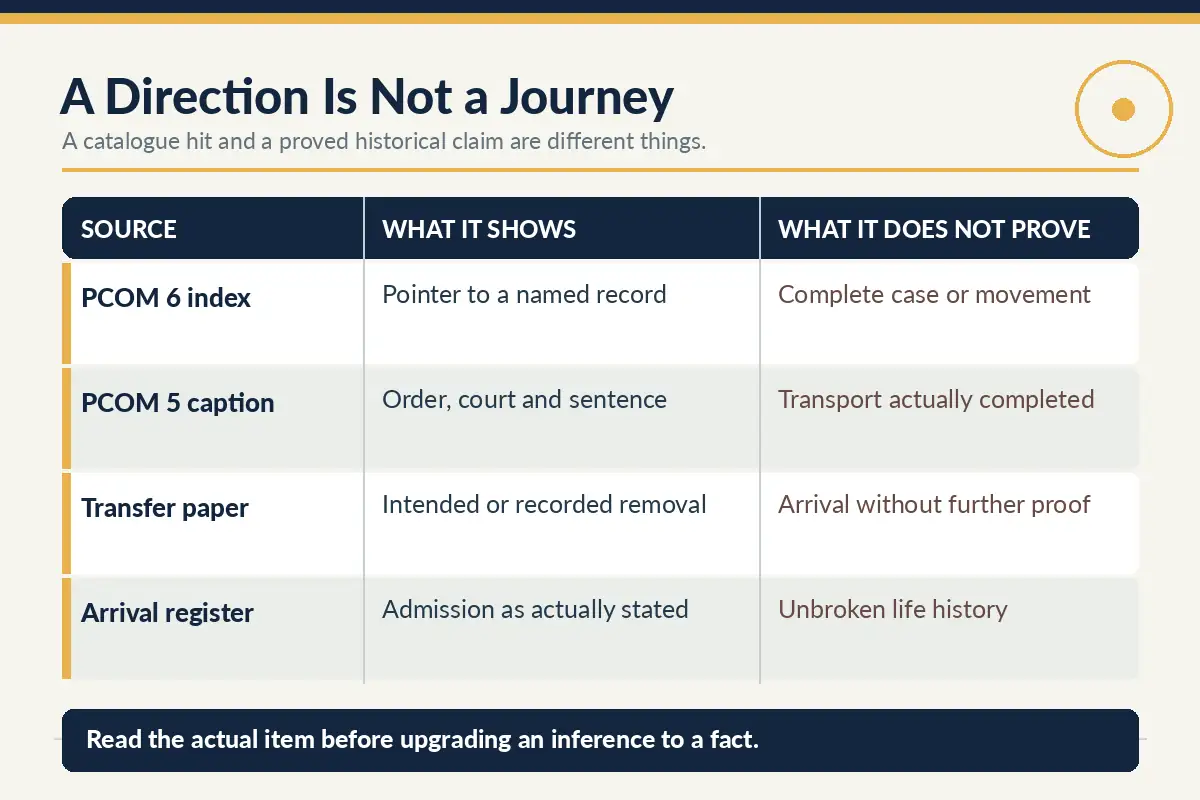
Separate a Court Direction From a Completed Movement
An old caption establishes what the court order says, not every subsequent step of its execution. A transfer direction can show that authorities intended to move a convict, but not that a particular journey was completed on the proposed day. PCOM 5 papers may contain movement information and other particulars; cite the exact statement when it does. A transportation sentence is especially liable to overinterpretation: the destination might change, an order might be delayed, or the person might serve time elsewhere.
Build an event ledger with separate rows for conviction, sentence, transfer instruction, confirmed prison admission or departure, and confirmed arrival if overseas transportation is alleged. Insert a date and exact evidence reference only for rows supported by a record. A prison register held by a county archive may help confirm an admission. A voyage or arrival claim may require a contemporary transport list or the destination administration’s records. No single national prison index should be treated as covering all of these steps.
Do not infer an Australian ancestor merely because a family story and a transportation order use the same surname. Use age, known home parish, aliases, sentence date and a later document tied to the same person. Be alert to historical legal terms and the distinction between a charge and a conviction. If a record quotes an allegation, label it as an allegation even when the person was later convicted of some related offence.

Protect Personal Context and Record the Gaps
A PCOM 5 file can reveal names, ages, descriptions and occasionally sensitive personal particulars. The official series information notes some bundles contain medical information. Such material should be handled as historical evidence, not as a basis for speculating about living descendants or treating a historical diagnosis as a modern clinical fact. Quote only what is relevant and preserve context around statements made by prison officials.
Record both positive and negative searches. A missing index hit may result from spelling changes, damaged entries, an incorrect assumed conviction year, a county-level file held elsewhere or a series-selection problem. Where the documented case predates or postdates the class, switch to the appropriate other prison holdings rather than extending the PCOM 5 date span to fit. A visible catalogue description is not confirmation that a record is instantly downloadable; verify current access and ordering details.
A concise research conclusion might say: “A court order dated X is preserved in PCOM 5 and appears to direct the transfer of a person matching Y; admission at the proposed destination has not been independently verified.” This is stronger history than an embellished statement that the convict certainly sailed, settled abroad or began a new life. Documenting the gap helps the next researcher choose the one source most likely to resolve it.
More Records and Archives Guides
How We Research Court and Transfer Papers
We use The National Archives’ PCOM 5 series description for the original-document arrangement and the date range. The official prisoners and prison staff guide distinguishes PCOM 5 court orders from PCOM 3 male licences, even though PCOM 6 can index both. The criminals and convicts guide provides cross-checking context. We do not claim to have read a particular convict’s file unless that file is separately identified.
Every schematic in this guide is an original educational illustration, not a facsimile of an archived prisoner document. We distinguish the index, the order and an independently proven event; our affiliate disclosure explains the site’s editorial relationships.
The National Archives series information describes Home Office old captions and transfer papers for 1843–1871.
PCOM 6 contains indexes used to locate PCOM 5 old captions and transfer papers; it also indexes some male prison licences in PCOM 3.
No. A sentencing or transfer document needs independent shipping and destination evidence to prove a completed journey.
Not necessarily. The series comprises original bundles with varying arrangement; locate the appropriate index and piece.
Check name variants, court and prison chronology, county repositories and other series, and document the coverage gap.