
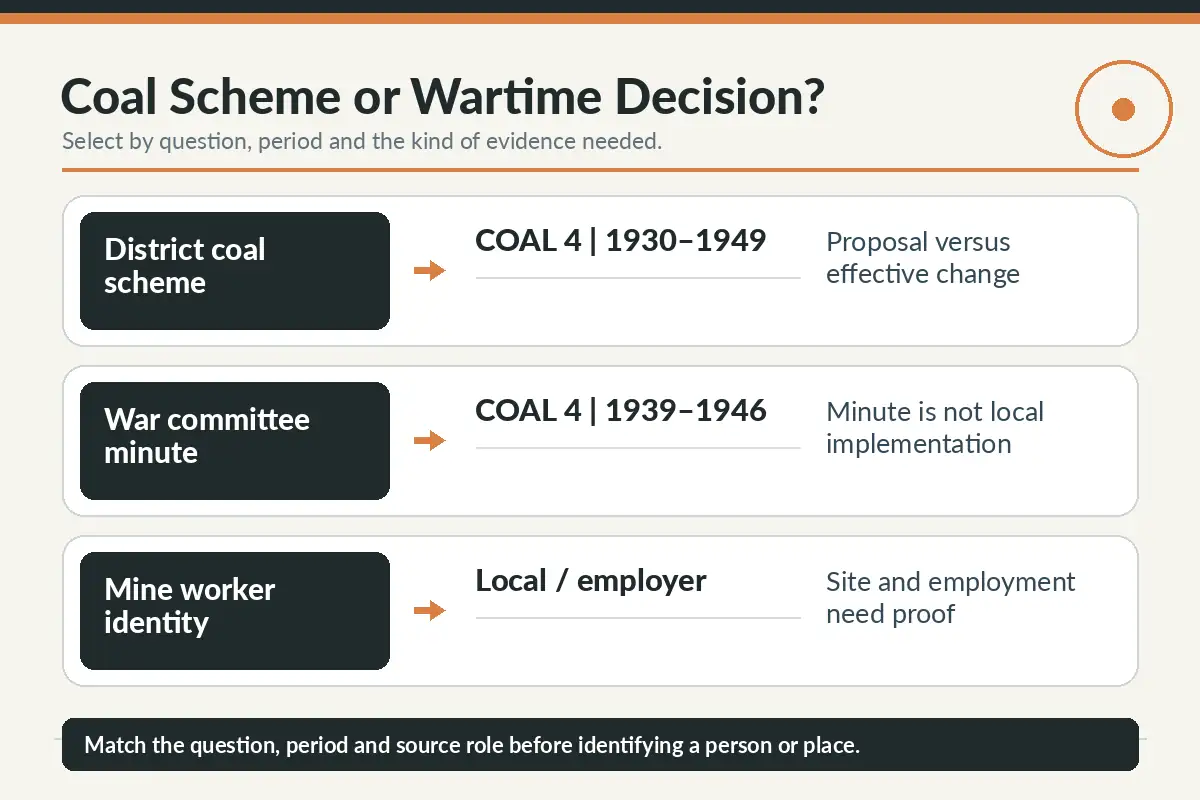
COAL 4 is not a miner employment register. The National Archives points to it for Central and District Coal Mines Schemes associated with reorganization in 1930–1949, and also identifies COAL 4 wartime War Emergency Committee minute books from 1939–1946. Start by deciding which administrative question you have, then trace a specific district, colliery or decision through related records. A proposed merger or emergency minute does not, without operational evidence, establish that a particular pit closed or that a named miner lost his job.
Separate Interwar Schemes From Wartime Minutes
The phrase “COAL 4” can bring together records about different periods and functions. In its mining research guide, The National Archives lists Central Coal Mines Scheme and District Coal Mines Scheme material in COAL 4 for 1930–1949. A separate section of the same guide identifies minute books of the War Emergency Committee on Coal Mines, 1939–1946. Do not read the two descriptions as a single sequence in which a district scheme automatically becomes a wartime committee order. First identify which kind of record a specific piece contains.
For a village history, fix the colliery name, its historic district and the date of the claimed change. A mine may have been described by a company name, a shaft name or a geographic locality that later changed. Capture all attested variants before searching. A local newspaper may call an event an “amalgamation” even if the archive records only a proposal. Record whether your actual question concerns ownership, geological boundaries, transport access, production instructions or people employed at the pit.
Create two routes in the research log. Route A follows an interwar scheme: announcement, district designation, administrative decision, and documented local consequence. Route B follows a wartime question: agenda, committee minute, communication to another body, and evidence of execution. Both routes can illuminate policy. Neither is a named roll of miners or a final, comprehensive inventory of pits. This distinction prevents an attractive central-government file from carrying more evidentiary weight than it can support.
Read the 1930 Reorganization Context Carefully
The National Archives explains that the Coal Mines Act 1930 created the Coal Mines Reorganisation Commission as part of attempts to reorganize the industry. Its guide also describes resistance from mine owners and the Commission’s dissolution in 1936. The Coal Act 1938 then created a Coal Commission concerned with coal deposits, but the outbreak of war affected subsequent plans. These are broad institutional milestones, not dates on which every mining district changed in the same way.
When a scheme mentions a district or proposed consolidation, read the full piece: its title, creator, dates, lists or maps if present, marginal revisions and cross-references. A draft line on a plan is not the same as a legally effective boundary, and a committee recommendation is not an executed transaction. If a locality is missing from an online index, it may be described in a regional or corporate file rather than by the pit name. Search relevant neighboring districts and the historical company where appropriate.
The research guide identifies COAL 12 for Coal Mines Reorganisation Commission material and COAL 17 for Coal Commission administrative files. Use these as conditional corroboration, not a compulsory chronological progression. A COAL 4 scheme might raise a legal or administrative question best addressed in COAL 12; a later land or deposit question might suggest COAL 17. In each case copy the actual piece and what it says. Never imply that the mere existence of related series proves a proposal went into effect.

Use War Emergency Minutes for Decisions, Not Events
For 1939–1946, COAL 4 War Emergency Committee minute books can be valuable evidence of discussion and recorded decisions about mining under wartime conditions. But a minute can summarize information received from another office, ask for further work or record a proposed response. It may not report what actually happened at each colliery. Record whether a passage is a report of an earlier event, a resolution, a deferred item or an instruction sent elsewhere.
The National Archives mining guide also directs readers to POWE 6 for wartime solid fuel controls, POWE 16 for emergency measures and production policy, and POWE 7 or POWE 10 for the Mines Inspectorate. Choose among these only when their functions answer the remaining question. A fuel rationing file does not prove a named mine stopped producing. An inspector’s discussion of safety may document a hazard without proving that a particular injury or prosecution took place.
For a timeline, distinguish at least five possible dates: the reported operating difficulty, the committee meeting, the approved policy, the local instruction and the documented implementation. Later published histories may compress these dates. If a coalfield map shows a seam or mine site, it supplies geographic context, not a day-by-day operating history. Compare a map’s survey date, amendments and scale to the date of the decision; a modern map should not be silently treated as an interwar map.

Verify a Colliery History With Local Evidence
The National Archives explicitly warns that it does not hold comprehensive coal-mining personnel records. Staff evidence may survive in company records, regional repositories, unions or privately held papers, subject to access conditions. If an ancestor supposedly worked at a pit affected by a COAL 4 scheme, first find a dated person-level source connecting that individual to the employer and site. A district-wide scheme cannot do that for you, and a surname appearing in a committee letter could belong to a company representative rather than a working miner.
Colliery change requires at least two layers of corroboration. The administrative layer answers what officials proposed or recorded. The operational layer might be an independently dated company report, trade directory, local newspaper account, production return or mine plan demonstrating what actually changed. For a closure claim, identify whether the sources mean cessation at one shaft, temporary suspension, amalgamation of management or final abandonment. Those are separate events with different local consequences.
Write conclusions at their proven level. “COAL 4 records discussed a district scheme for this area” may be supported by a located item. “The scheme closed this named mine in a particular month” needs direct evidence of implementation. “My grandfather was dismissed because of the scheme” needs a person-specific link and a causal record, not a plausible narrative assembled from dates. Archive silences are documented gaps, not proof that workers never existed.
More House and Local History Guides
How We Research Coal Schemes and Coalfields
Our starting point is The National Archives’ mines and mining guide, which identifies the COAL 4 interwar and wartime functions and related COAL and POWE series. We follow its Discovery instructions to distinguish departmental headings, pieces and the dates covered by specific records. The archive’s account of the General Strike provides earlier social context but is not a piece-level list of affected collieries.
We do not equate state policy with local closure, employment, or family residence, and the drawn mining scene is illustrative rather than a historical survey. Editorial relationships are explained in the affiliate disclosure.
The National Archives lists Central and District Coal Mines Scheme material for 1930–1949 in COAL 4.
The National Archives identifies War Emergency Committee minute books for 1939–1946.
No. You need separate dated evidence that the proposed change was implemented at that pit.
COAL 12 concerns the reorganization commission, COAL 17 administrative files, and POWE records can cover wartime control or mines inspection.
Not generally; seek surviving employer, local archive, union or other individual-level documentation.