
WO 379 is listed by The National Archives as a source for the disposition and movement of British Army regiments, covering 1737–1967. It is valuable for asking where a unit was recorded at a particular time. It is not an automatic roster of everybody who served in that regiment or proof that one ancestor followed every movement. Regiments could change names, divide into battalions or detachments, and be listed in summaries made for different administrative purposes. Begin with a unit identity, a narrow date and the location claim you want to verify.
Identify the Regiment Before Plotting Its Route
A regimental name may persist for decades while its administrative identity changes. A familiar number, territorial designation or later title can mislead a search for an earlier period. Write the unit name exactly as it appears in a dated record, with battalion or company information when available. Then use related Army unit-designation sources to determine whether the label refers to the same formation across the proposed timeline.
The National Archives distinguishes WO 379 for dispositions and movements from WO 380, which covers designations, establishments and stations of regiments. WO 17 monthly returns and WO 73 later monthly returns answer different strength-and-location questions for their respective periods. A search should therefore begin with whether you need a long-term location overview, a formal name change, or a month-specific unit return. These are alternative research paths, not a required chronological sequence.
Build a unit-identity table with original spelling or number, any confirmed later title, component battalion, dates and source references. Do not silently equate a depot with the active battalion or a headquarters location with every detached company. Where the available source lacks this precision, write “regiment reported at” rather than inventing the exact barracks or soldiers involved.

Extract a Dated Movement Without Adding a Soldier
Search WO 379 by the regiment and the relevant span. Record the date expressed in the source, the reporting unit, the place as written and the kind of movement or station entry. A compiled location summary may be retrospective, and its dates should not be treated as the precise arrival day unless explicitly stated. Keep date-of-record and date-of-event separate where those differ.
When placing a location on a modern map, verify its historic place name and territorial jurisdiction. A station name can refer to a broader garrison, town or administrative district rather than a modern address. If a unit is listed overseas, avoid assuming that all elements of the regiment were in the same area. A regimental disposition is useful contextual evidence, not a personal travel itinerary.

For example, a hypothetical family story places a soldier in a port during a given year. A WO 379 entry for his alleged regiment might support the regiment’s presence there. It cannot prove the person joined the unit, remained in service at that moment or embarked on a named ship. The next question must be tested with a service document, muster, pay record, medal paperwork or another person-specific source appropriate to the era.
Compare WO 379 With Other Army Records
The Army operations guide lists WO 5 marching orders for 1683–1852, WO 27 inspection returns for 1750–1912 and WO 17 monthly returns for 1754–1866. Their survival and contents vary. A movement order indicates an instruction; it is not identical to an arrival report. A monthly return can give a more specific date or strength context but may still be organized at the unit level and omit individual names.
Before claiming a move happened, compare a relevant disposition with a dated return or contemporary unit account. If the documents disagree, check whether they describe an intended route, a temporary detachment, a station, or a retrospective list. Do not conceal contradictory dates by choosing the one that fits a narrative. Note when a month or year is only an approximate bound because the source lacks a day.
To connect an ancestor, first establish the person in that regiment through a separate dated record. A discharge, attestation, pension record, muster or personnel document may supply service dates and unit identifiers, but availability differs by period. Only then compare the overlapping date with WO 379. An ancestor who joined the same regiment five years later cannot be placed on an earlier march merely because the unit name matches.
Record Uncertainty When the Unit Disappears From View
If a regiment is absent from a volume or a search result, check changes of title, disbandment, reorganization and the level of the catalog description. A lack of a WO 379 result is not proof that the unit did not exist or that a soldier was absent. A modern name may not retrieve an older listing. Log the variants and date span before concluding that the archive has a meaningful gap.
Create a movement ledger with columns for unit, source date, named location, precision, corroborating record and individual-service test. A timeline should distinguish “recorded there,” “ordered to go there,” and “person documented there.” Use symbols or written labels rather than one solid arrow that makes those three levels look equivalent. This also gives a reader a path to retrace your conclusion without relying on a bare map pin.
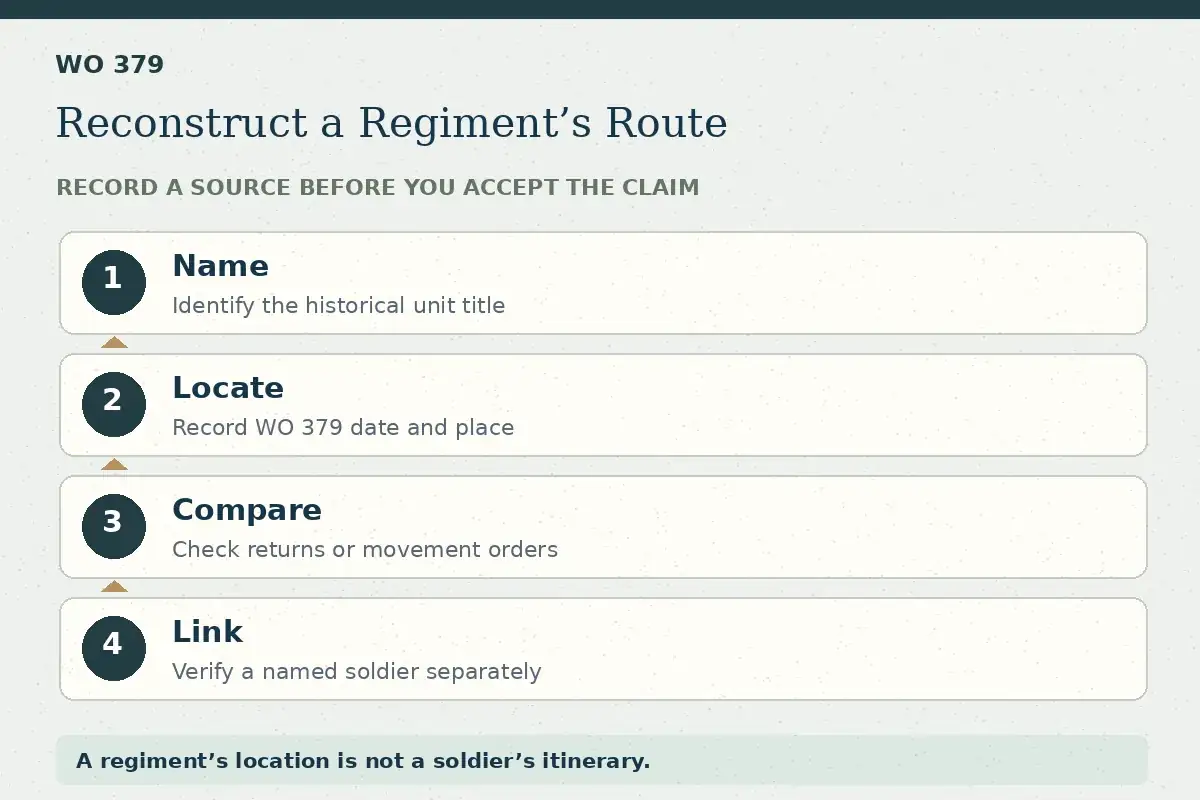
When presenting a military family story, write that the regiment was listed at a particular station and separately say whether the named ancestor’s service overlaps the period. If no personal record links them, describe the location as background context only. Respect access restrictions for more recent individual service records; their absence from public search does not authorize speculative identification or disclosure.
More Records and Archives Guides
How We Research Army Unit Movement Records
We use The National Archives operations guide to date WO 379 and distinguish it from unit-name and inspection series. Its Army personnel guidance helps direct individual-service questions to the appropriate separate records, while Discovery guidance supports repeatable searches and complete citations.
All example soldiers and scenarios are hypothetical. We do not convert a unit location into a named person’s movement without proof of service and matching dates. Our policies are explained at our affiliate disclosure; no archive endorsement or affiliate access arrangement is suggested.
The National Archives lists dispositions and movements of regiments in WO 379 for 1737–1967.
No. It is a unit-movement source; individual service must be established in other appropriate records.
Use contemporary titles and compare WO 380 designation and station records rather than searching only the modern name.
Not necessarily. Check dated station, return or operations records for actual movement and distinguish orders from outcomes.
Yes as unit context if labeled accurately, but do not plot an individual ancestor without a separate service link.