
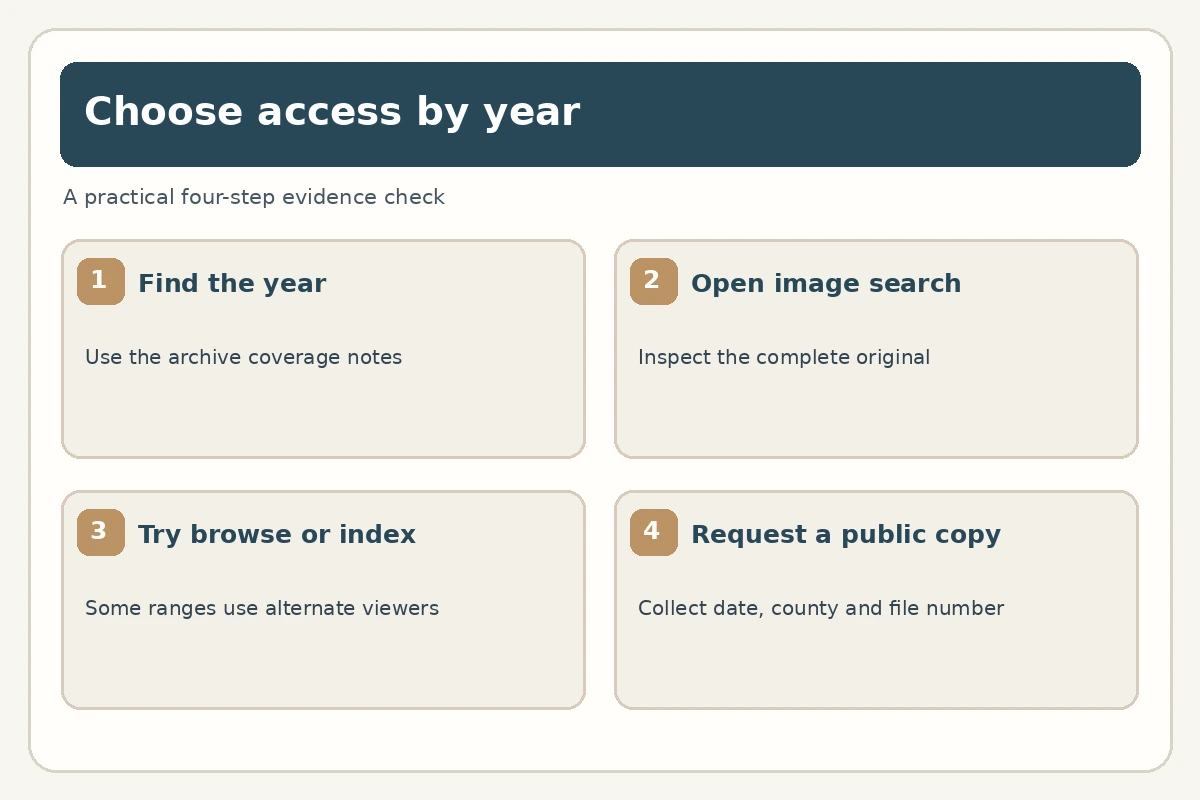
Choose the access route by year before searching a surname. Utah State Archives describes an online historical death-certificate series that began in 1904. But it does not provide every year through a single identical image viewer. Some years are browsable or searchable as historical images. Later public records may require a request supported by an index and file number. That difference matters when a family researcher confuses “indexed” with “downloadable.” This guide builds a dated path to a source image or lawful copy and explains how to read its genealogical claims without disclosing recent family information.
Choose the correct route for the date of death
Use the Utah State Archives’ own death-certificate collection page as the first stop. The historical digital description names Series 81448, records beginning in 1904, and images from FamilySearch for the 1905–1958 portion. The archive’s index pages describe name and browse functions into later years and a request workflow for more recent public certificates. Do not infer that every indexed year has an immediately viewable image or that all individual images have equal scan quality. On the day you search, note which years the archive offers as browse, index, image, or request. A dated coverage note matters more than a screenshot from an old genealogy blog. Our guide “Missouri Death Certificates, 1910–1975” covers a related question.
Search the names index while preserving the record number
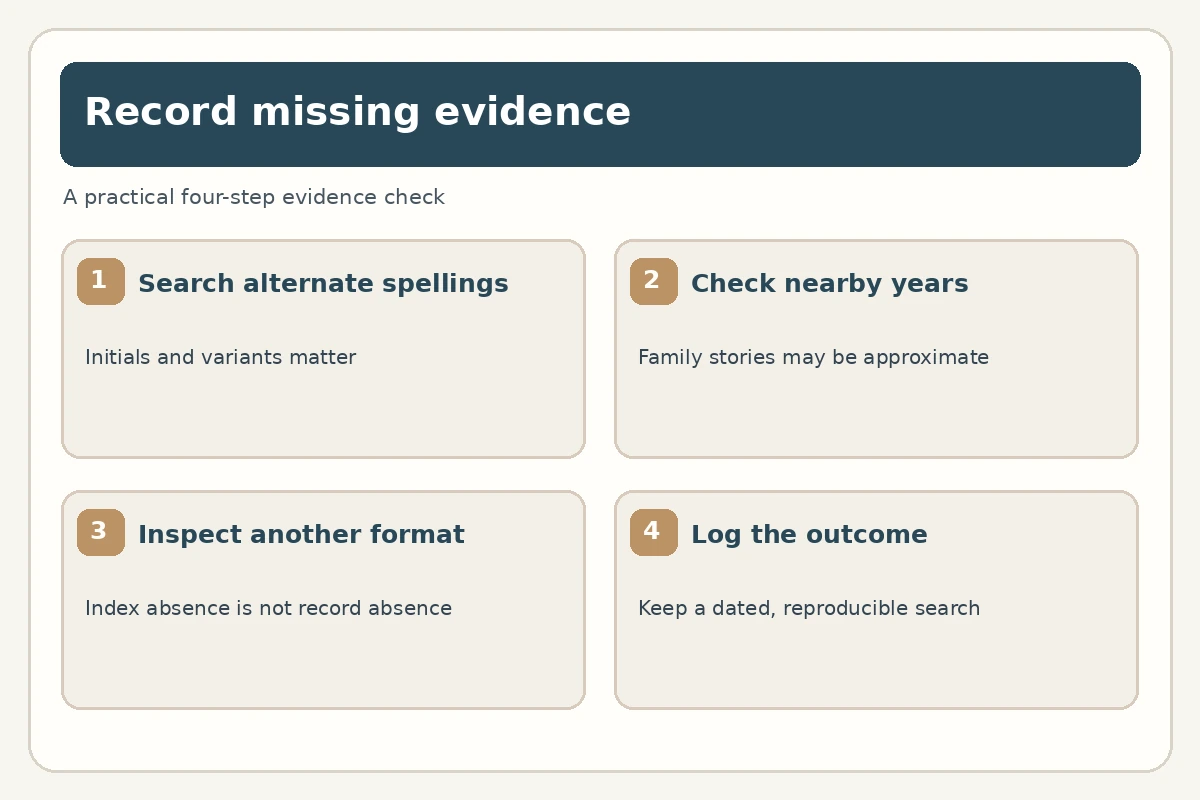
Start with a full name, then repeat with middle initials or spelling variants. Restrict the search with a known death year only after testing a wider span; family stories and copied trees can be off by a year. Utah’s electronic index for 1971–1975 is designed to identify records for a request, including the state file number. Copy such numbers exactly if available, along with county and death date. An index can help locate a paper record without independently proving every reported family relationship. When two people share a name, compare the city or county and a non-index source before deciding. Keep a search log, including alternative names that returned nothing.
Know when browsing is better than a surname search
The archive provides browse options for some years and explicitly notes image quality issues affecting certificates in 1962 and 1963. A name that fails to appear in one text index may still be traceable through browsable images or a direct repository request. Use a date and county to narrow a browse sequence, but avoid assuming that an unclear scan is evidence that a field is empty. If a certificate is unreadable, flag the particular line rather than filling in an attractive guess from another tree. The source page may link to a replacement image or updated scan. Cite whichever actual version was read, including any change in the scan or archival page.
Keep residence, death, and burial places separate
Utah death certificates can present several locations that answer different questions. The county where a person died, their permanent address, birthplace, and place of burial are not interchangeable. A death in a regional hospital may have occurred far from a family homestead. A cemetery could be across a county or state line. Copy each label verbatim before mapping places or selecting the next county archive. When a spelling is unfamiliar, check historical county boundaries and the era’s place names, without claiming that a modern map confirms the original wording. A chronology table with event date and location keeps movements distinct from administrative reporting.
Evaluate parents and marital details as reported information
An official death certificate is a strong source for the administrative occurrence of a death. But personal biography on the form often comes from an informant. Utah’s archive description lists fields such as parents, birthplace, marital status, and burial information. But their presence on the form does not guarantee they are correctly completed on an individual certificate. Ask who likely supplied the names and how they would have known. A parent’s surname may be recorded as a married name; a birth year may be approximated. Compare these claims with a birth or marriage source nearer the original event. Mark a field as absent, unclear, or contradictory rather than silently improving the archived record.

Request a public record without bypassing release rules
The archive describes procedures for obtaining copies of public certificates that have passed the required interval and for records in its indexing pipeline. For a request, gather the decedent’s name, date and county of death, and file number when available. Use the institution’s current public instructions; do not promise an exact fee or turnaround without a dated official confirmation. A request-only path does not mean a record has been destroyed, and a “not yet online” message is not proof that no certificate exists. Be mindful of living relatives mentioned in supporting papers, and avoid circulating personal identifying information merely to crowdsourced search a recent death.
Build a source citation that survives changing interfaces
A practical citation records “Utah Division of Archives and Records Service,” Series 81448, the certificate’s date and county, the individual’s name as written, a file or image reference, how you reached it, and your access date. If you found a name through an index and ordered a separate document, cite each layer appropriately. When sharing research, attach the exact transcription passage to the image citation rather than placing a bare link in a family profile. Keep notes explaining whether the evidence came from a certified copy, online image, browse viewer, or text index. Those distinctions allow later readers to evaluate what was actually seen and what still needs checking.
Use substitute records when an image cannot be located
Try an obituary, burial record, funeral director’s register, county probate file, newspaper notice, or census household when a certificate search is unsuccessful. Each replacement has its own limits. A gravestone usually does not identify the source of the birth date, and an obituary may use a family’s retrospective account. Reconstruct one question at a time: which person died, when, where, and what documentary basis supports each proposed relative. If a later certificate becomes available, return to the unresolved statements rather than treating its arrival as automatic confirmation. A transparent “not found in the Utah index as searched” is a valuable research result without turning absence into certainty.
How We Research These Historical Materials
Our access-path review compared Utah State Archives’ Series 81448 description, the historical name-search page, and its separate electronic index for requested copies. These are different services, so the diagram explicitly warns against treating an index result as a complete image. The archive’s note about scans from 1962 and 1963 was checked before drafting. The narrative does not claim that all named ancestors appear in a particular year or that later certificates are publicly downloadable.
More Records and Archives Guides
Official Sources and Collection Descriptions
archives.utah.gov source guidance: Utah State Archives reports statewide death certificates beginning in 1904, Series 81448, historic online ranges, and its FamilySearch image partnership.
Utah State Archives shows name/browse access through 1970 and request workflows for public certificates in 1971–1976, according to the record age.
archives.utah.gov source guidance: Utah electronic 1971–1975 death-certificate index can supply identifying data and file numbers for requests.
These educational images depict search decisions, not an authentic Utah archival item or a particular deceased person. Viewers must follow the archive’s present request eligibility and privacy policy for each record year. The illustrations have no Utah State Archives endorsement, and no commercial genealogical partnership is claimed. Read the site’s affiliate disclosure for relevant policies.
No. The archive distinguishes online historical images, searchable or browsable indexes, and later public records that must be requested.
The archive’s electronic death-certificate index for certain later public years can provide the number used to request a copy.
Utah State Archives has identified image-quality issues in those years; inspect any replacement image or contact the archive.
They may supply names from an informant, but those family claims should be corroborated using independent records.
Not necessarily. Try other names, browse paths, a different year or a direct archive inquiry.