
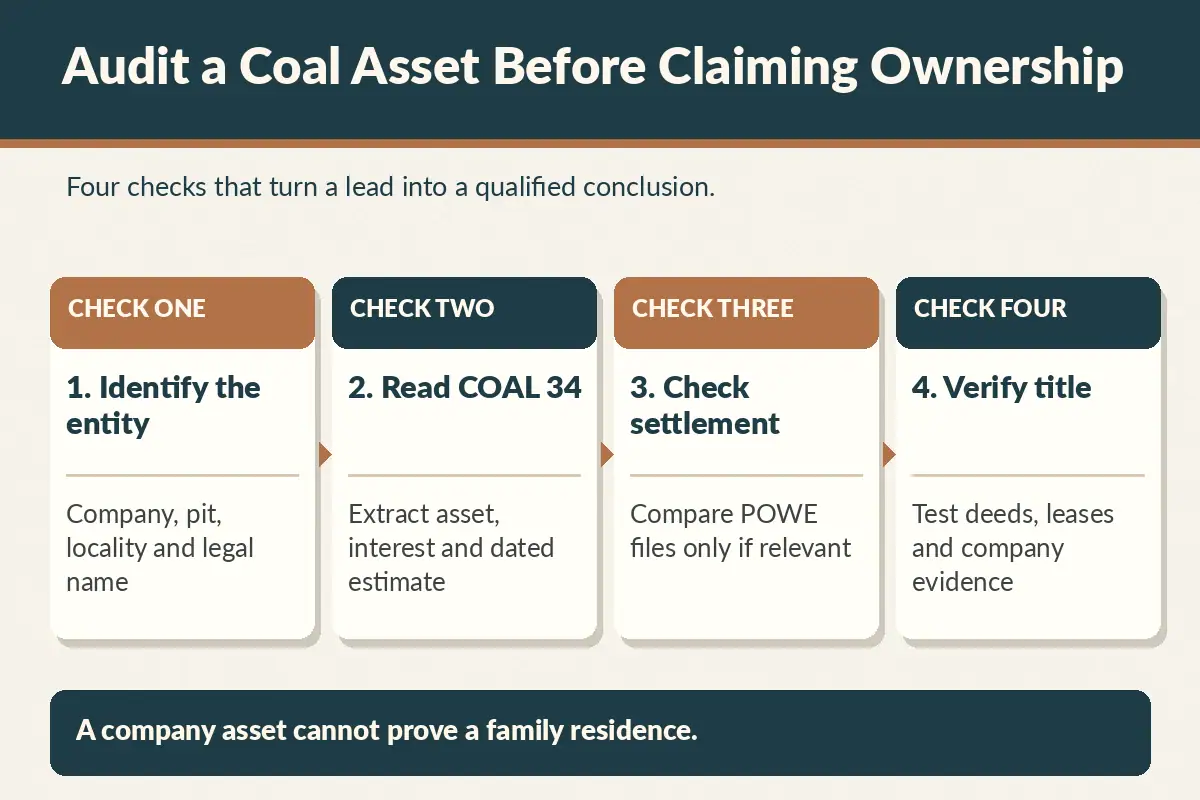
A registered interest is not proof of a title deed. COAL 34 is described by The National Archives as papers relating to registration of assets, estimates of value and statements of interest around coal-industry nationalization. In this guide, the record is treated as an archival source with explicit proof limits: the catalogue can locate a document, while the original and an independent source establish what can responsibly be claimed. You can use the following worksheet-style route even if the person or building you are tracing has not yet been identified.
Identify the Asset and the Historical Company
COAL 34 is described by The National Archives as papers relating to registration of assets, estimates of value and statements of interest around coal-industry nationalization. The National Archives also explains that the Coal Industry Nationalisation Act 1946 led to winding up many private coal companies. Such records are useful for reconstructing how assets were represented in an administrative process; they are not automatically the original title deeds for the land, mines or houses that an entry describes.
Start with the mine, colliery or company name as used at the relevant date, not just a present-day heritage-site label. Record alternate names, owners as reported, locality and what asset you wish to trace: mineral rights, buildings, surface land, equipment or a financial interest. A holding company, operating company and named pit may be three different entities. Do not merge them into one proprietor on the basis of a shared place or trade name.
Distinguish Registered Interests From Legal Title
The words “registration,” “estimate” and “statement of interest” describe different kinds of administrative evidence. A declaration of interest can tell a researcher that a party asserted or registered a relationship to an asset. An estimate can provide a figure made for valuation purposes. Neither automatically proves uncontested ownership, the amount actually compensated, or residence at a property. Read the form or paper’s purpose and date before translating its terminology into a modern property-history claim.
Create an asset ledger with fields for the named applicant or corporation, mine or asset, interest stated, valuation date, sums reported, any objections or amendments, and the precise COAL 34 reference. Where numbers differ between documents, preserve both and note whether they concern different dates or categories. Avoid describing an estimate as an agreed price or sale. Nationalization and ordinary private conveyancing are distinct legal and administrative contexts; record what the document did rather than assuming it functioned as a private deed.

Route Compensation Questions to Different Files
The National Archives mining guide directs researchers to POWE 35 and POWE 36 for sample company files showing how assets were settled and compensation awarded, and to POWE 42 for the Central Valuation Board. These records are possible comparisons with COAL 34 but cover different aspects of the process. The guide says the POWE 35/36 papers relate to 32 sample companies; do not imply the sample is a complete list of every enterprise transferred. A COAL 34 registration may therefore have no matching file in that particular sample.
If the question is whether compensation was approved, identify the formal decision and the entity entitled to receive it. A stated claim can be disputed, recalculated or apportioned. An award is not necessarily evidence of the date or method of a payment, and a payment to a company is not proof that a named worker or household received funds. Keep original accounting statements, settlement decisions and bank or distribution evidence distinct where they survive. This prevents converting an administrative claim into a fictional family windfall.
Compare Land, Company and Employment Evidence
Mine ownership can be a bundle of legal and practical interests, including surface occupation, mineral rights, leases and company shareholdings. The National Archives suggests examining earlier company incorporation and shareholder material under BT 31 or BT 41 for relevant companies dissolved by or before nationalization. Those files often concern company formation rather than every operational transaction. Local deeds, estate papers and land-registration sources are needed to establish a particular title chain where the asset interest is uncertain.
For genealogy, keep the economic history of the company separate from the employment of an ancestor. A miner may have worked at a pit and lived nearby without owning any registered asset. A director or shareholder may have had a financial connection without living on the site. Historical directories, wage books where surviving, electoral rolls and household records can bridge specific person-level questions. In the absence of such a bridge, the strongest defensible statement may concern a company’s registered interest rather than a family’s property.

Record Archive Limits and a Reproducible Finding
Use Discovery to search within COAL 34 by company name, colliery name, county and relevant postwar dates. Widen the search when the legal owner and the operating name differ. Note the catalogue level, holding repository and whether the record is digitized or requires a visit or copy order. The National Archives guide warns that local archives are often better starting points for records of individual collieries. Failure to find a named pit in a central government catalogue is not proof that it operated without property or assets.
For a final citation, identify The National Archives, full COAL 34 piece, document title or registration number if visible, and document date. Cite any related POWE compensation file or local deed separately. Write conclusions proportionate to what was inspected: “a statement of interest was registered” is different from “legal ownership was established,” and “a sum was estimated” is different from “the owner was paid.” The payoff is an accurate local asset history that can support, rather than substitute for, a family’s documentary story.
More House and Local History Guides
How We Research Original Documents and Their Limits
This research route relies on original institutional guidance, not an invented visit to an individual archive piece. The topical source is The National Archives research guide; record-finding limits are explained in Discovery search guidance; and the citation standard is described in The National Archives citation guidance. We have not inferred that a particular person or project appears in an unseen piece. The accompanying scenes and diagrams are newly composed explanatory illustrations, not reproduced historic documents.
Before citing a conclusion, keep separate the catalogue description, the original document as inspected, your literal transcription, and the independent evidence used to test identity or outcome. Record spelling variants and failed searches, including the date and scope of each attempt. Avoid assuming that everything in a surviving series is individually keyword indexed or digitally accessible. The site’s affiliate disclosure explains relationships and funding; these steps do not depend on an unverified commercial service or a fabricated referral.
No. It describes asset registration or related interest and valuation papers, which should be checked against title evidence.
Not automatically. Valuation, compensation decision and payment are different claims.
No. The official guide identifies sample-company papers for 32 companies.
No. Employment needs independent person-level records.
Consider BT 31 and BT 41 incorporation and shareholder records, and local records where appropriate.