
Royal Marines POW List ADM 201/111: Confirm Captivity Without Inventing a Camp History starts with a distinction often missed in family and local history research: an archival entry describes a particular document or administrative act, but does not automatically establish every related event. Use the official series research guide to select the correct record, then check the related source guidance before extending the conclusion. The steps below identify what ADM 201/111 Royal Marines prisoners of war can show, what it cannot show, and which independent reference could resolve uncertainty.
Begin With the Specific Royal Marines POW List
The National Archives identifies ADM 201/111 as nominal lists of Royal Marines who were prisoners of war in Germany during the Second World War, 1939–1945. This is a very specific starting point, not a universal list of naval personnel captured in every theater. A Royal Marine attached to a ship or shore unit must be identified as a Marine before the list can be used to substantiate the family story.
Write down the alleged prisoner’s full name, initials, rank if known, service number, approximate dates and his formation. The list may be searched through a partner collection of digitized prisoner-of-war records. A matching name is a candidate until the associated service details are checked. Do not assume a missing name means the person was never captured; coverage and record survival vary.
Distinguish a Nominal Entry From a Personal File
A nominal list was produced to identify people in a particular administrative category. It may contain useful identifiers, but it is not an individual service record or a diary of internment. The official British and Commonwealth POW guide emphasizes that there is no definitive prisoner file containing every surviving fact about a person’s captivity. Relevant evidence is distributed among lists, service papers, questionnaires, reports and correspondence.
Copy the entire entry, including any number, abbreviated rank or location, and note any column headings before interpreting them. A camp designation beside a name, if present, is evidence of an administrative association at a particular reporting point, not proof of where the prisoner spent every month. Record unclear fields without guessing and preserve the catalogue reference independently of a search-platform URL.

Check That the Man Served in the Royal Marines
Royal Marines service records, enlistment information and appointments can supply a bridge from a family identity to a name in ADM 201/111. Use the appropriate Royal Marines guidance for officers or other ranks. A similar surname on a wartime casualty list belonging to the Army or Royal Navy cannot automatically be assumed to denote the same man. Branch of service is essential to the identification.
Rank could change before capture, and official numbers or unit abbreviations may be copied inconsistently. Compare a candidate against a dated personal record, an official address or next-of-kin detail when available. If two candidates remain, keep both on the worksheet. A single match of rank plus surname is weaker than a match of service number, unit and chronology.

Find Camp and Transfer Evidence Separately
It is tempting to turn one prisoner listing into a detailed camp narrative. The National Archives POW guide instead describes several independent routes: general prisoner lists, liberation questionnaires, escape and evasion reports and camp records. Which sources are relevant depends on the person’s circumstances, surviving material and whether the prisoner was held in Europe or another theater.
If a family account names a Stalag or Oflag, verify that camp name using a dated record rather than relying on wartime geography alone. A transfer after capture may make two different camp names true at different times. Conversely, a report about conditions at a camp does not prove the named Marine was confined there. Keep camp-level information and person-level evidence in separate columns until linked.
Interpret Capture, Missing and Release Dates
A man might appear as missing before official confirmation that he was a prisoner. Dates attached to lists may refer to reporting, capture or later administration; they are not interchangeable. Seek a casualty notification or service record to establish what was known at the time, then compare its wording with the nominal prisoner list. If a later questionnaire states a capture date, cite it as that person’s reported account.
Release and repatriation also demand independent evidence. Being in an ADM 201/111 list does not establish the date of liberation, route home, medical treatment or a subsequent discharge. Those events may be documented elsewhere, but some prisoners left few surviving records. A timeline should include an “unconfirmed” category rather than filling missing months from general histories of the war.
Test an Ambiguous POW Family Story
Imagine a family notes that “Marine Albert Harris spent four years in Stalag X.” ADM 201/111 contains an Albert Harris, but the entry alone does not tell you that the camp detail is correct or that he is the relative. Compare service number, service branch and wartime address or other identifying facts before accepting the listing. Write “possible match” in the meantime.
If a personal service file confirms the candidate but no surviving paper establishes Stalag X, report the confirmed captivity without repeating the unsupported camp. If a liberation questionnaire names several camps, distinguish the dates and sources for each. This approach respects the wartime experience without conflating a named person with a general account of what prisoners in one camp endured.
More Records and Archives Guides
How We Research Royal Marines Captivity
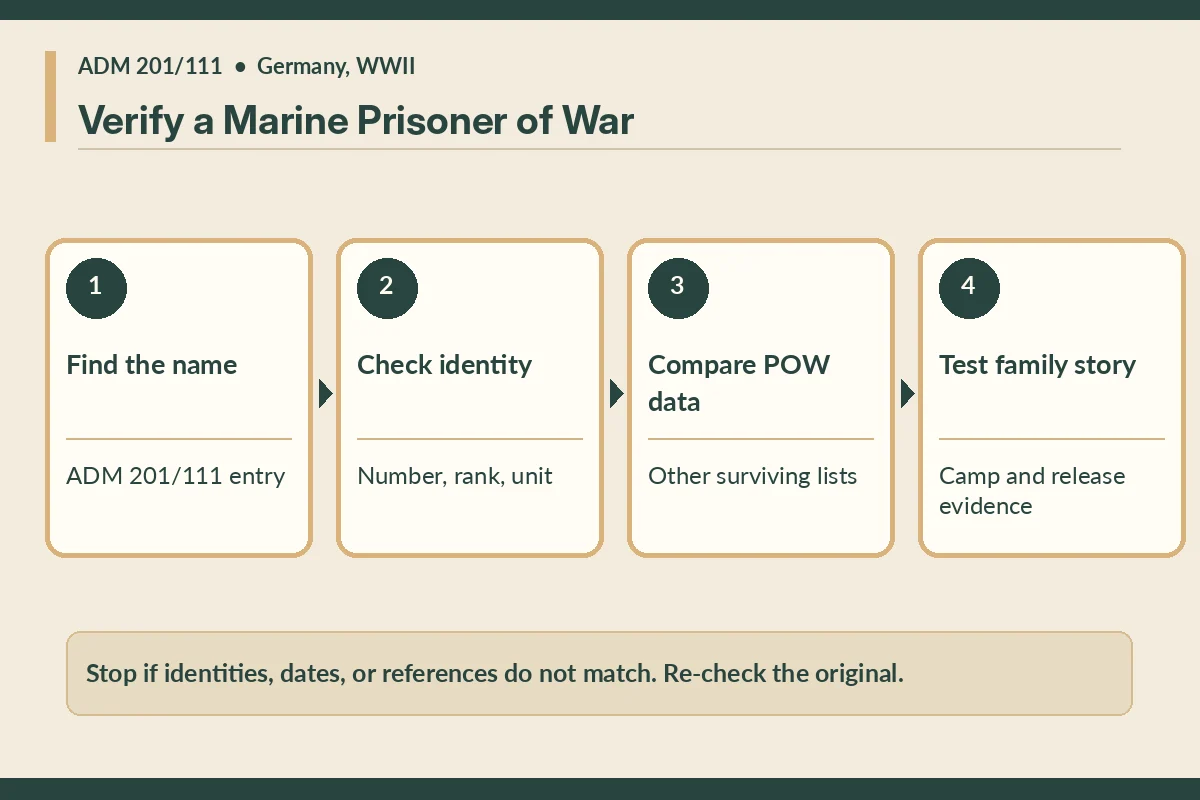
Our recommended sequence starts with the individual’s service identity, reads the nominal ADM 201/111 entry, searches additional POW records, and checks any family claim about camp, date or release against person-level evidence. We cite each reference and distinguish the date of capture from an administrative reporting date. We do not manufacture a complete captivity story from a line in a list.
The official research guides provide the series route, access cautions and alternatives when records are missing. Search availability and partner access arrangements may change. We preserve uncertainty rather than treating a failed search as disproving capture. For a disclosure of how resource links are handled, see the GenHis affiliate disclosure.
The National Archives identifies nominal lists of Royal Marines held as prisoners in Germany during the Second World War.
No. A nominal list does not provide the full history of capture, transfers, treatment or release.
The Royal Marines officer and other-rank guides both point readers to the ADM 201/111 lists.
No. Use service number, rank, unit, dates and independent personal evidence where available.
Check spelling, incomplete capture, other prisoner collections and the relevant service record; absence is not conclusive proof that captivity never occurred.