
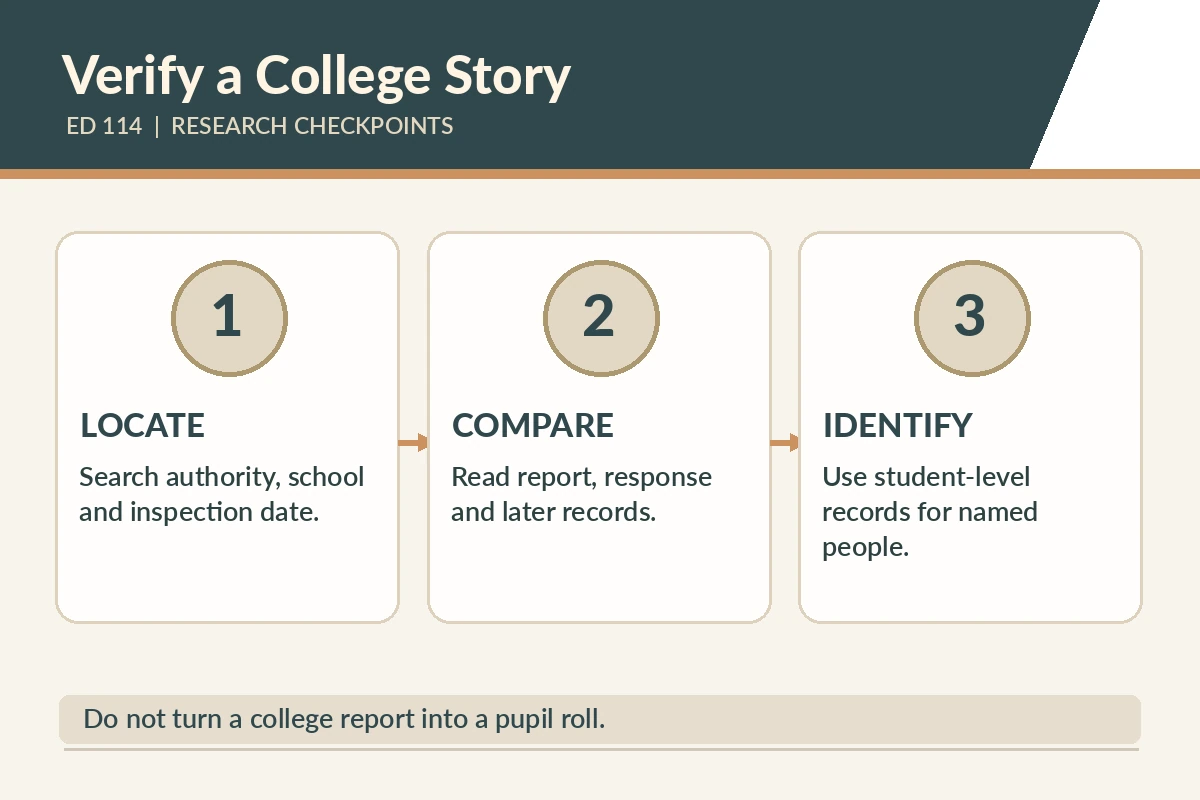
ED 114 contains reports by HM Inspectors on further-education establishments and is best used to research a college or local education system, not to assert that a particular student attended. The National Archives directs researchers to search this series by county or borough, and to consider related reports in ED 197. Begin with the establishment’s historical name, its county or borough, approximate inspection period and any known institutional changes. An inspection report may document teaching, facilities and administration, but a name missing from it says little about individual enrollment. For official series scope, consult The National Archives research guide.
Search by authority before a student name
The National Archives’ further education research guide identifies ED 114 as a route to HM Inspectors’ reports. Its inspection guide locates ED 114 and ED 197 within reports on further educational establishments, with searches organized by county or borough. This is a different discovery problem from looking up a pupil in a parish school register. Start with the governing locality and historical establishment name, noting town boundaries and possible mergers. A catalogue description may use an older county title or a predecessor college name.
Record the search terms and date intervals tested. If a modern institution began as an evening institute, a technical school or several merged departments, do not automatically carry its present-day name back into the early twentieth century. Check local directories, education committee minutes and institutional histories to reconstruct naming stages. A report on a local authority may discuss multiple centers; distinguish the authority-wide observation from one named classroom or building.

Place an inspection inside the institution’s history
Inspection practice changed as technical and further education expanded. The official technical education guide explains that junior technical schools, commercial schools and art schools were subsequently integrated into the revised secondary system after the Second World War. The record category under which a college was inspected may therefore shift. Check the date before selecting ED 114 or another educational series. Do not assume that a document classified as ‘further education’ describes exactly the same institution type in 1910 and in 1970.
Create a history table with the institution’s name, location, responsible authority, date of inspection and the precise kind of provision reviewed. The original inspection date is not always the date of a later report, reply or administrative decision. Separating those dates may show that recommendations were discussed for years before any documented change. A proposal to add a workshop or course cannot be converted into proof that it opened without subsequent budgets, returns or contemporary institutional records.
Read findings and recommendations separately
An HMI report might describe teaching standards, workshop equipment, staffing or the range of classes. Those are observations or judgments made within a particular inspection exercise. A recommendation is not an order that was fulfilled, and an inspector’s criticism does not imply that every teacher or pupil behaved in a particular way. Quote the scope of the inspected material, including whether it covers the whole college, one department or a sample of lessons.
Read responses from administrators alongside the report where the file contains them. A council may accept, contest or defer findings. Identify the author, date and institutional standpoint for each statement instead of blending all voices into a single official conclusion. For local history, distinguish a reported shortage from a documented closure; for family history, distinguish a statement about a training program from proof that a named ancestor joined it.

Locate the right personal record elsewhere
Enrollment registers, admissions lists, exam records and student files are created for different purposes from national inspection reports. Such evidence may be held by an institutional archive, a local authority or a successor college, and may be subject to privacy or access restrictions. An ED 114 entry about a college’s size may support a headcount but generally cannot identify the individuals behind it. When the research question concerns a person, ask the institution or local archive what student-level material survives.
A course list, prospectus or published prize roll might establish that a subject was offered or that a named student achieved a documented result. Each carries its own limitations. A person living near a college may never have enrolled; a trade recorded in a census does not prove formal technical training there. Verify the person’s age, address and dates before connecting an institutional report to a biography. Keep unlocated admissions material marked as unsearched rather than announcing absence.
Check related inspectorate series by purpose
ED 197 is another further-education inspection route in the official guide. ED 109 is associated with full secondary-school reports, while ED 162 can contain inspection digests and ED 70 concerns practical instruction centers. These are alternatives conditional on institution type and period, not an automatic sequence through which one student progresses. Use the official table to select a series, then test its description for the right year and administrative responsibility.
Some records are not digitized; the National Archives guide notes that many technical and further-education series must be seen at Kew or ordered as copies. The catalogue’s ‘Held by’ field matters when regional archives are included in search results. A digital catalog entry is not the complete inspection. If only a summary has been consulted, do not claim to have verified quoted comments from the underlying report.
Write a bounded local or family-history claim
A defensible sentence might say that a specific inspection report described the workshops at a named college during a particular year. It would not say that an ancestor was trained in those workshops without corroboration. For building history, an inspected plan or criticism of premises is not by itself a certificate that an extension was completed. Trace local authority committee minutes, photographs, building permits and subsequent inspections before asserting when a change occurred.
Preserve a complete citation including ED 114 document reference, report date, institution name and page where visible. Note whether you viewed the report or only a catalogue description. Record all name variants and local-authority boundaries tested. Make separate rows for institution-level findings and personal evidence. This approach remains useful even when individual student records do not survive, because it provides a truthful picture of the educational environment without inventing attendance.
More Records and Archives Guides
How We Research ED 114 Records
We first cross-check the National Archives guides to education inspectorate reports and further-education institutions, distinguishing ED 114 from ED 197 and school-specific alternatives. We treat reports as snapshots of institutional conditions and seek separate enrollment evidence for an individual. We record changes of name, local authority and institution type, plus the exact access method and document inspected. Our affiliate disclosure explains any external links.
HM Inspectors reports relating to further education institutions, rather than comprehensive student registers.
Start with its historical town, county or borough and then test earlier college names and dates.
No. You need separate person-specific enrollment, examination or institution records.
ED 197 is another further-education route; ED 109 and other series serve different institution types.
No. Consult the catalogue and official access guidance for Kew visits or copy orders.