
WO 33 contains War Office reports and memoranda, a useful route into the context of British Army operations, but it is not a name-searchable roll of every soldier present. Begin with an action, theater, approximate date and unit if known. Identify the purpose and date of a report, then compare it with contemporary unit material before making a claim about one person. A well-described operation may still provide no evidence that a particular relative participated.
The National Archives describes WO 33 as reports and memoranda covering 1853–1969. Its guides to the First and Second World Wars direct readers to the series for operational reports and studies, while distinguishing war diaries and personnel records. A post-action narrative can use information gathered after the event; its preparation date and the date of the fighting are not interchangeable.
Start with the military question, not an assumed ancestor
Write the research question as a dated action or movement: which unit took part near a named place, what was reported, and how was the action interpreted? A family story may provide a useful starting place, but it is not a catalogue reference. List all spellings of the place, a plausible date window, and the military formation rather than assuming a regiment from a surname.
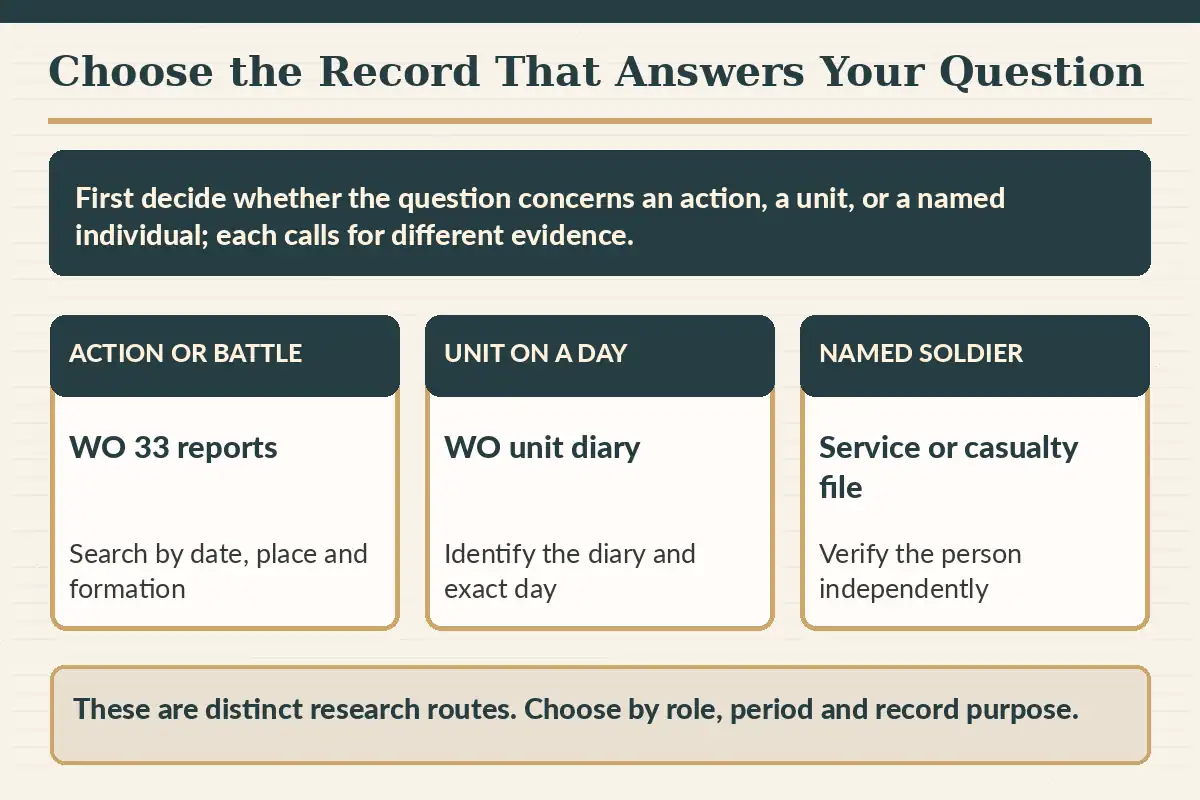
WO 33 reports describe operational questions, so searches by theater, operation, formation and year generally make more sense than searches for an ordinary soldier. If a catalogue description contains a person’s name, determine whether that person is the author, a commander, someone mentioned, or the actual subject. These roles cannot be exchanged without reading the original.
Read a report as a created document with a purpose
Record the report title, responsible office, date of compilation, time period discussed, intended audience and any appendices or map references. A document written after the campaign can contain analyzed figures or lessons learned rather than a diary-like minute-by-minute account. Quote or summarize the precise passage that supports the claim; avoid extending a general statement to an individual patrol.
Separate what the report directly says from what a researcher concludes. For example, a report may record that a brigade advanced on a particular date; that does not establish the precise movements of every subordinate unit. Some reports draw on earlier papers, so repeated figures in two later summaries might come from the same source rather than providing independent confirmation.
Move from the formation to a contemporary war diary
After finding a relevant WO 33 passage, identify the lowest confidently known formation and the dates of the incident. The Second World War guide routes unit war diaries by theater to series such as WO 166 for Home Forces and other geographic series; the First World War has its own diary arrangements. Do not invent a single universal diary reference for all units.
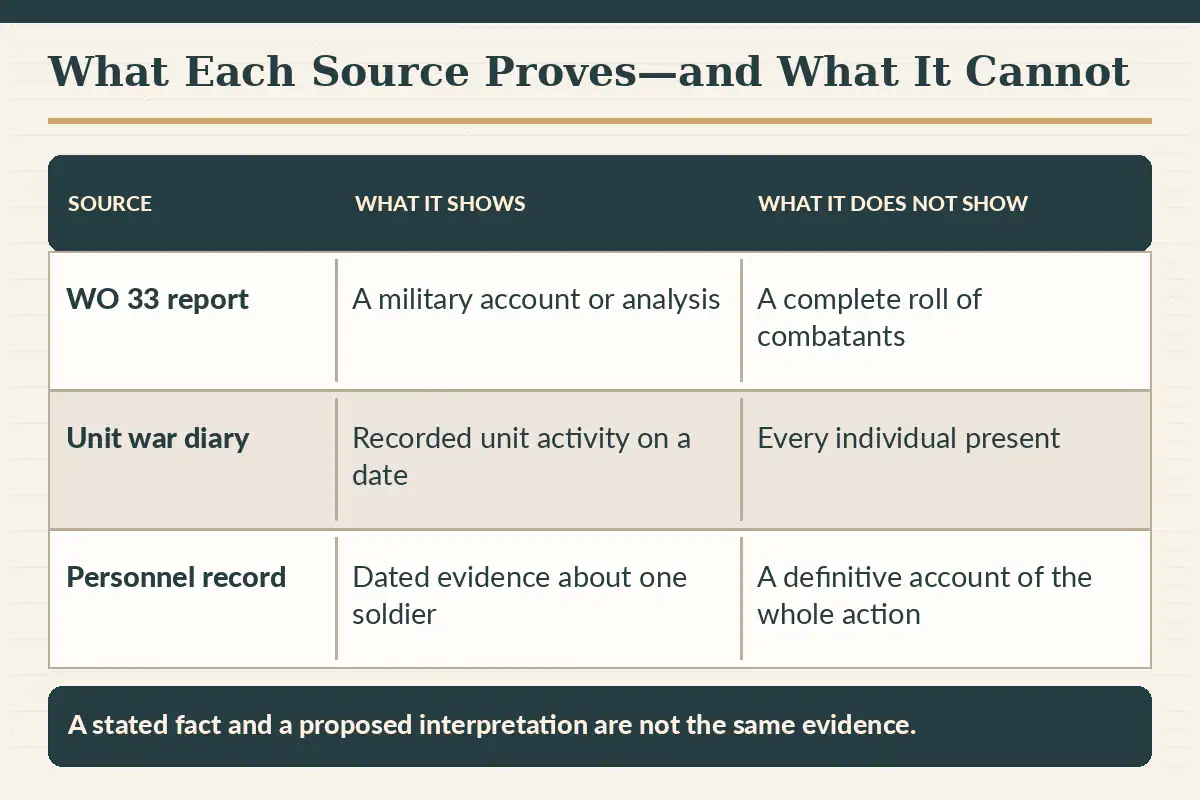
Compare the report with the appropriate dated diary entry, its appendices and any surviving maps. The diary may establish a unit’s activity on a day, but it seldom records a full nominal roll. A map grid reference is especially vulnerable to being misread if its map edition, scale or grid is unknown. Preserve unresolved differences between reports instead of smoothing them into a fictional battle narrative.
Build an independent identity gate for the soldier
A soldier’s service documents, casualty lists, medal evidence or other named sources address identity. Record regiment, service number, rank, dates and any change of unit before linking that person to an action. A shared surname and a general unit history are not enough. Where a person transferred, look for dated orders or records that establish which unit applied on the relevant day.
Treat a soldier’s entitlement to a campaign medal or an entry on an establishment list as different from proof of participation in a specific engagement. A later account of the regiment may describe a battle that occurred during the person’s broad service period without showing their individual presence. State the narrower conclusion when the evidence stops at the unit level.
Explain missing material and conflicting narratives
An unsuccessful catalogue search may reflect broad descriptions, different terminology, surviving only higher-level reports or material held with another War Office branch. Note exact keywords and date ranges checked. A missing report is not evidence that an operation never happened. If the report is only available for consultation at Kew or through a copy request, record that access status honestly.
When a summary contradicts a dated contemporary entry, compare their creation dates, vantage points and scope. A commander’s report may cover an entire formation; a local diary may describe only its own sector. Neither should silently override the other. Identify the unresolved assertion and the next document that might resolve it.
Prepare a source-led action timeline
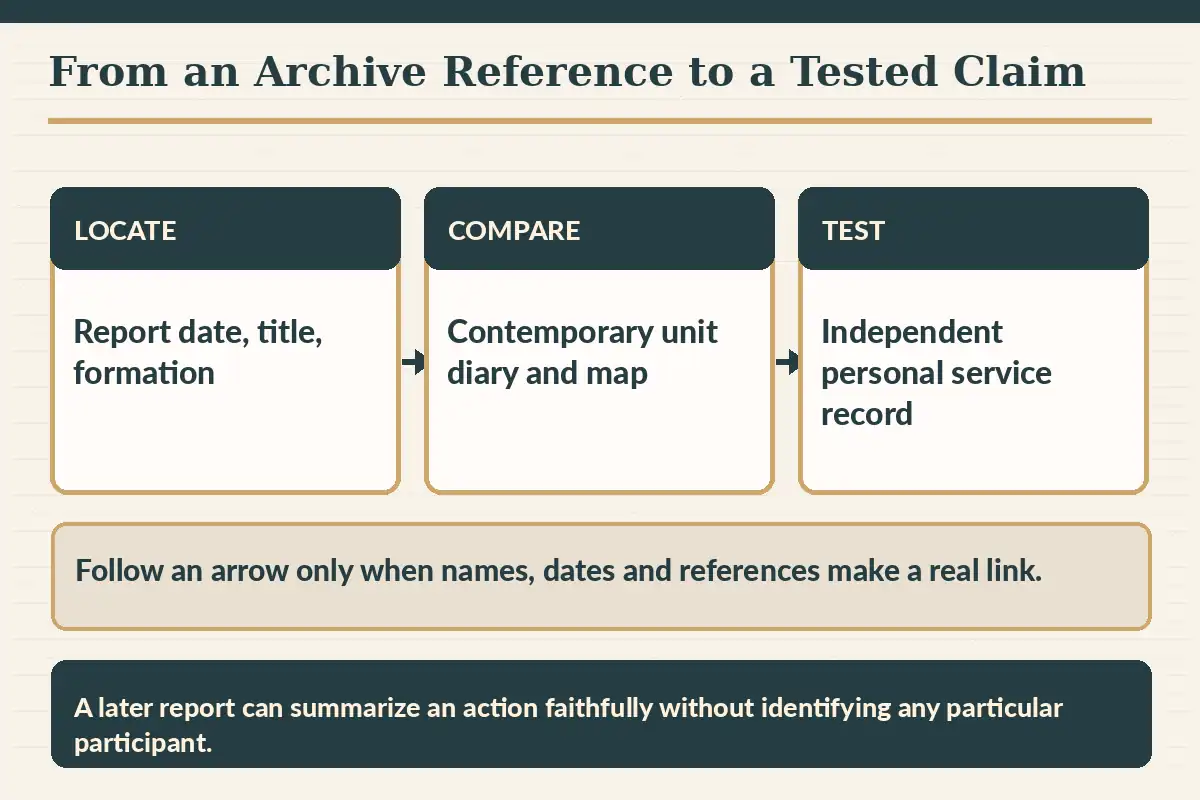
Build rows for reported event date, report compilation date, archive reference, formation, location, source passage and corroborating diary. Add a separate column for personal-service evidence rather than attaching a relative’s name to the report title. Keep uncertainty visible with terms such as “unit reported near” or “later account states” when warranted.
The final finding should specify the claim and its level: WO 33 describes an action; a dated diary supports a unit location; an independent named source may link a soldier. An accurately bounded conclusion is much more useful to family historians than an apparently complete story assembled from documents that were created for different purposes.
Make the evidence traceable and reproducible
For the next search, open a source ledger with separate columns for the exact reference, creator, document type, original date, event date, names and roles, location, original wording, inference and the record still needed. First decide whether the question concerns an action, a unit, or a named individual; each calls for different evidence. Save searches that fail with the terms and actual series coverage; a failed name search in an administrative series is not negative evidence about a person. Only cite an image as inspected when you saw it rather than a catalogue abstract.
When independent sources disagree, preserve the different dates and wording and identify their creators. A later report can summarize an action faithfully without identifying any particular participant. Two websites presenting the same archival description are not two independent records. A useful final conclusion names the exact documented fact, the inference left unresolved and a practicable next archive or local collection to consult. Avoid converting administrative context into an imagined family biography.
More Records and Archives Guides
How We Research and Verify These Archives
We checked archival source guidance on 2026-11-03. The official Second World War operations guide explicitly sends researchers to WO 33 for reports on actions and force-location context, and separates unit war diaries from those reports. The source supports a record-search route, not the presence of an invented ancestor in an unexamined file.
We checked archival source guidance on 2026-11-03. The First World War operations guide lists WO 33 among broad operational series but distinguishes them from unit diaries and individual personnel files. The source supports a record-search route, not the presence of an invented ancestor in an unexamined file.
We checked archival source guidance on 2026-11-03. The Army nurses guide identifies WO 33 as War Office reports and memoranda, 1853–1969, and distinguishes policy records from nursing service files. The source supports a record-search route, not the presence of an invented ancestor in an unexamined file.
The accompanying illustrations are newly drawn explanatory artwork, not images of particular surviving archival originals. No paid partner or purchase is suggested. Read the affiliate disclosure.
Try a name only if the record description gives reason to, but WO 33 is organized chiefly around reports, subjects and operations.
Usually not as a complete roll. Use independent individual service or casualty material.
A report may analyze an operation afterward; a unit diary records its activities as part of contemporary administration.
Note both the event date and the date the report was created; they answer different questions.
No. Catalogue coverage, survival and record choice must be evaluated before drawing a negative inference.