
The National Archives holds COAL 13, a group of 116 slides called From Pit to Fireplace, mainly showing former Barber Walker collieries around Moorgreen and Brinsley in Nottinghamshire. The guide dates the imagery broadly to 1907–1917 and connects it to an illustrated talk associated with the Rev. F. W. Cobb. This is a valuable place-and-industry source, but it is not an employee register. Start with a colliery and a verifiable caption before associating any miner with the scene.
Begin with a question you can test: a named person, a particular place, a precise date window or a document type. The official archive guide establishes the scope of this series; it does not substitute for an original item. Keep a research log with the exact reference, original wording, record creator, retrieval method, contradictory clues and unanswered questions. This protects a family narrative from a plausible but unsupported inference.
Establish the collection’s provenance before identifying the mine
The National Archives describes the COAL 13 slides as a named historical collection, largely depicting Moorgreen and Brinsley collieries of Barber Walker and Co. The images are associated with a talk about mining history, so the selection may reflect what the presenter wanted to explain rather than a complete year-by-year company record. Treat a collection title, a slide caption and a later catalogue description as distinct pieces of provenance.
Record the original slide reference, any caption, attributed photographer, image date if stated and the series-level date range. A photograph copied into a talk decades after it was taken can acquire a different order or label; document which source supplies each claim.
Use the two colliery locations as search anchors
Moorgreen and Brinsley are useful geographical starting points, but a slide with miners or equipment is not automatically from one of those locations. Search for the exact caption and known site features, then compare with dated colliery plans, maps or local historical records. A pithead winding structure, rail siding or chimney might provide an identification clue, but similar industrial structures occur across many mines.
Use at least two independent spatial markers before committing to a location. Keep a separate ‘unlocated industrial scene’ category if the evidence remains weak. For a family historian, an uncertain place label is better than a confident but wrong mine.
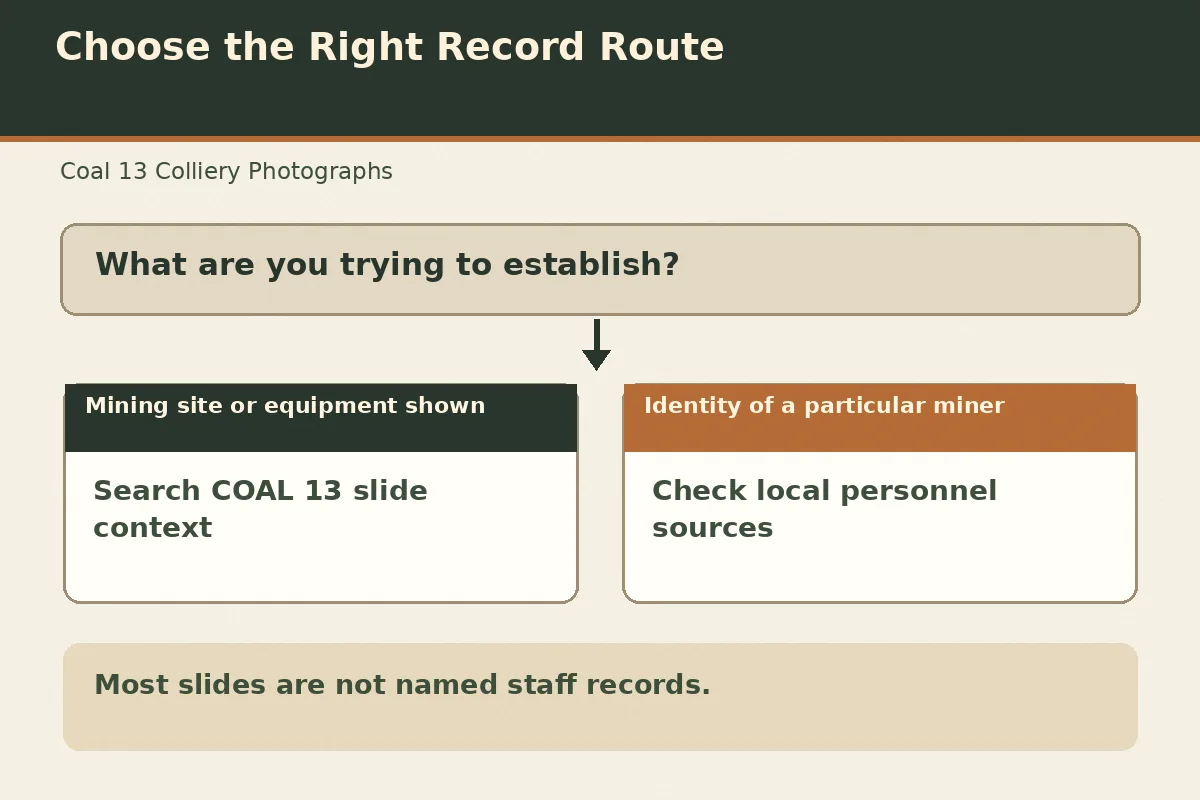
Read machinery and work activity as visual context
A photograph can illustrate mining equipment, transport arrangements, a pithead or a workplace process at the moment the image was captured. It may not prove which shift used the machinery, how long the equipment remained in service or whether a particular safety practice was routine. The talk-based collection may show posed or specially selected scenes rather than typical conditions across the entire mining industry.
Separate what you can see—rails, cages, winding gear, workers, buildings—from explanatory labels or later industrial interpretation. Avoid adding an exact technical identification unless the caption, a reliable mining history or a technical drawing supports it.
Do not use the group photograph as a staff list
The National Archives mining guide explicitly says it does not hold general personnel records for miners; surviving records naming individual employees are more likely in local record offices. A group image without identifications does not become a genealogical roster simply because an ancestor worked at the colliery. Distinguish an unnamed figure, a name written in a caption and a person securely identified by independent evidence.
A strong identification might compare a labeled contemporaneous photo, an employment record and family-held provenance. Facial resemblance alone is weak evidence, especially where protective clothing or image quality obscures features. Do not publish an individual’s name as fact when the image source does not establish it.

| Source | What it can establish | What it does not establish |
|---|---|---|
| COAL 13 slide | A photographed place or equipment | Named worker’s service |
| Caption or talk notes | Historic attributed subject | Every person’s identity |
| Local employment source | A named miner if retained | All staff pictured in a slide |
Cross-check the company and site timeline
Barber Walker’s colliery history can be approached through local maps, trade directories, surviving company papers and government records where relevant. The COAL 13 slide collection does not by itself date a building’s construction or closure. Images of similar winding towers taken years apart may show modification, but only when the camera viewpoints and original dates are sufficiently secure.
Make a site chronology with separate columns for visual observation, dated documentary evidence and remaining uncertainty. A story told by a descendant can prompt a search, but it cannot silently supply missing dates to a photographed structure.
Find local repositories for the named miner
For an ancestor believed to have worked at Moorgreen or Brinsley, seek a contemporaneous address, occupation entry, union document, company payroll if it survives, or local press report. The mining guide directs researchers toward local record offices for individual employees and company collections. The relevant repository depends on where a particular set of papers was deposited, not only on the mine’s corporate name.
Use a name-and-employer evidence table. A person listed as ‘miner’ in a census may have worked at a different pit, and a neighboring residence is not enough to prove his colliery. Label each new claim by what its source actually shows.

Explain the limits of surviving images
The National Archives notes that most historic photographs are not immediately viewable online and that many images are identified only within collections. A catalogue hit for COAL 13 does not guarantee a high-resolution online scan of every slide. Conversely, a missing picture of a family member cannot be interpreted as evidence that the individual did not work in mining.
Finish with a finding that can be repeated: identified colliery and slide if supported, observed subject, date attribution, and any independently documented miner connection. Preserve uncertainty about unattributed people rather than converting a compelling image into a family portrait.
Worked Example: Separate a Lead From Evidence
Imagine a fictional descendant finds an unlabeled image of a winding engine and believes a grandfather worked beside it in 1912. The first task is to verify the COAL 13 reference and place using a caption and local plan. The next is to find a dated source explicitly naming the grandfather in the relevant employment context. A 1911 census saying ‘coal miner’ would establish occupation, but not the particular machine or even the particular colliery. The example is hypothetical, not an archival identification.
In a real case, retain the exact original reference and write a one-sentence proof statement with its limitation. If a crucial document has not been inspected, say which missing item would change the conclusion. Never give an invented person, address, date or image caption the authority of a historical source.
More House and Local History Guides
How We Research This Record Series
This guide compares the primary official research description with a second National Archives guide. We checked the series scope, arrangement, historical limits and the difference between a catalogue description and a document examined directly. The illustrations are original explanatory artwork, not purported scans of documents. We also compared the topic and intended research result with the available GenHis article catalog.
For a reproducible finding, keep the institution and full piece reference, the creator and date of the document, your image or reading-room access method, important quotations, and any negative or contradictory evidence. A site or series name is not an original record citation. A colliery image does not independently identify any depicted worker. The affiliate disclosure explains our site policy; no partnership or paid search service is assumed here.
A National Archives collection of 116 historical slides titled From Pit to Fireplace.
The archive guide identifies Moorgreen and Brinsley collieries near Eastwood, Nottinghamshire.
No. Use a separate source naming the person and preferably the employer or colliery.
No. This is a slide collection, and the archive advises seeking employment records locally.
Keep the broad date attribution and seek independent dating evidence rather than inventing a year.