
Start With the Archival Series and a Specific Question
The National Archives identifies 40 lantern slides in National Park Service RG 79 EA showing construction and engineering projects at national parks and historic sites from 1928 to 1939. For a family tracing a park worker or a community studying the history of a trail, road, bridge, or building, these slides provide useful visual context. They are not interchangeable with architectural approval, final acceptance, payroll, or the date an improvement opened to visitors.
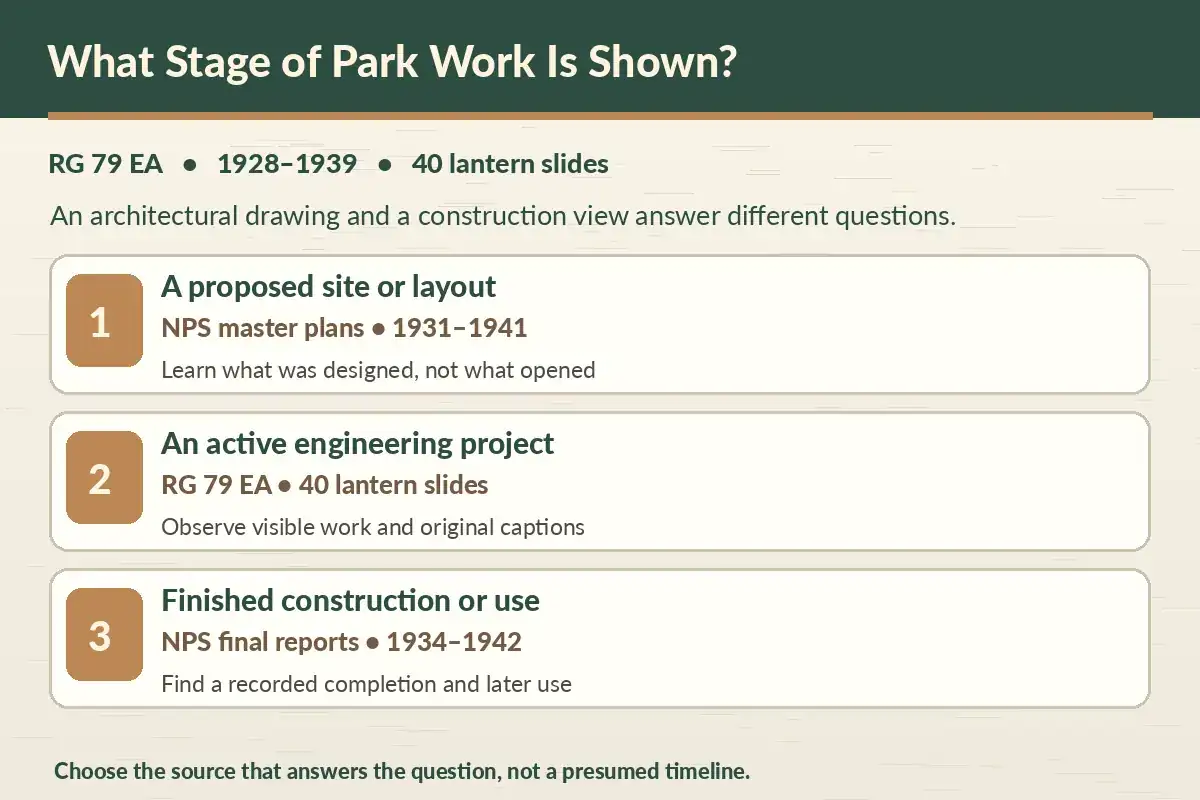
The most reliable approach separates three stages: what was proposed, what was actually pictured under construction, and what the park later reported as completed. The same NARA record-group guide describes 1931–1941 master plans and 1934–1942 final construction reports. Those related records make it possible to test a specific built-environment claim rather than assuming the existence of a feature from a beautifully prepared presentation slide.
Find an EA Slide and Preserve Its Project Label
RG 79 EA is described as a small lantern-slide series of 40 images, not as a comprehensive photographic inventory of every park project. Start with the park or historic-site name, then search the EA designation and any project title, slide number, or label. A glass slide might reproduce an older photograph, plan, or drawing; the date range attached to the collection does not itself prove when the depicted construction occurred. Note the medium before interpreting its evidentiary date.
Copy the original mount or caption language, any item identifier, and whether a reproduction is cropped. A road or bridge can be misidentified when the slide is separated from the project folder that once accompanied it. Historic park-unit names and administrative boundaries may differ from current ones. Record the name printed in the original source and then establish the present-day equivalent with independent, dated evidence rather than rewriting the historical caption as if it used modern geography.
Read the Plans as Intent, Not As-Built Evidence
The same NARA guide identifies 6,500 NPS master-plan maps dating from 1931 to 1941. A plan can show alignments, building locations, vegetation treatments, projected roads, and a design vocabulary. It does not by itself establish that a contractor built every feature or that a design remained unchanged. When comparing an EA slide to a master plan, match the park, feature label, scale, date, and drawing revision before deciding that the two describe the same phase.
Look for explicit plan annotations such as existing, proposed, revised, or removed. A line on a sheet may mark an alternative route rather than a completed road. Historic engineering plans can be copied or reused after approval, so creation, revision, and approval dates should remain separate. If a structure appears in a design but not in a later photograph, treat the discrepancy as a question to investigate, not proof of an error in either source.
Link Visible Construction to Dated Work Reports
The NPS group guide lists final construction reports from 1934 to 1942 as related administrative records. These can help distinguish an active worksite from a completed and accepted project. Start by transcribing visible work: stonework, excavations, wooden falsework, grading, or installed railings. Then compare the scene with the report’s specified project, location, time span, and reported result. Avoid applying the final report date automatically to the earlier photographed phase.
An image may display a temporary scaffold or an unfinished retaining wall that was later redesigned. Conversely, a completed bridge in the background does not prove that the foreground project was finished. Use a three-column chronology: design reference, observed work in the slide, and completion statement. When the reports are not directly accessible, state that completion is unverified rather than relying on the slide’s presence in an official agency collection.

Locate the Site With Stable Landscape Features
National parks contain repeated types of roads, stone structures, trail junctions, and forested slopes. Match the scene through topography, watercourses, nearby rock forms, road curves, and identifiable structures rather than generic materials alone. Compare contemporary topographic maps and dated aerial views where available. Vegetation, road widths, and drainage channels may have changed, so a modern photograph is a later comparison rather than a transparent window into the construction year.
For house and local history, an exact location matters more than a broad park name. Record historic mileposts or section designators only when an archival plan establishes them. Do not invent latitude and longitude from the apparent position of a mountain in a sketch. If an image depicts a typical engineering demonstration rather than a particular site, identify it as illustrative until a caption or project file supplies a defensible place.
Keep Labor History Separate From a Worksite View
A uniform, a tool, or a vehicle can suggest the kind of work being performed; it rarely proves the name of the person holding it. Federal park projects in the 1930s involved varying combinations of NPS staff, contractors, and other labor programs. Do not assign workers to a particular corps or company just because a photograph falls within the Depression-era period. Search project payrolls, contractor reports, camp files, or independently named correspondence before identifying an ancestor.
Even a named engineer on a project report may have supervised work without standing in a particular photograph. Conversely, a worker in the frame may not appear in the surviving administrative file. Keep role, employment dates, and physical presence as separate facts. When you find two individuals with the same surname, compare addresses, dates, units, and occupational histories instead of choosing the person whose life story best fits the scene.
Assemble a Reproducible Park-Project Citation
For each slide, record National Archives, RG 79, EA, the exact local number, caption, medium, and verified image date if available. Cite any NPS master plan and final report independently by its own series and folder. This makes the reasoning visible: one source establishes intended design, another shows physical work, and a third may establish completion. Do not make a master plan stand in as a construction certificate because all three records share the same record group.
Present the conclusion in graded terms. For example, an EA image may document a stone bridge under construction at a named park while the completion date remains contingent on locating a final report. If the evidence identifies only a general feature, say so. A small series of 40 lantern slides is a curated survival sample. Its omissions reveal little about the total volume of park projects or the identity of all people who built them.

More House and Local History Guides
How We Research This Collection and Its Limits
The series-specific count, dates, and record designation were checked against the National Archives federal records guide on November 16, 2026. Independent context was compared with a second official research source, while NARA still-picture citation guidance establishes the information needed to locate an exact image. The site topic list and earlier production titles were compared for duplication. A series description does not identify every subject, date, or object in every frame, and access to a fully digitized item cannot be assumed. The figures in this guide are newly drawn explanatory editorial illustrations, not historical negatives or genuine reproductions. We make no unverified claims of commercial endorsements. See the affiliate disclosure for site policy.
NARA describes 40 lantern slides of park construction and engineering projects.
The EA series is listed for 1928–1939; individual slide dates require item evidence.
No. Compare a dated project report or later physical evidence.
Only with a reliable caption or independently corroborated personnel or contractor record.
The EA item, its relevant dated master plan, and the independent completion document.