
Use NARA microfilm M279 to research an 1820 manufacturing establishment, not to reconstruct a named employee roster. Start with the state and township, distinguish original schedules from official tabulations, then compare the population census without assuming a matching person. Consult NARA’s 1820 census guidance and our affiliate disclosure.
Separate the Factory Survey From the Household Count
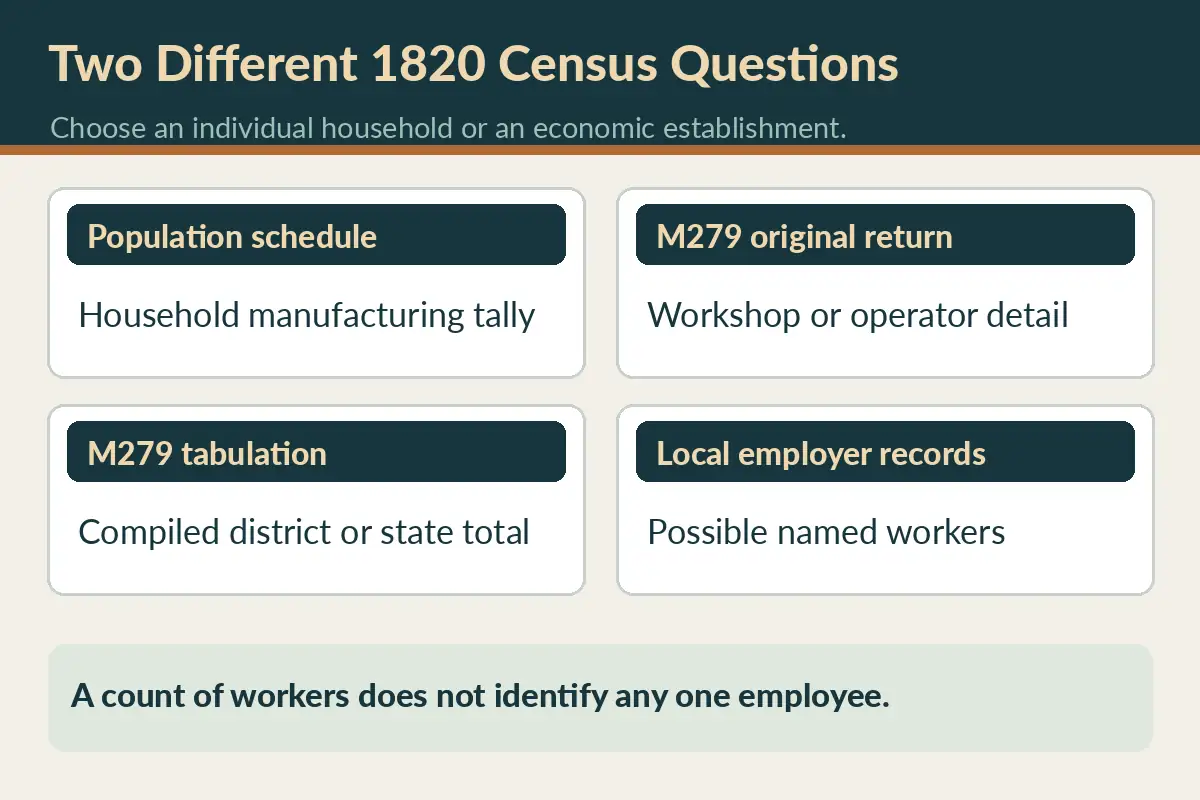
The 1820 population census reports how many people in a household were engaged in manufacturing, among other categories. It normally does not identify those workers by name. M279 is a different record set: the special 1820 census of manufactures, recorded for establishments and certain craftspeople. The National Archives’ early census guide explicitly warns that the two enumerations do not form a one-to-one list. Do not read a reported household manufacturing count as a named employee roster.
Begin with a carefully scoped question. Are you trying to identify who operated a tannery, what a workshop produced, how many workers were reported or whether a particular ancestor was employed there? The survey can sometimes address an operator or establishment; it normally cannot name all employees. A family story that an ancestor worked at a mill must be checked against payrolls, apprenticeships, ledgers, tax records and residence documents. A business listed near a household is not proof that household supplied its labor.
Use State and Locality Before Personal Names
M279 contains 27 microfilm rolls. Its content includes 1820 schedules, material aggregated by officials, and related papers. Begin with the state and locality, then locate the right roll rather than assuming an internet search covers every establishment. Some state materials may be represented by compiled tables where individual forms do not survive. The official nonpopulation inventory distinguishes census record types and identifies microfilm by state.
When a family’s residence falls near a state or county boundary, search both actual 1820 jurisdictions before declaring the establishment absent. Town names can be reused, and a proprietor’s business locality may differ from their residence. Record the roll, page or sheet sequence, printed heading and exact spelling used by the marshal. If a modern index is incomplete, browse the images or request a catalogue-level reference. A negative surname search is not a verified absence from all the source material.
Transcribe Business Inputs and Outputs Precisely
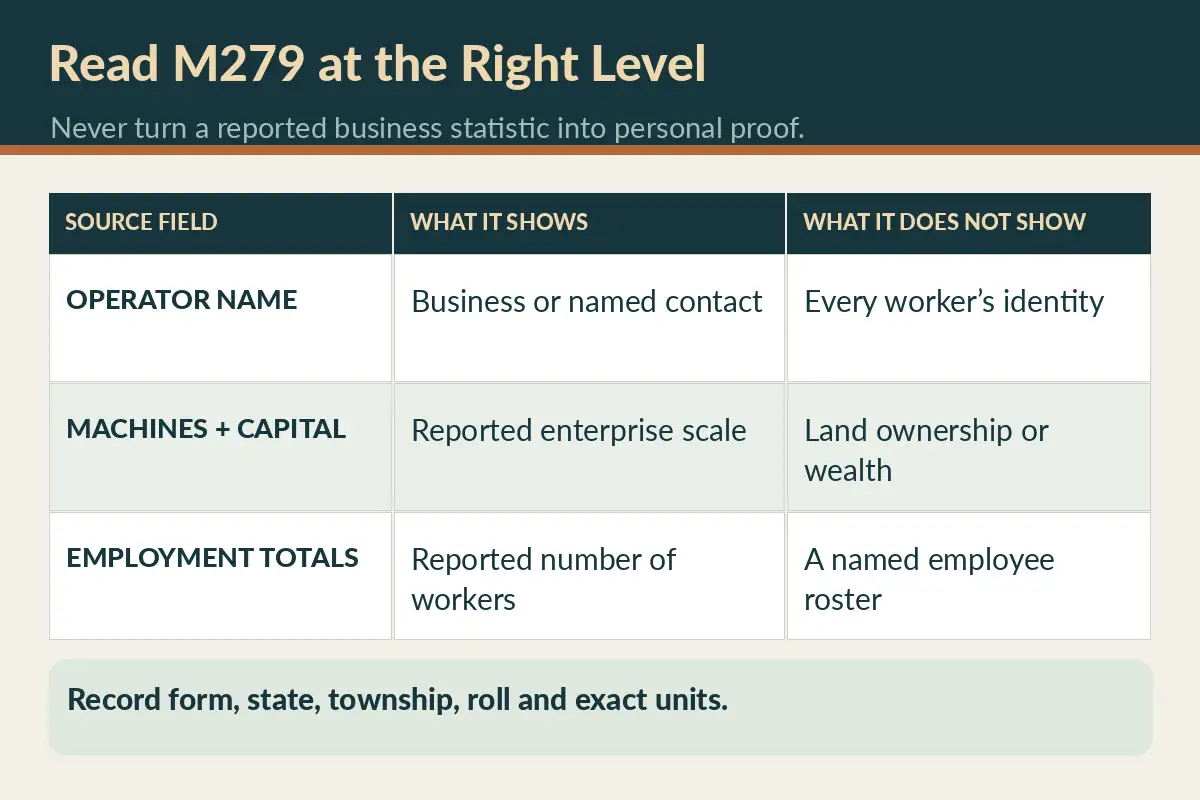
The surviving manufacturing returns can describe the kind of enterprise, materials used, types of machinery, capital invested, employment totals, wages and annual production. Those measurements depict a reported business at a particular moment, not its entire commercial history. Check the actual question wording because marshals gathered information under instructions that could be applied inconsistently. Avoid turning a rough reported value into a tax assessment or converting a count of men and women into specific identifiable people.
Make a worksheet with three levels: exact wording, normalized unit or interpretation, and a warning about what the field cannot establish. A number for workers means a count, not a list of their full names; a reported proprietor might manage premises without holding the land title. A machine count cannot establish technical skill of one ancestor. Copy original currencies, units and unusual spelling before comparisons, then record any conversions separately. This preserves historical meaning and makes a second researcher able to reproduce your result.
Cross-Check the 1820 Household Without Forcing a Match
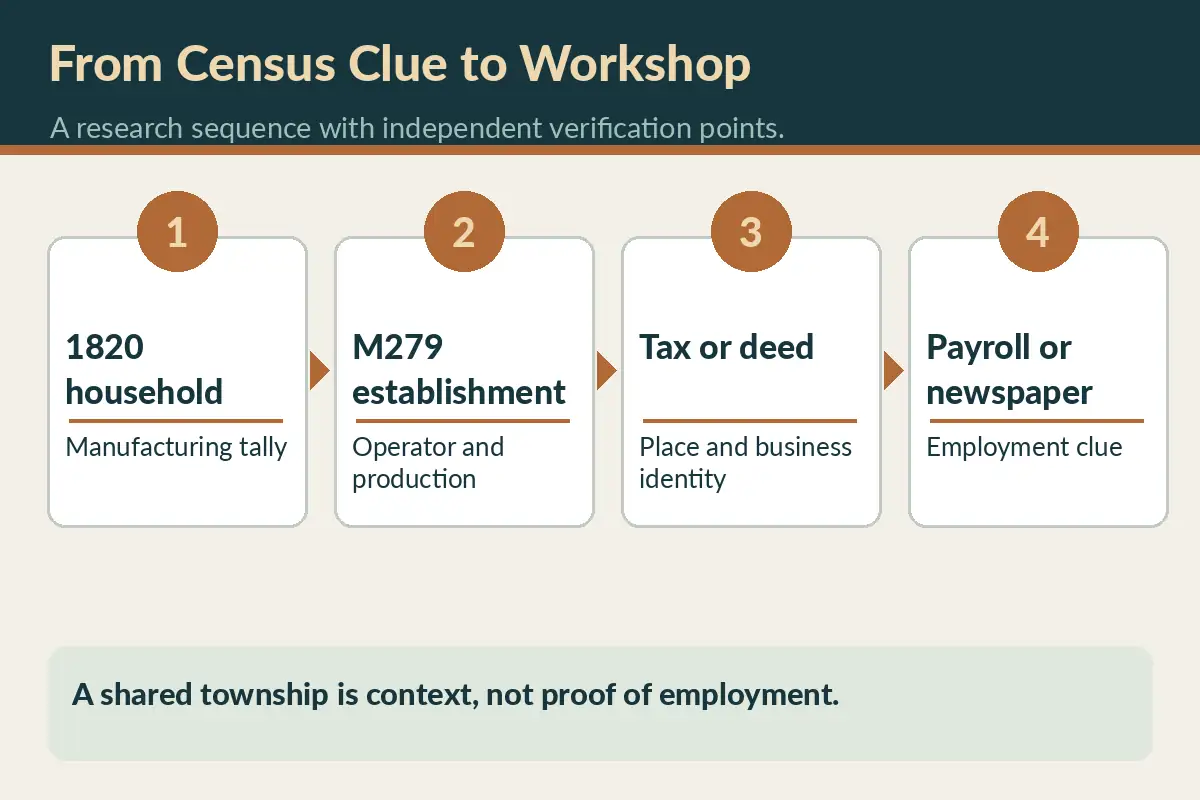
NARA documents real cases where a workshop appears in M279 without a directly corresponding manufacturer designation in the population count, and vice versa. Imagine a fictional blacksmith named Samuel Reed on a workshop schedule while a Samuel Reed household appears nearby. A shared name and township are starting clues, but the proprietor might be a different man, a partner or a person living beyond the township. Check taxes, deeds, advertisements and known associates before linking the files.
For every candidate, capture district or township, employer or firm name as recorded, product, nearby people, and the 1820 household age categories. Then compare independent evidence for occupation and address. A household’s manufacturing tally may refer to residents whose names were not separately recorded; the workshop name could be a partnership. Do not back-fill unnamed workers from adjacent household lines. If the establishment schedule has no personal identifiers beyond a business name, describe the linkage as tentative.
Explain Coverage Gaps Rather Than Generalizing
This special enumeration was an ambitious early economic survey, not a complete directory of every artisan. Some surviving M279 records are original schedules, others are aggregated statements or related material. Coverage varies by place and later survival. The mere fact that a family was recorded as working in manufacturing in the population census does not guarantee a special establishment form exists. State the observed gaps and distinguish a never-recorded business from a record not yet located.
Search failures should be recorded by repository and exact scope. “No indexed Samuel Reed in this database” is not “no Reed manufacturing establishment in 1820.” Try partnerships, local trade labels, adjoining townships and period newspapers, then compare state and county tax lists. When a single return appears to record an implausibly large workforce, verify whether it concerns a whole establishment or an aggregated district report. The record form itself governs the inference you can make.
Write a Useful Establishment-Level Citation
An audit-ready citation identifies the United States 1820 census of manufactures, the state and locality, the named business or operator, the roll or publication M279 reference, sheet or page, the repository or digital image source and access date. Preserve the image order and section headings because a page isolated from a preceding roll title can be misattributed. If the source is a printed summary rather than a manuscript form, label it as such.
The strongest end product is a cautious statement such as “a manufacturing establishment reported these materials, machines and worker totals in this town in 1820.” It is not “the named ancestor worked there” unless separate employment evidence supports that claim. Keep your unresolved identity matches visible. If you later discover a partner, lease or payroll, update the hypothesis while retaining the original transcription and the evidence that previously made the conclusion uncertain.
How We Research Early Manufacturing
Our first decision is whether the question concerns a household occupation tally, a manufacturing establishment or a particular worker. We use NARA’s state-and-roll identification for M279 and inspect whether the chosen item is an original schedule, official tabulation or related paper. We record counts literally and cross-check operators through independent local records. We never invent names for the unnamed workforce, even where the occupation figures appear to align.
More Records and Archives Guides
Official References and Record Access
Our source checks use the custodian’s published descriptions, not guessed coverage. Primary repository guide supports the scope and identification method stated here. Additional official context supports the scope and identification method stated here. Independent form or finding aid supports the scope and identification method stated here.
No. It is a separate manufacturing enumeration reproduced on 27 microfilm rolls.
No. It generally reports employment counts; payroll and employer records are needed for named workers.
No. NARA gives examples of mismatches between occupation tallies and establishment returns.
Identify that surviving item precisely and avoid attributing its totals to a nonexistent individual form.
State, locality, manuscript or tabulation type, M279 roll, page or image, and repository.