
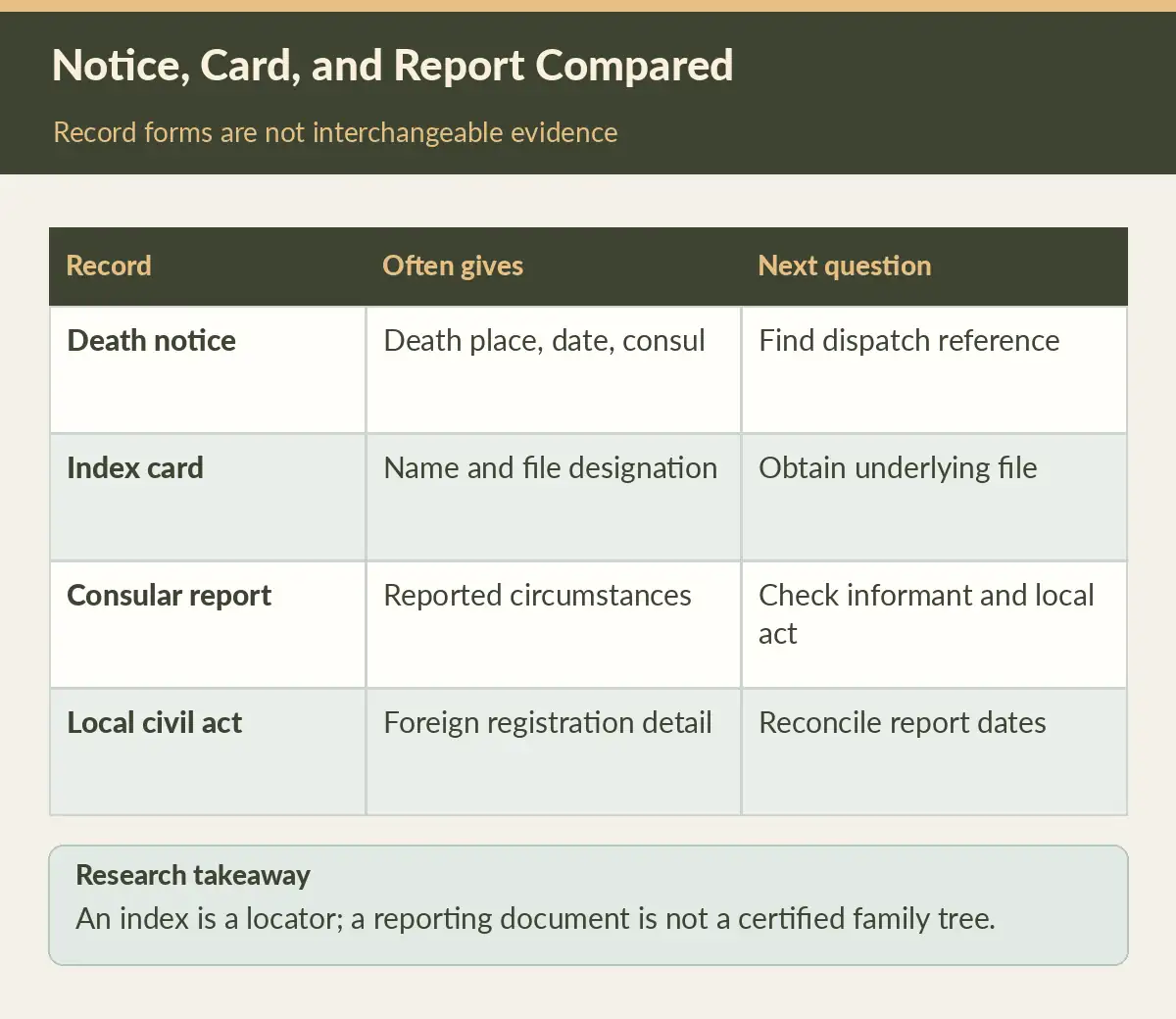
For an American who died overseas, start with the date and consular district, then select the correct State Department series. NARA holds consular death-report material through 1974, but its filing systems changed repeatedly. A newspaper notice, name card and complete consular report are different records; none automatically replaces an overseas civil death certificate.
Identify the Death Year Before Trying a Name
A precise year or a narrow interval is the most useful first filter because the federal paperwork was filed differently across eras. Start with a dated obituary, gravestone report, estate correspondence or family letter, and distinguish the date of death from the date the consul sent a dispatch. Determine the city or country where death occurred, not just where the person last lived in the United States.
Consular reports may be arranged under a consulate located elsewhere in the region. The National Archives’ State Department genealogy guide describes the periods and finding aids. Make a small chronology before searching a surname list.
Use Early Consular Dispatches Before 1906
For much of the nineteenth century, reports reached the State Department as dispatches from consulates and were filed by the consular city and then in date order. Registers for 1828–1906 can help locate the dispatch designation. The chronological government correspondence is not a searchable national death register.
When a notice gives a consulate and dispatch number, capture both: the destination country alone may be inadequate for retrieving the underlying report. An early dispatch can include practical information about effects, correspondence or circumstances, but the form and detail vary. Reproduce only what the original says and avoid assuming that every individual had a complete, identical consular report.

Distinguish the Two Newspaper Notice Series
One State Department compilation covers death notices sent to U.S. newspapers in 1835–1855; a later series covers 1857–1922 and includes 34 chronological volumes. The later notices commonly record a deceased person’s name, place and date of death, reporting consul and dispatch number. NARA lists these series as separately digitized original records in its partner digitization inventory.
A form sent for newspaper publication is not the whole consular investigation. Use the dispatch reference as a bridge to correspondence where it survives. Note that 1856 is not covered by either advertised notice date range; a missing notice does not establish no overseas death.
Handle the 1906–1910 Filing Transition
Between 1906 and 1910, death reports may be in the State Department Numerical and Minor Files instead of the earlier consular-despatch arrangement. NARA specifically warns that these death reports are not part of the digitized files highlighted for some later periods. Search the alphabetical card index and the contemporary notices if appropriate, then capture the file designation indicated by the card.
Do not say the paper does not exist merely because an online death-report database returns no hit. The index is a guide to a file, and the file itself can contain more than the summary description. An exact card reference is an archival next step, not a verified narrative of the death.
Use 1910–1963 Name Cards With Care
Death reports in the Central Decimal File for this period are assisted by a name-card index linked to a file designation. An apparent match needs the correct name, date and geographic context before the actual file can be assigned to a known person. NARA explains that name-card finding aids are not universal indexes to every person mentioned in all State Department papers.
If a candidate’s entry names a consular post unfamiliar from family lore, check whether that post covered the reported country and event. The central file is administrative correspondence, not an overseas parish or national civil-registration substitute. Use it to locate a government record, then compare its statements to independent local evidence.
For 1963–1974 Follow Year and Surname
For the later historical portion of the NARA holdings, the death reports were maintained separately by year and in broadly alphabetical order. You need both the approximate death year and a name to make an efficient request. From 1975 forward, the State Department rather than NARA holds the reports identified by the custodian’s historical guidance; do not cite those later records as if already in RG 59.
Changes in custody do not prove that a particular record is public or available online. Restrict the present historical workflow to deceased people and respect any privacy or access limitation indicated by a repository. A recent foreign death may require entirely different procedures.
Separate Citizenship, Reporting and Civil Registration
A consular report originated because the authorities received information regarding a presumed American death overseas. Some American deaths were never reported to the Department, and active-duty military deaths follow a distinct reporting route. Absence from the consular material therefore provides very weak negative evidence.
A report can contain a stated nationality, next-of-kin claim or cause of death as received by the consular officer. The foreign civil death certificate, local church register or medical registration may be the better source for a formally registered event. Never equate a foreign government record with a consular certification unless they are actually the same attached document.
Test a Person With the Same Name Abroad
Imagine an index offers two overseas deaths of a John Wallace, one reported by a Mediterranean consulate and another by a northern European post. Your candidate disappeared from a U.S. directory around the same decade. That directory gap is not enough to pick either record.
Compare age, occupation, residence, passport or travel dates, spouse and independent notices. Ask whether a relative or employer provided the consulate with identifying details. Keep a list of disagreements instead of discarding them after a convenient name match. The people in this example are invented for demonstration; it is the evidentiary method, not their details, that should be copied into a research log.

How We Research Consular Death Records
We decide which archival filing system applies to the actual death year, then collect the consular post, dispatch or file designation and original document date. We distinguish a public newspaper notice, an index card and a report image before quoting any statement.
We review the State Department’s institutional boundaries, including the 1906–10 transition and the transfer point after 1974. We compare names and circumstances with independent overseas and American sources, and record which ones remain unavailable. The affiliate disclosure applies to links on this site; commercial access is not described as evidence in itself.
More Records and Archives Guides
Cite the Report With Its Archival Path
A practical citation names the specific State Department record in RG 59, the record or notice series, original event and report dates, consular city, dispatch number or name-card file designation, and the image or folio consulted. An indexed listing without a manuscript image should be identified as an index, with its own URL and access date.
If you obtained only a newspaper notice, do not invent details that might appear in a longer report. Preserve the identity checks alongside the citation. When a local death certificate conflicts with a consular date, retain both and investigate whether one date refers to receipt or transcription rather than death itself.
The described NARA death report holdings run through 1974; later reports remain with the State Department.
No. It may provide a post and dispatch number that helps locate underlying correspondence.
No. NARA identifies a separate card-indexed filing system and warns that the reports are not among its highlighted digitized collections.
No. Not every event was reported, and indexes and access differ by period.
No. Compare a report’s statements with local civil or church registration when available.