
The National Archives RG 30 inventory lists 2,451 lantern slides in series R showing road construction, road repair techniques and equipment, and scenic views. Crucially, the series is marked “n.d.” — no dates supplied in the overview. A slide may illuminate how engineers represented a road, bridge, grading machine or repair method, but the inventory does not justify attaching a precise year or highway number to every image.
For road and community history, the correct starting point is not “What year was this machine used?” but “What does the original slide actually identify?” Separate subject, location, process and date. If an image resembles your ancestor’s road district, do not assert that the person built or repaired it without a named employment record. The R designation is an archival photo-series code, not a highway route number.
Keep the Undated R Slides Separate From HOH
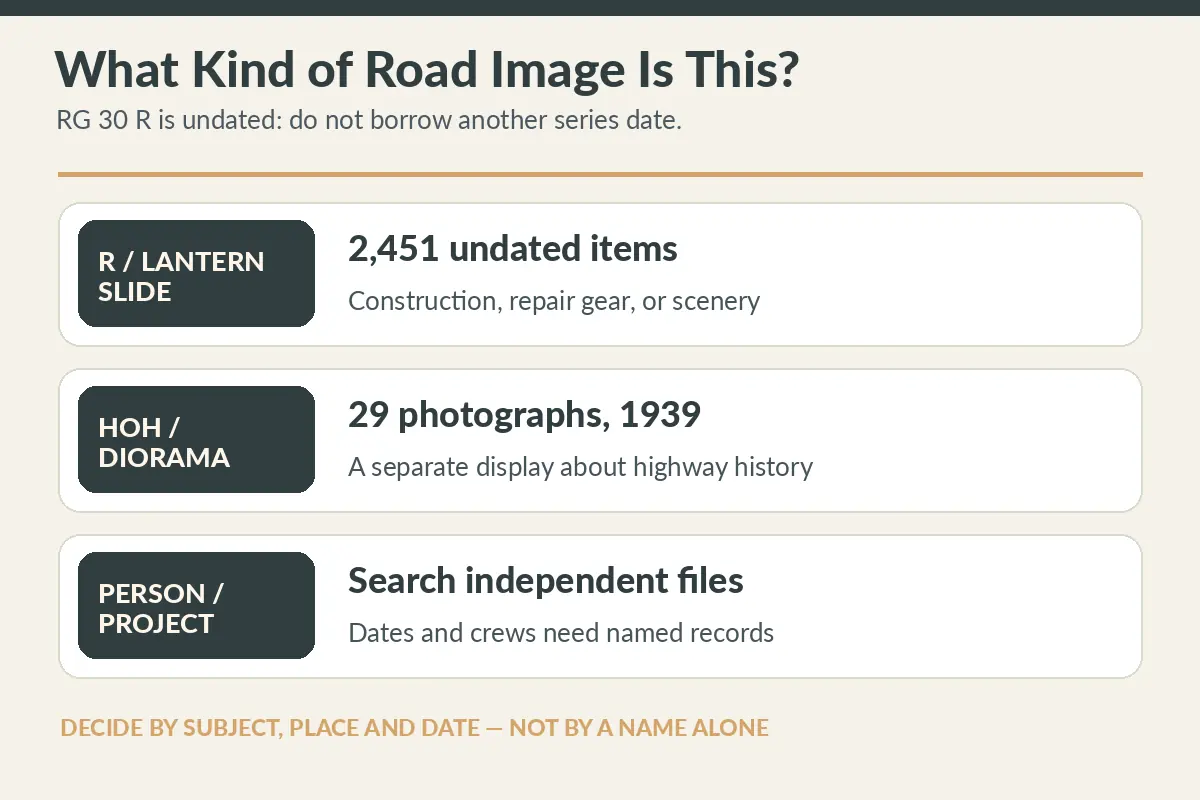
The RG 30 still-pictures section distinguishes the R lantern slides from several other series. For example, HOH comprises twenty-nine color photographs of a 1939 diorama of highway history, while N photographs broadly cover roads and construction, and HH contains photographs of the aftermath of the 1906 San Francisco earthquake. These are different media and research questions. The 1939 HOH date must never be transferred to an R slide simply because both are indexed by the Bureau of Public Roads.
Lantern slides were often prepared for projection and explanation. A slide may reproduce an older image or a diagram, with dates added by later presenters or catalogers. Record any indication of whether you are seeing an original photograph, a copy of a drawing, a chart or a later photographed object. Check the mount and source notes when possible. A projected presentation date is not necessarily the date when the depicted road was built.
Sort Slides by Construction, Repair, and Landscape
First categorize the visible subject using only evidence in the image. New road construction may show grading, subgrade preparation or drainage work; maintenance may show surface patching, resurfacing, rollers or other repair tools; scenery may simply illustrate a road’s surroundings. The NARA guide explicitly includes all three topics in the R series. Do not make the presence of equipment prove whether a project was new construction or routine repair.
Write the descriptive features in plain language, noting uncertainty. A broad machine silhouette might be consistent with more than one kind of grader; a road surface may look like gravel without revealing its specification or construction date. If a caption names a technique, preserve that wording, but corroborate performance or engineering claims with an appropriate manual or project file. A picture of a machine is not its maintenance or production log.
Recover Geographic Context From a Specific Item
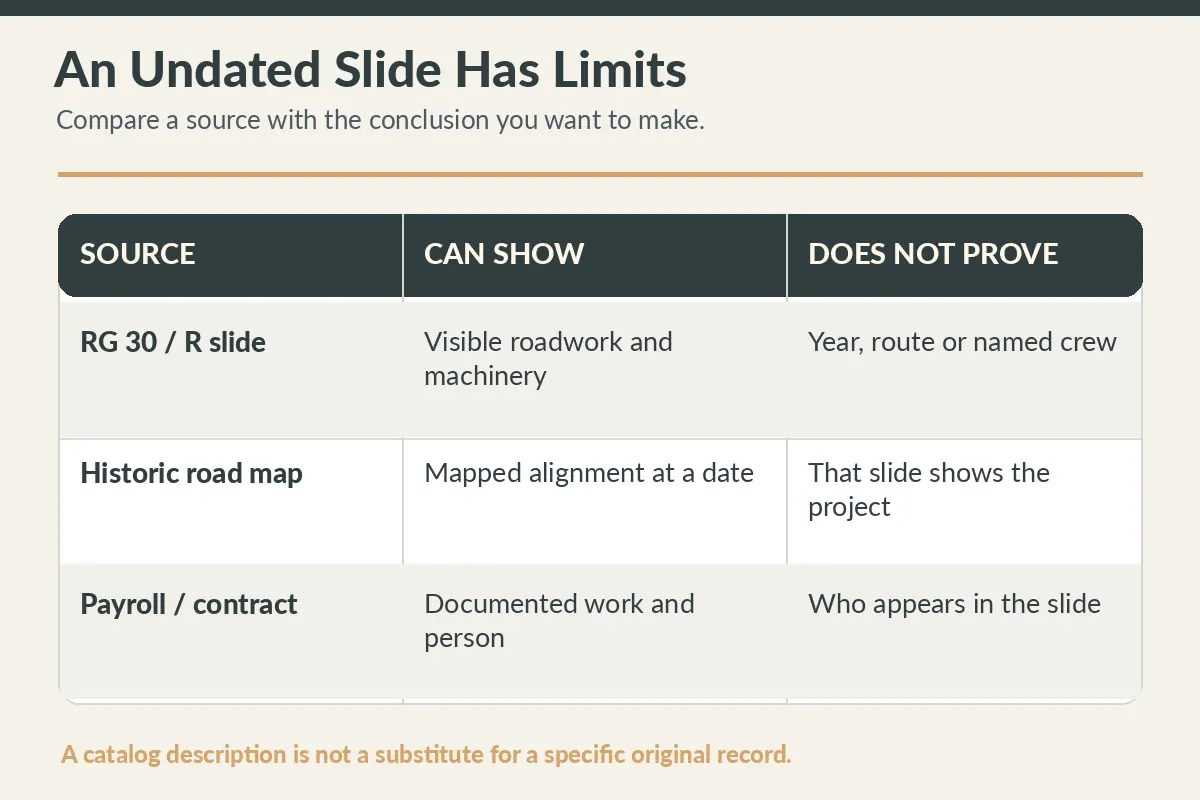
Search original titles, visible signposts, mile markers, bridge forms, junctions and landscape. If an item identifies a county or state, compare contemporaneous official highway maps and engineering project records. Modern route numbers can differ substantially from older alignments; a present-day interstate label cannot be retroactively assigned to a photographed rural road. If no place is supplied, keep it as an unidentified scene rather than choosing a plausible local road.
A geographic attribution should state what is independently matched. One hill or bend is rarely conclusive; a combination of distinctive structures, survey points, named waterways and period descriptions is stronger. Roads can be widened, rerouted, paved or abandoned, so modern satellite imagery may obscure the old alignment. Record each map’s date and scale, and distinguish the surveyed route from the road actually constructed on the ground.
Test a Proposed Date Instead of Inventing One
Because the series-level description is undated, any individual date must come from the slide, its linked archive metadata or independent evidence. A machine model may constrain a possible period, but apparent age and equipment design are not sufficient for a single-year claim. A staged training slide could show an obsolete procedure long after its initial adoption. Avoid importing dates from unrelated nearby catalog entries.
Build a date-confidence table: exact dated caption or project report, a documented range from construction records, or an unresolved date. A date printed on a modern reproduction label should be traced to its source. When two pieces of evidence conflict, record the discrepancy rather than selecting the more photogenic year. If the evidence supports only “first half of the twentieth century,” a broader qualified caption is more accurate than a false precision.
Link Roadwork to an Ancestor Through Labor Records
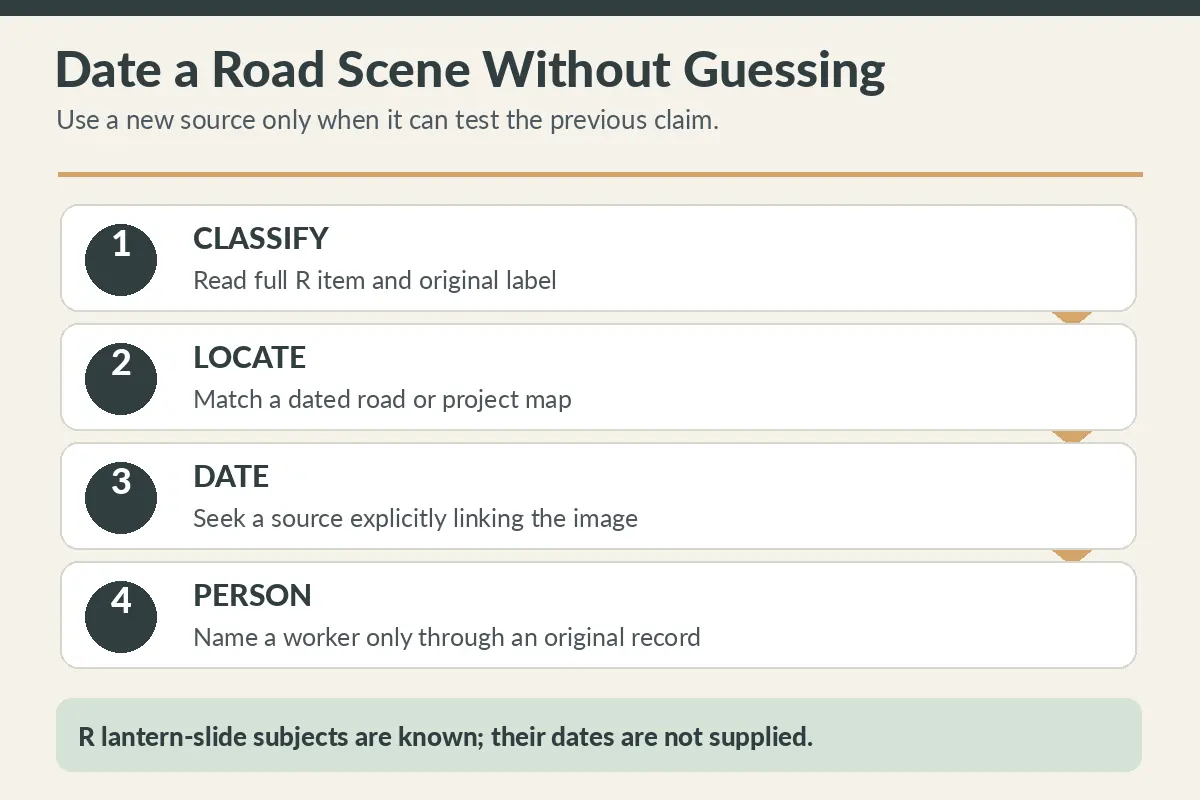
If a family story says a relative worked on a county road crew, begin with the person’s documented residences, occupations and service dates. County payrolls, road board minutes, contractor papers, project employment rolls or contemporary local notices may provide a name. RG 30 R images were not created as a comprehensive register of highway workers. An anonymous person operating a grader should not be identified from the road’s apparent location alone.
Watch for different agencies and contractors. Federal Bureau of Public Roads records may describe funding or research while county officials or private companies supervised a particular work crew. The agency credited with a photograph is not always the person’s employer. Use contract and administrative records to determine responsibility and avoid presenting general federal highway context as proof of an individual federal appointment.
Cite the Slide, Map, and Project File Separately
A useful local-history account may combine an R slide, a historic highway map and a dated repair contract. Each item answers a different question: visible technique, geographic alignment and authorized work. Present them in separate citations and explain the relation rather than drawing one continuous arrow that implies the slide directly documents the contract. A matching technique is contextual unless the item identifies the project.
When reproducing the slide, preserve any archival markings and identify whether the image is a photograph, lantern slide, diagram or modern scan. A diagram drawn today to explain an identification process should never imitate a verified government plan. For a community display, prefer cautious statements such as “illustrates a road-repair method represented in RG 30 R” where year, route and crew remain unconfirmed.
Worked Example: A Road Roller in an Undated Slide
Imagine an R lantern slide showing a roller beside a gravel road. A local newspaper says the county resurfaced a road in 1929, and family tradition credits a relative with the job. The image cannot be attached to that article merely because both mention rolling equipment. Seek a slide caption naming the county or project, then look for the repair contract and a named payroll or crew document. This is a hypothetical example, not a claim about a particular RG 30 image.
If no location is found, use the slide only to illustrate a type of road work and state that limitation. Cite the 1929 newspaper independently for the county repair and the person-level source for employment, if found. That creates a credible family story with a useful technical image without turning an undated federal teaching slide into a false local portrait.
More Place and Jurisdiction Guides
How We Research and Verify the Archive
We checked the RG 30 guide, section 30.9 for the 2,451 R lantern slides and its explicit “n.d.” designation. We compared the series with the separately described 1939 HOH diorama pictures and the NARA Still Picture Branch guide. We do not assign an individual date, highway route or named worker without item-level corroboration.
Our diagrams keep the “undated” status visible and distinguish photography from engineering documentation. Every illustrated road is a modern stylized example, not a claimed original government map. For the site’s editorial policy, consult affiliate disclosure; no speculative equipment purchase or affiliate link is included.
The guide describes 2,451 slides under series R.
The RG 30 guide describes the R series as undated, so precise dates require item-level or independent evidence.
No. HOH is a separate series of 29 color photographs of a 1939 diorama.
No. A distinctive item caption or independent geographic evidence is necessary.
Not by itself. Look for named payroll, contractor, project or local records.