
The National Archives describes 100 photographs of improvements at the Naval Fuel Depot, Pearl Harbor, Hawaii, in 1933–1934 within RG 71’s still-picture holdings. Their published series abbreviation is PH. These images may illuminate tanks, pipes, roadways, utility works, construction stages and changing facility layouts, but the series description does not name every building, photographer, or person. A photograph of ongoing work is not a completion certificate, a photograph showing workers is not a payroll, and a picture that belongs to a 1933–1934 collection need not be taken on the same date as its neighbor.
The RG 71 guide identifies the Bureau of Yards and Docks as the agency responsible for design, construction and maintenance of naval facilities and utilities. That institutional context explains why improvement photographs were made, but it does not transform the images into records of service or residence. For a site or family-history question, start with the PH item identifier, then connect image detail to dated engineering and local administrative documents, keeping every inference explicit.
Find the PH Group Before Searching by Building Name
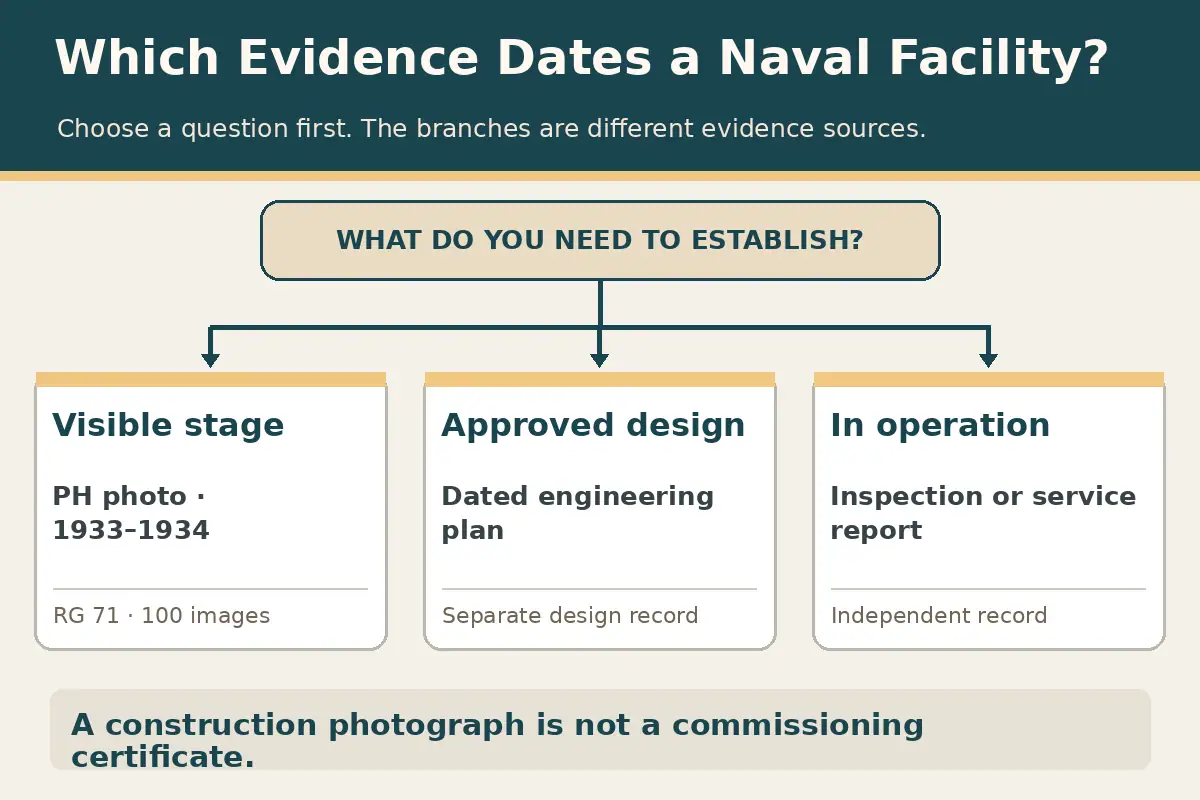
RG 71 section 71.6 lists a still-picture group designated PH and described as improvements at the Naval Fuel Depot from 1933 to 1934. Search the National Archives Catalog for the record group, the PH series designation and Pearl Harbor fuel facilities. Avoid treating any recent image of a Pearl Harbor fuel tank as an archival PH photograph. The published count of 100 is a series description; it does not guarantee that 100 item-level files have been digitized, indexed by building or placed online in a uniform sequence.
Ask for the local photo number, original caption and any negative or album notation. NARA’s Still Picture guidance identifies the record group, series, possible box or folder and the individual item number as essential citation elements. Preserve the caption exactly, including uncertain spellings or dates. A file name downloaded from an online gallery is less useful than the archival identifier when another researcher needs to locate a physical print or inspect an uncropped view.
Separate the Exposure Date From the Work Stage
An image may show excavation, foundations, installation, inspection, finishing work or a completed structure. Do not automatically read every stage as chronological in the order that images are displayed. A photographer may have returned to the same site, documented different angles on a single day, or placed older prints into an album later. If a dated caption exists, record it as an item-level fact; if a date is inferred from a visible stage, mark it as an inference rather than converting the series range into a precise calendar date.
Compare identifiable structural features such as tank diameters, pipeline crossings, road grades, retaining walls and nearby buildings. A new pipe visible in a second view is evidence of physical change only after you confirm both pictures show the same location and direction. Lighting, camera angle and cropping can make objects seem to appear or vanish. Create a sequence with image ID, view direction, visible feature, printed date and confidence level. This is more defensible than a simple before-and-after label assigned without checking the originals.
Distinguish Planned Work From Finished Facilities
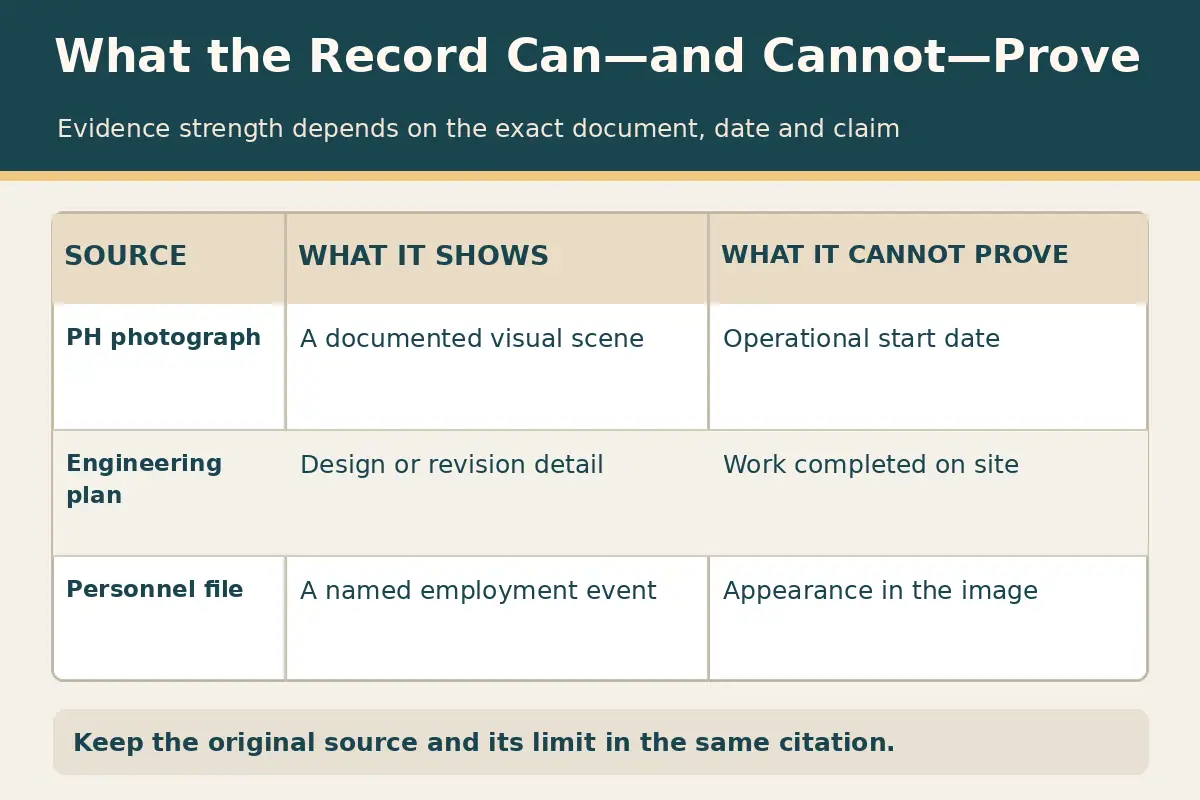
The Bureau of Yards and Docks also maintained plans, engineering files, and correspondence about facilities. A proposed addition may appear in a drawing or work order before it is built; an image may capture a partly constructed installation; and a subsequent inspection or operating record may establish that the facility entered service. These are separate events. NARA’s published PH description confirms improvement images, not the completion status of each individual structure, so cite engineering or administrative records for stronger statements about the start or finish of construction.
When comparing a photograph to a plan, check the date and revision status of the plan, scale and feature labels. Retain the construction contract or work-order number if it appears on a verified record. A historical photo may establish an externally visible tank but not its contents, capacity, ownership arrangements or safety procedures. For those topics, find technical documentation from the relevant period. Avoid applying modern installation names to a 1930s view unless continuity has been independently documented.
Research Workers Without Inventing Their Participation
A construction crew in a PH photograph may include military personnel, civilian employees, contractors or visitors; clothing and proximity alone rarely distinguish them reliably. A family story that a relative worked at Pearl Harbor in 1933 can be investigated through a dated appointment letter, contractor payroll, census residence, shipyard pass, local directory or official personnel file, but those sources must be tied to the correct person. Presence at a naval depot does not prove service in the Navy, and a job somewhere on Oahu does not prove participation in the fuel improvement project.
RG 181 covers naval districts and shore establishments and may provide relevant administrative context, while federal personnel records depend on employing organization and period. Keep a person-evidence table separate from the building timeline. Even if a worker is identified in one image, the image only proves a particular appearance at the moment of exposure; it cannot establish length of employment or role on other dates. If the faces are indistinct or the captions are generic, publish the image as an unidentified work scene rather than assigning an identity for narrative effect.
Give Each Image an Auditable Facility Citation
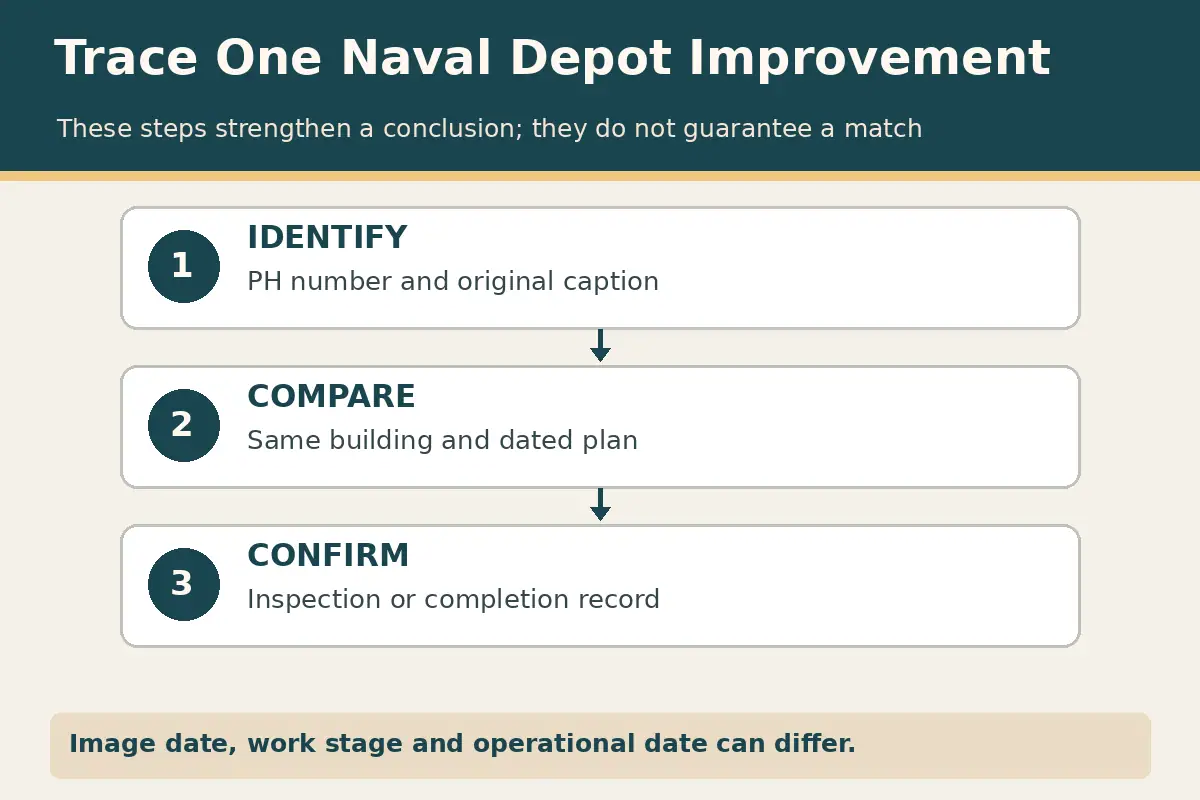
Record RG 71, the PH designation, the complete local photo identifier, caption and any original date. Then add location, viewing angle and the visible features used in your interpretation. When a plan, contract or inspection report supports a completion date, cite it separately. If a modern photograph is used for comparison, account for alterations and reused structures instead of assuming that surviving external shapes prove unbroken use. A preservation caption can acknowledge continuity as a research hypothesis rather than a documented conclusion.
A family-history presentation might state that the PH collection illustrates improvements at the Naval Fuel Depot during 1933–1934, followed by the precise item number and a description of a visible feature. It should not state that the person in the frame is an ancestor, that an installation was ready for operation on the photograph date, or that the image documents World War II service without additional proof. Clear distinctions make the set useful for the history of a place even when personnel records are missing.
More House and Local History Guides
How We Research These Historical Records
We used NARA’s RG 71 PH still-picture listing, its official Still Picture citation instructions, and the separate RG 181 institutional guide. We preserve 1933–1934 as the group’s stated span and do not claim to know each photograph’s precise exposure date or the operational status of a depicted facility. A building identification, contractor attribution or named-person claim needs the original image plus independent dated documentation. Affiliate disclosure.
The RG 71 guide identifies 100 photographs of Naval Fuel Depot improvements from 1933–1934.
Not necessarily. A visual construction stage is different from a commissioning or operating record.
No. PH is a still-picture set about facility improvements, not a personnel register.
No. Use item-level dates when available and label other dating as inference.
Record group, PH series, unique local number and relevant folder information, following NARA guidance.