
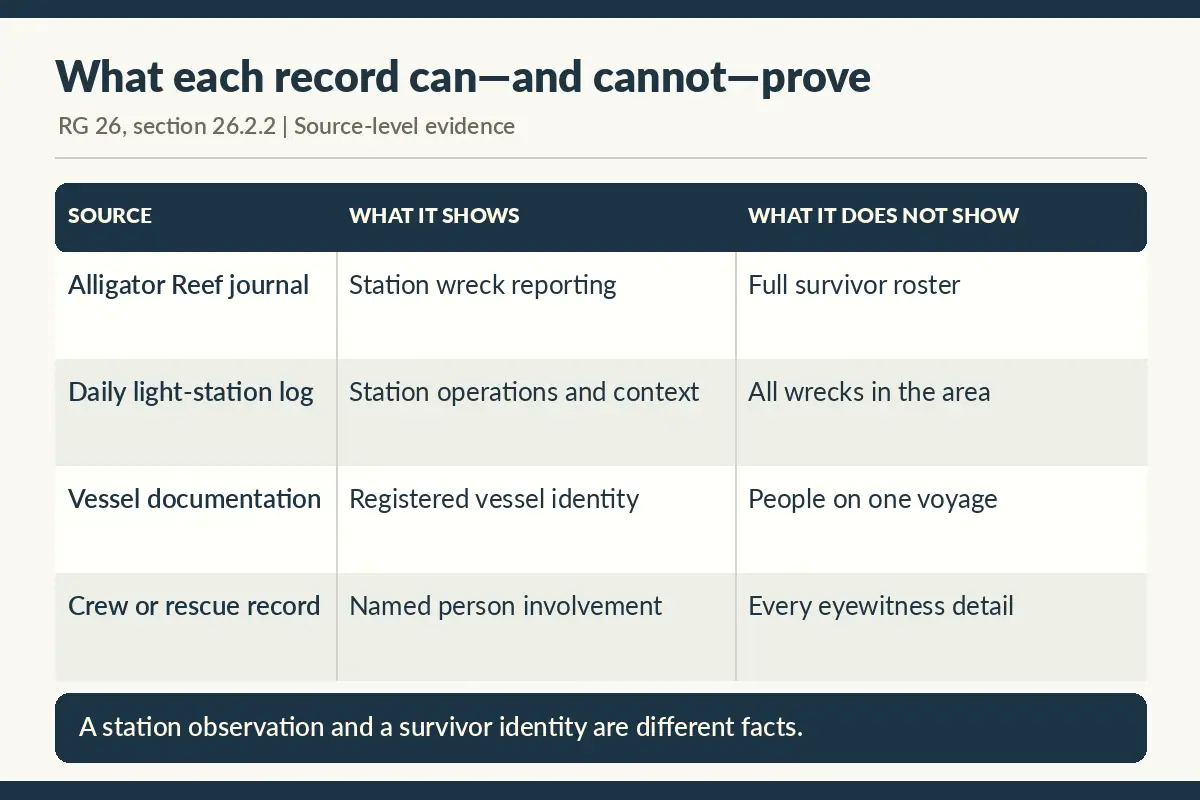
The Lighthouse Service’s journal of shipwrecks for Alligator Reef, Florida, covers 1874–1911 in Record Group 26. Its existence is documented in NARA’s federal record guide, under lighthouse operations. That tells you where to begin investigating a reported casualty near the Florida Keys; it does not tell you the name of every vessel, the cause of a wreck, or the identities of rescued people. A station journal may preserve what observers recorded, while a ship register, official inquiry, newspaper, or rescue account preserves a different view of the same event.
Alligator Reef is a place-based starting point, so begin with an approximate date, historical vessel name if known, and the reported location. A family story that a grandfather survived a wreck “off the reef” is not proof that an indexed item will mention him. The RG 26 overview specifically lists shipwreck journals apart from the wider sequence of lighthouse and light-vessel logbooks. That distinction prevents a common failure: requesting a daily keeper log, not finding a surname, and assuming the incident never occurred.
Choose a Shipwreck Journal, Not Just Any Log
NARA lists the Alligator Reef shipwreck journals for 1874–1911 and identifies Atlanta as the repository location in the historical guide. Confirm current custody and request procedures before ordering. The same RG 26 section also describes broader lighthouse, tender, and light-vessel logbooks covering 1872–1944. Those series may overlap in time and geography, but they had different administrative functions. A shipwreck journal is the most direct candidate for an incident; a daily station log may add context or describe weather, maintenance, and routine activity.
Start a request using “Alligator Reef,” “journals of shipwrecks,” the relevant date, RG 26 section 26.2.2, and the original record creator. Ask for the correct volume and whether any date or incident finding aid survives. The Guide is not a transcription of the journals, so do not invent what a single page says. A date outside 1874–1911 cannot be tested by this named run, even though other Coast Guard or maritime records may exist for the earlier or later event.

Identify the Vessel Before Naming a Person
A ship may be mentioned by an abbreviated name, flag, type, or approximate position. If the original journal supplies any of these, transcribe them exactly and keep a separate normalized search form. Two schooners with similar names can pass through the Keys years apart. Compare the incident date and place with an independent vessel registration, merchant-shipping notice, log, local port entry, or contemporaneous news report before selecting one vessel identity.
Be cautious with geographical descriptions. “At Alligator Reef,” “seen from the light,” and “near the reef” may refer to different positions, each affected by visibility and the writer’s vantage point. Do not convert an observed bearing into precise modern coordinates without documented method and period chart context. A note that a vessel was wrecked does not automatically establish total loss, casualties, salvage rights, or the later fate of the ship. Those are separate questions with separate records.
Separate Observation, Rescue, and Casualty Claims
If a station observer reported a distress signal, boat launch, or rescue attempt, record the exact verbs and temporal sequence. “Reported,” “sighted,” “sent assistance,” and “rescued” have different meanings. An initial observer may have received news from a passing boat rather than personally seen the incident. Without the original page, none of those acts can be attributed to a named keeper. A station journal also need not list every person carried on a vessel.
To establish a family member’s involvement, seek crew agreements, vessel registers, passenger accounts if applicable, official casualty investigations, hospital or relief records, and verified newspaper lists. Check independently which agency created each record and whether it reflects firsthand evidence or later reporting. A newspaper’s survivor list can contain spelling errors; a later family story can compress several events into one. The aim is not to create a seamless adventure but to mark where each claim is documented.

For a method example, imagine a local newspaper says a schooner grounded near Alligator Reef in 1892, while the family remembers a rescue in 1893. Record both dates as competing leads, not as a combined event. Consult the relevant original journal volume, compare the reported vessel name with contemporary registries, and look for official or press reports dated near the incident. A mismatch may reflect delayed publication, different vessels, or faulty recollection. Without the primary entry, do not create a supposed rescue date to close the gap.
Document Gaps and Build a Traceable Incident File
Use an incident ledger with date, time as written, station, reported vessel, nature of observation, original page, and any external corroboration. Flag uncertain handwriting and alternative vessel names. A photograph of a modern lighthouse or a museum display may help orient a reader but does not stand in for an 1880s eyewitness entry. If you consult a historical chart, record its year; shoals and navigation aids may change across decades.
Finish with a narrow statement supported by the documents actually inspected. For example, a properly cited journal entry might substantiate that a vessel of a stated name was reported in distress near Alligator Reef on a particular date. Naming a rescued passenger requires an additional named source. If you find no entry, report only which volume and dates were searched, any missing pages, and the alternate sources to check. Silence in a surviving station volume is not proof that no wreck occurred.
Even a successful vessel identification leaves questions about individual people. A captain may be documented in one shipping record but replaced before the casualty. A crew list may be signed at a different port and time; a rescue report may distinguish survivors from passengers. Note the creation date and purpose of every record before using it in a life story. Reconcile spelling variants with ages, home ports, and dates rather than choosing the first online match. If multiple candidates remain, publish the uncertainty rather than presenting one as established.
More Place and Jurisdiction Guides
How We Research These Archival Claims
We relied on the NARA RG 26 description for the journal’s precise Alligator Reef place/date scope and used NARA’s Lighthouse Service guide to check how these records are held and searched. We deliberately did not assign a vessel, keeper, survivor, or casualty to an incident without reading a corresponding manuscript entry.
Begin with NARA RG 26, section 26.2.2, review Lighthouse Service research guidance, and use the Catalog to request the exact volume. Our affiliate disclosure describes any site relationships; no commercial database is needed for this search plan.
The NARA guide identifies 1874–1911 for the named Alligator Reef journal series.
No. NARA lists shipwreck journals separately from the broader logbooks of stations, tenders and vessels.
There is no such guarantee. Inspect the original entry and use independently created crew, passenger or rescue sources.
NARA section 26.2.2 indicates Atlanta for the Alligator Reef journals; verify present arrangements in the Catalog.
No. Search scope, missing pages, reporting choices and alternative sources all affect that conclusion.