
First Identify Which Railroad Authority Heard the Matter
During World War I the United States Railroad Administration directed transportation systems taken under federal control. NARA places its records in RG 14 and records the return of carriers to private control on March 1, 1920. The Board of Railroad Wages and Working Conditions was established May 25, 1918 to investigate disputes about wages and working conditions, and abolished April 1, 1920. This is a particularly defined two-year search window. A letter protesting pay during 1919 may belong to a board case, but a family memory about railway work in 1925 requires a different route.
Do not equate every federal railroad file with an individual worker’s service record. The board investigated complaints involving carriers, groups and labor conditions; evidence may speak on behalf of many employees without naming each one. Start with the railway company, craft or union, city, approximate date and the actual issue under dispute. If the family story names only an ancestor and says “worked for the railroads,” look first for person-level railroad payroll, pension or employment records. A government wage case becomes relevant only when the person or workplace can be connected to it.
Choose a Docket, a Hearing, or a Recommendation
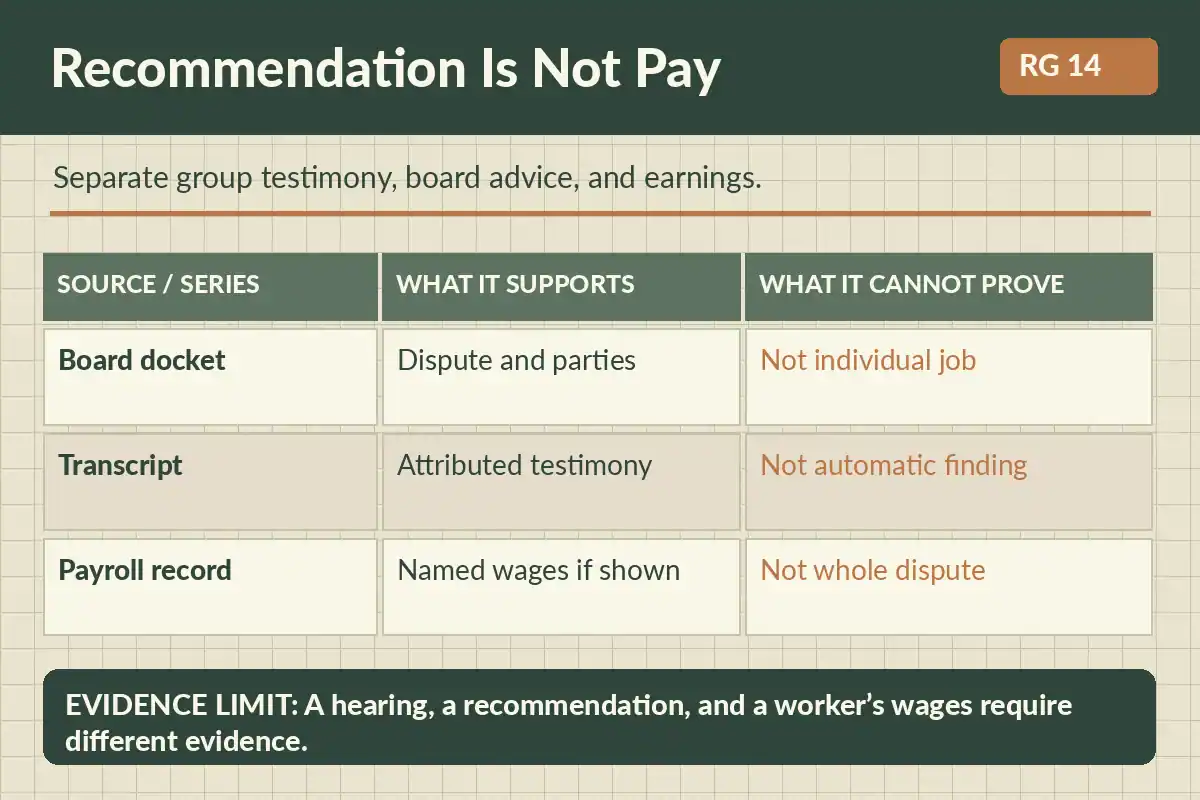
NARA identifies three different types of board holdings for 1918–1920: docketed case files and related papers concerning recommendations; transcripts and digests of hearings; and compiled reports, data and working papers. These do not tell identical stories. A docket establishes that a matter was lodged or considered; a hearing may record testimony and competing positions; a recommendation is advice or a proposed resolution, not necessarily payroll evidence. Preserve those distinctions when describing a supposed victory or pay increase.
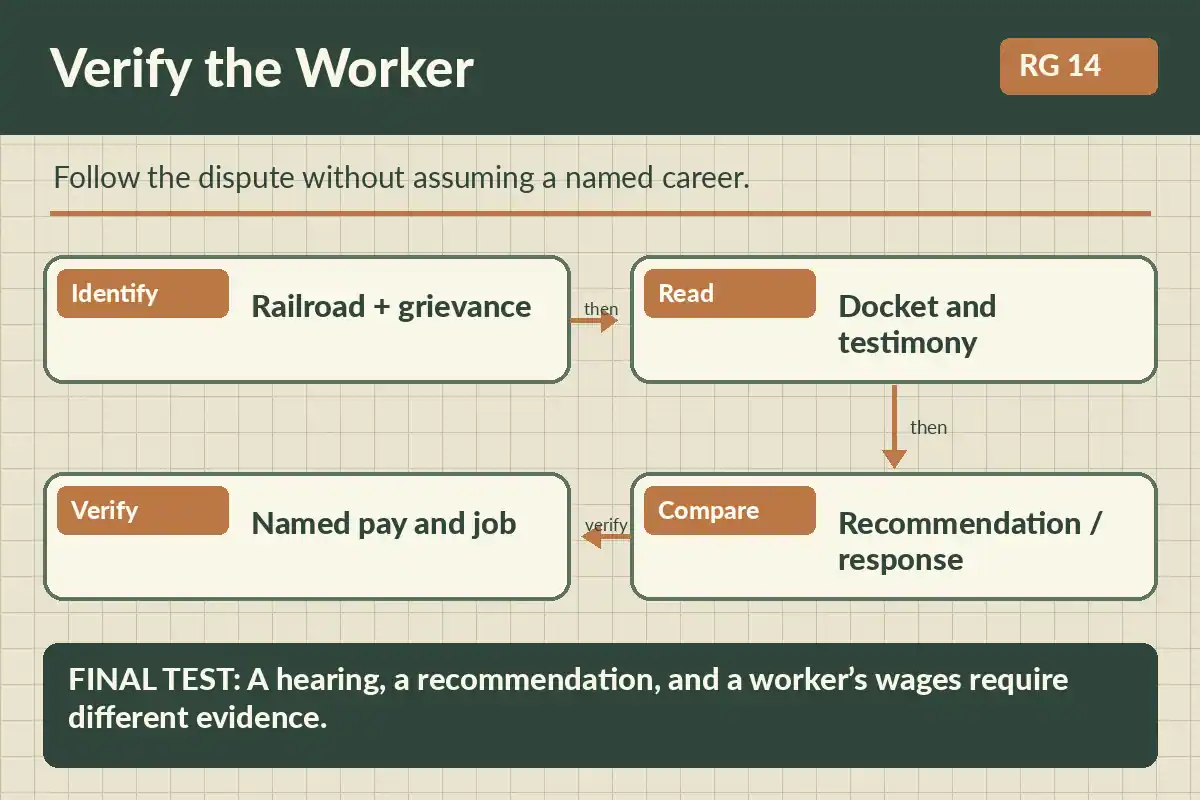
If the family has a newspaper clipping about a wage hearing, take the date, company, location, and disputed craft to the hearing records. If it names a docket or recommendation, follow that exact number and title where the surviving finding aid permits. Treat a hearing witness as a documented participant only when the transcript explicitly names and identifies the person. A summary of wage scales can explain labor context but cannot prove that your particular ancestor worked those hours or received that rate.

Read Federal Control Dates Against the Case Timeline
The U.S. Railroad Administration was created following the December 26, 1917 federal-control proclamation. The Board started hearings in 1918 and ceased in April 1920, shortly after carriers returned to private control in March. Later USRA files may concern settlement, liquidation, litigation, or compensation rather than operating a railway. NARA describes Division of Law records of claims through the 1930s. A claim dated 1924 is therefore not evidence that the railroad remained in federal operation that year.
An archival record might show three dates: incident, complaint filing and hearing or ruling. Record each separately. An employee might have changed jobs between those dates, and a group grievance might continue after federal control ended. Do not infer a person’s job duration or union membership from the board’s administrative closing date. Where the chronology seems inconsistent, inspect the document’s header and referenced original dispute rather than choosing the date of the latest copied letter.
Separate Union Evidence From a Named Employee
National wage agreements and union correspondence can reveal the conditions that applied to a category of railway workers. They may not list every member or beneficiary. A union represented a craft, district or group; the presence of the union name in a file is not proof that a particular relative paid dues. A petitioner described as “employees of” a railroad may be a collective voice. Look for signatures, named witness statements, addresses, job descriptions or documented work sites, and assess whether these appear in the actual file.
To test individual employment, seek a personnel record, pay roster, pension file, local directory or household census entry appropriate to the time and employer. Compare the person’s occupation, age, address and railway division. If two railroads used similar names or several people shared a surname, a case about one carrier cannot be transferred to the other by assumption. Keep administrative and personal evidence in separate columns until a dated, specific connection is visible.
What a Favorable Finding Does Not Prove
A positive board recommendation may address a wage scale or working rule rather than an identified employee’s compensation. Even where the government recommended an adjustment, the amount ultimately paid to one worker calls for a separate payroll, settlement or personnel record. Similarly, a hearing transcript can include allegations about unsafe conditions, deductions, discrimination or discipline. Record those as statements attributed to speakers, not established events, unless the decision or other evidence confirms them.
Make an evidence table listing the request, cited testimony, recommendation, subsequent response, and named-pay evidence. If a file is incomplete, mark the action not found rather than writing that the claim was denied. A dispute might have affected multiple lines or districts differently. Avoid calculating arrears for an ancestor from a published wage table without verified position, rate, date range and proof that the adjustment applied to that person.
Follow the Post-1920 Path Without Mixing Agencies
After the board’s abolition, a dispute may reappear in other labor or railroad bodies, company records or a court. NARA points to related records of the National Mediation Board in RG 13, but institutional continuity should not be presumed. Search by the named railroad, employee group and legal question before selecting a new agency. RG 14 also includes USRA Division of Labor and Division of Law holdings whose roles differ from the wage board. One record group label cannot replace a precise series citation.
Ask NARA for RG 14, the Board of Railroad Wages and Working Conditions, a 1918–1920 case docket or hearing transcript, and the relevant railroad or dispute. Verify available indexes and the current item-level description. Save source title, docket, parties, exact dates, page identifiers and any explicit disposition. If no record is identified, state which docket or index was checked and the archival limits. A defensible story can document the wage dispute’s history while leaving one ancestor’s participation and final pay unverified.
More Research Method Guides
How We Research This Archival Question
We reviewed the official RG 14 archival series description and checked the date spans and record types in the source against every decision shown in the accompanying explanations. We also used a second institutional source for the historical or collection-specific distinction. These are descriptions of archival holdings and practices; they are not evidence that a particular person, building, design, or vessel was present. We did not infer complete series survival or universal digitization from a collection heading. The evidence table marks what remains to be verified in an individual record.
For the research and citation workflow, we checked NARA’s Catalog guidance, which distinguishes record groups, series, file units, and individual items. Researchers should use current Catalog entries and repository staff to confirm custody, availability, exact date coverage, and restrictions because the printed Guide to Federal Records is a historical overview rather than a constantly updated item inventory. All reader-facing images on this page are original explanatory illustrations, not scans of original archival objects. We have not confirmed any paid partner referral; the site’s affiliate disclosure states the general policy.
NARA identifies establishment on May 25, 1918 and abolition on April 1, 1920.
No. NARA says carriers returned to private control on March 1, 1920; later USRA work covered residual settlements.
No. Use independent named employment evidence and connect it to the specific company and date.
No. Verify implementation and a person-level payment record where available.
RG 14 section 14.3 lists the Board of Railroad Wages and Working Conditions transcripts, digests and docketed cases.