
AIR 34 contains Air Ministry Central Interpretation Unit reports and photographs, including many aerial reconnaissance images and some ground-level photographs. The National Archives also notes a First World War aerial album in this collection, while much of the other material dates from 1939–1952. An intelligence image can help study a site; it is not automatically proof of a particular RAF sortie or aircrew. This guide gives a precise source route, identifies what the archive can and cannot show, and names the independent documents needed before a personal or geographic conclusion becomes defensible.
Determine Whether You Have an Image, Report or Album
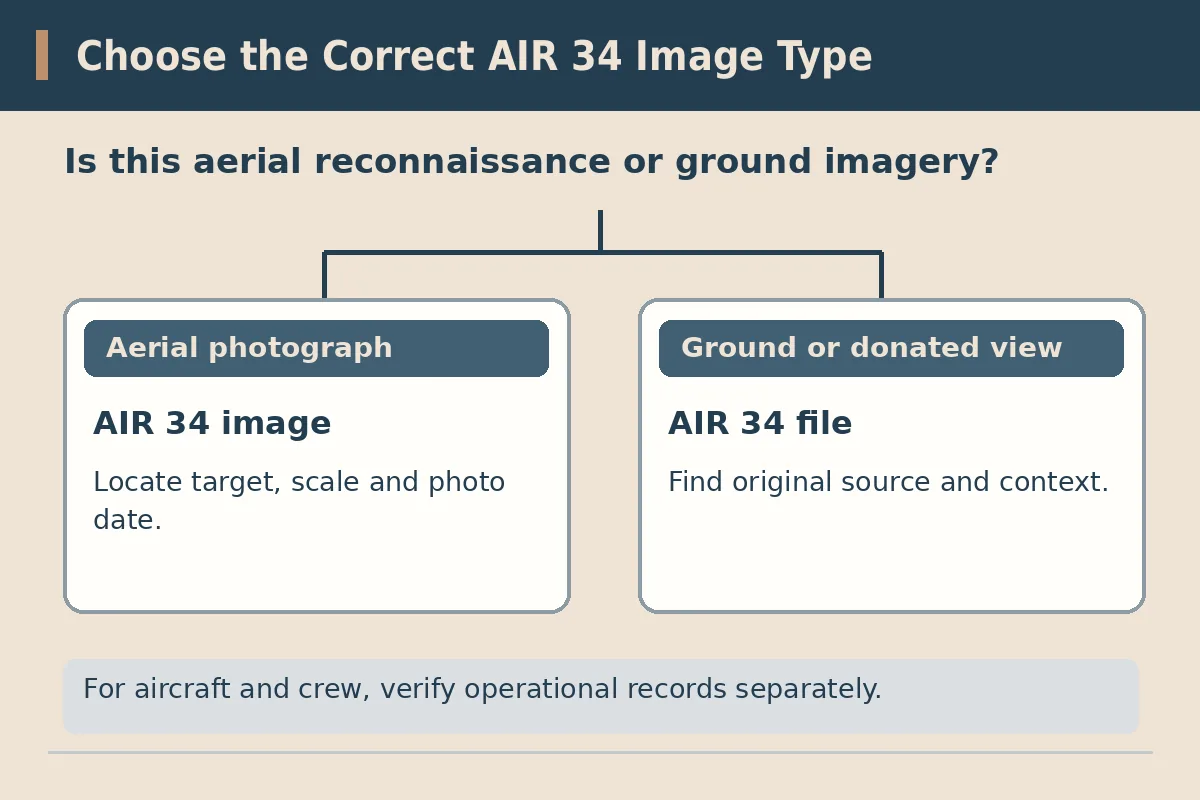
The most important distinction in AIR 34 is documentary form. An aerial negative, printed photograph, montage and written interpretation report answer different questions. The National Archives describes reports and photographs from the Central Interpretation Unit, including a significant quantity of reconnaissance imagery. It also notes ground pictures drawn from sources such as prewar tourist photography. Do not assume every image was taken by an RAF reconnaissance aircraft simply because it appears in an Air Ministry file.
Start with the target location and approximate historical date. Search Discovery within AIR 34, combining alternate place spellings, target type, location code where documented and words such as “photograph,” “report” or “interpretation.” Record the full series and piece reference and whether the catalogue entry identifies a single frame or a file of mixed contents. A keyword match to a town may refer to a report describing it rather than a visible photograph of its streets.
Separate Exposure Date from Analyst’s Report Date
Aerial imagery can be flown on one date, printed later and interpreted in a report written later still. A wartime file may also include prewar ground images. Keep exposure date, photograph identifier, report issue date and any later supplement in distinct columns. Never infer a specific aircraft mission from the date of an intelligence assessment alone. If an image caption has a date but no time or mission reference, record only what the caption actually states.
The presence of a First World War aerial album among later records is a special trap for decade-based searches. An overall AIR 34 series date range does not prove every view relates to the Second World War, even when most of the intelligence reports do. If you need a 1940s airfield layout, check the photograph’s original identification and map features against a dated plan, instead of selecting any image from the same geographic folder.
Hypothetical example: a report dated 1944 contains an aerial view of a railway junction. The report date tells you when the assessment was produced, not necessarily when the exposure occurred. Compare the image’s original number and caption with a second dated image; if an operational record seems to match, verify target, date and unit. No crew member should be named on the strength of the report heading alone.
Read the Analyst’s Claims as Interpretations
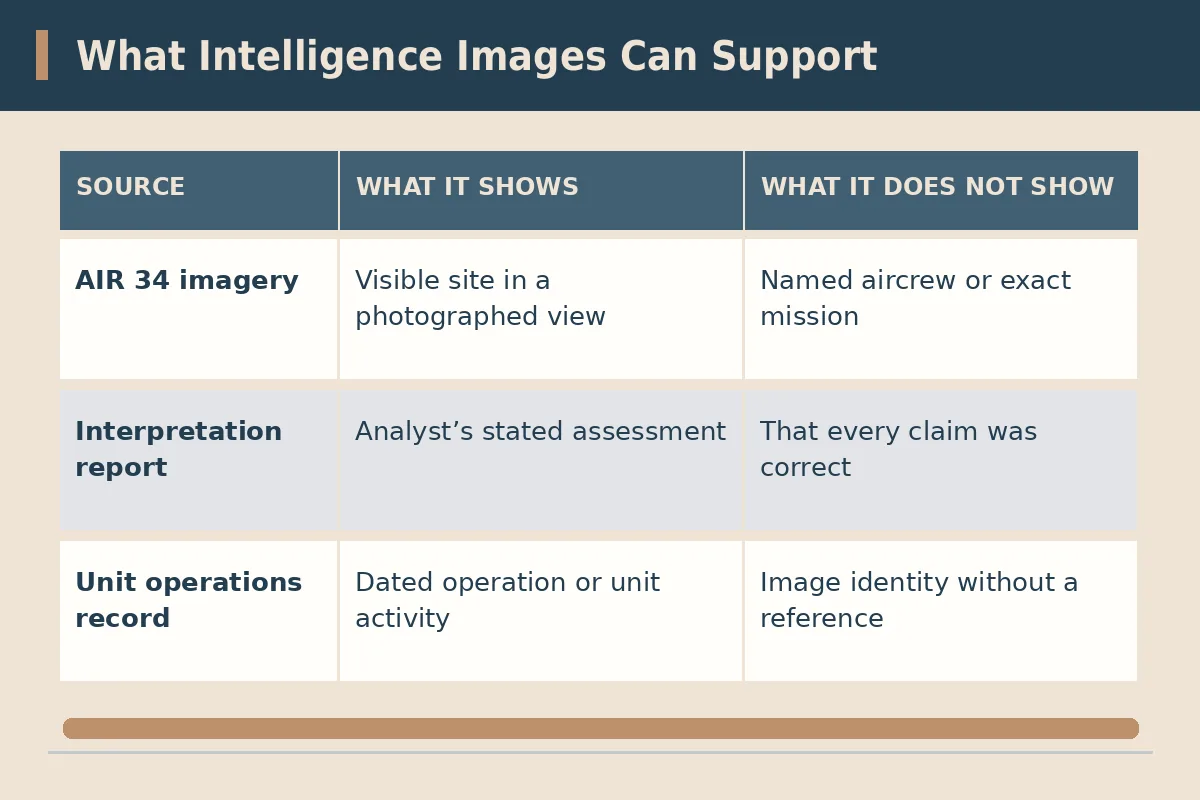
An interpretation report may identify possible structures, aircraft dispersals, tracks or industrial features. These are judgments based on what an analyst could see and infer, not necessarily a later verified outcome. Make two columns: “visible feature” and “report labels it as.” If the report uses a qualifying expression such as “probable,” keep that uncertainty. Do not turn a possible target into a proven installation without confirmation from maps, subsequent imagery or another original record.
Photograph scale, altitude, shadows, cloud, season and camera angle can affect what seems visible. A building that disappears between two photographs may have been concealed by cloud, cropped out or obscured by image quality. When comparing frames, register common landmarks, approximate viewpoint and original date evidence. A map overlay is useful only after confirming the historic site; otherwise an attractive overlay may increase confidence in a wrong geographic match.
Investigate Sorties with Operations Records, Not Pictures Alone
Even a securely dated aerial photograph does not necessarily identify the aircraft, unit or crew responsible. For a specific sortie, seek the appropriate squadron operations record and any surviving mission reference, then test whether it matches the image number, target and date. RAF squadron operations records are often associated with AIR 27, but not all relevant flight details or personnel names survive, and a mission entry does not establish which print was used in a later intelligence file.
If family research motivates the search, begin with a named service record and unit details. An image over a town where an ancestor lived is not evidence that the ancestor saw the aircraft or participated in its mission. Likewise, a reconnaissance unit’s known station does not identify the crew of a particular flight. State the chain of evidence explicitly: AIR 34 supports image or assessment history; unit records may support operations; individual records support a named person.

Preserve Original Identifiers and Access Limitations
Photographs in intelligence files may be scattered rather than separately indexed. The National Archives cautions that most of its photographs are not available online and that catalogue descriptions may name a series or file rather than every image. Request full piece descriptions, photograph numbers and captions when arranging access. Record whether a frame is original, copied, retouched or reproduced in an analyst’s report. A modern screen capture may omit essential marginal information.
Cite the exact AIR 34 file or image reference, target geography, photograph identifier and original dates if legible. If interpreting a site visually, separate observations from the archive’s own words and record the historical map used for corroboration. Do not publish locations or identities that are unsupported or subject to access restrictions. An honest unresolved image identification is preferable to a detailed invented account of a wartime flight.
Citation template: The National Archives (UK), AIR 34/[piece], Central Interpretation Unit report title, target, image or frame identifier, stated exposure date and report date, and original page. Cite the operations record, map or other corroborating image separately. Use qualifiers where photographic analysis identifies a feature only tentatively.
More Place and Jurisdiction Guides
How We Research This Archive Series
This guide starts with the documented evidence in an authoritative source, not a claim that we have inspected a particular person’s private file or a specific original piece. The archival statements here concern the series or research method. A hypothetical example is labelled as such; it is not a newly discovered historical event. We use the Discovery search guidance to distinguish keyword matches from archive holdings and document contents, because catalogue descriptions do not transcribe every word of an original.
For every real candidate, record its historical place or person’s name, the creator, document type, date, full AIR 34 piece or item reference, access restrictions, and the exact claim being tested. The official citation guide explains how to document those references so another researcher can retrace them. An unread document remains a catalogue lead, never proof of imagined details. If a record is missing, preserve the searched terms and dates and examine survival and alternate custodians before interpreting the gap.
Before sharing a conclusion, audit the difference between original source wording and your interpretation. Require independent evidence for any further claim about an individual, property owner, legal effect, or completed action. Respect archival access limits and living people’s privacy. This website also provides an affiliate disclosure; no paid partnership or commercial access is implied by these archival references.
Central Interpretation Unit reports and images, principally wartime aerial reconnaissance with some ground views.
Yes. The photographic guide identifies a First World War aerial album within AIR 34.
No. Record image exposure and report preparation separately.
Not by itself. Corroborate with unit and person-level records.
No. Many photographs are scattered within larger archival files.