
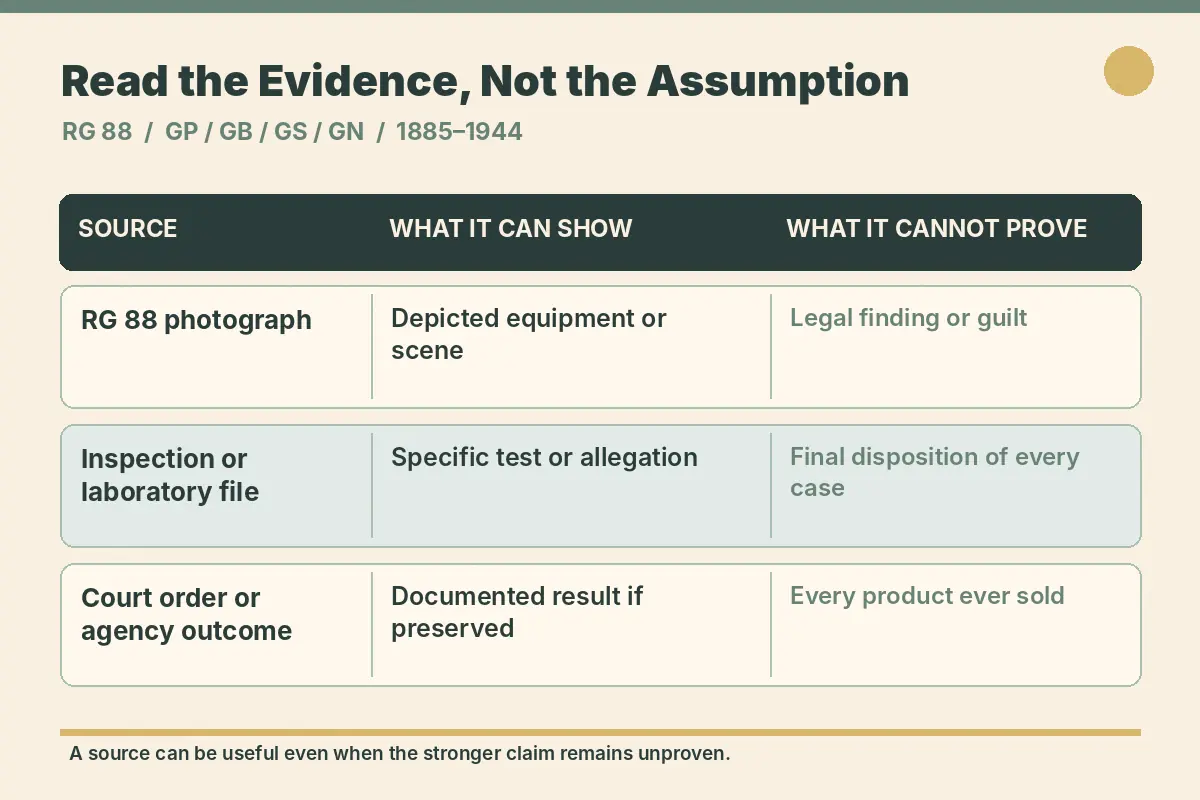
A laboratory bench with bottles or a photograph of condemned food may reveal how early federal regulation was depicted, but the image alone cannot establish a legal violation. NARA describes 4,000 photographs and lantern slides associated with the Food and Drug Administration and predecessor agencies, dated 1885–1944, under RG 88 series GP, GB, GS and GN. The subjects include drug analysis, suspected fraudulent labeling, food inspections, contaminated products and manufacturing scenes. The existence of a picture does not tell you whether a particular person or business was charged, judged liable or acquitted.
These are four archival series designations, not one continuous photo album with every subject arranged by event. The National Archives specifically mentions shelf lists for GB and GS, which can provide useful next steps when a general catalog search does not locate an item. RG 88 spans agencies and predecessor organizations with changing responsibilities over time; do not apply a modern FDA organizational title to every photograph from the nineteenth century. Record the series code, original descriptive caption, probable creator and media format before drawing conclusions.
Choose an Archival Route That Matches the Claim
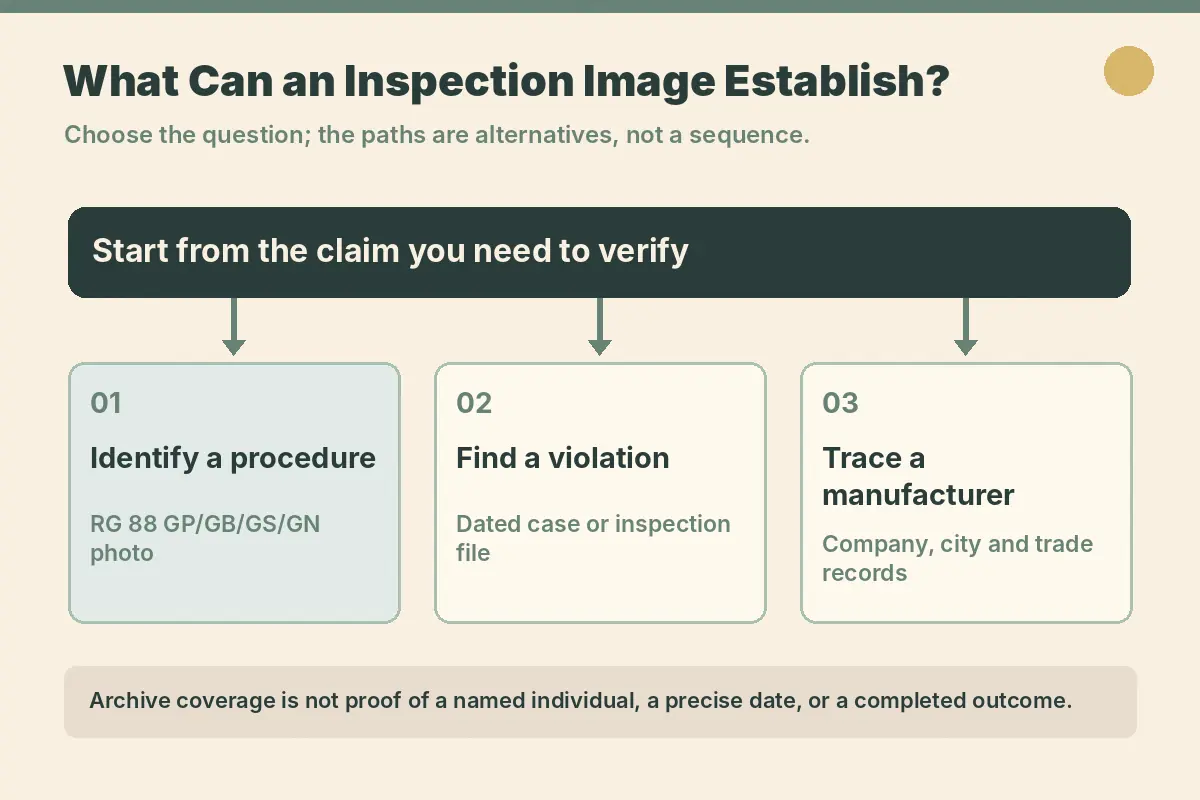
Define the claim before searching. For the appearance of a laboratory method or factory process, a captioned photograph may be an adequate descriptive source. For a suspected labeling violation or food seizure, locate an inspection, laboratory or administrative case file associated with the same product, place and date. For a confirmed legal outcome, pursue the final agency disposition or court record if one exists. A single staged image cannot supply a full enforcement chronology, and a sample bottle in a picture may have no surviving case file.
The guide’s 1885–1944 coverage describes subjects from an era when chemical analysis, manufacturing standards and agency powers changed. A photograph dated 1900 cannot automatically be described as an inspection under a statute enacted later. Be precise about which predecessor office was active in that year and what evidence was created. The photograph may show a process, an allegation or a teaching demonstration. Even images of destroyed products need the original caption and dated records before describing why that destruction occurred.
The National Archives guide identifies 4,000 images in RG 88, series GP / GB / GS / GN, for 1885–1944. That is series-level information. It is not an item-by-item inventory, proof that everything is digitized, or confirmation of a particular person. Record the archival hierarchy before copying a citation: repository, record group, series, actual item identifier and the original descriptive wording. A photograph, lithograph or publicity artifact may have been reproduced or annotated later; those later actions are not identical to the historical event represented.
Date the Source Before Dating the Historical Event
Separate exposure date from case date and label date. A jar in an image could carry a brand still used years after the exposure; a lantern slide might have been assembled for a later educational lecture using older photographs. Shelf-list entries and original media markings may distinguish the recording of a sample from a subsequent presentation. If an image date is vague, say so. Never turn a general historical photograph into a precise account of an enforcement action without the matching numbered file or correspondence.
Manufacturing scenes are particularly vulnerable to overinterpretation. A photographer might have documented production methods in a candy plant, beverage facility or food factory without suggesting wrongdoing. The NARA description groups ordinary manufacturing with analytical and regulatory subjects in the same broad archival entry. Retain that difference in captions and diagrams. A factory building is not automatically a contaminated-food site, while an inspection camera view is not a measurement of purity or sanitation standards.
Separate What the Image Shows From What It Suggests
When the aim is to study a named product or merchant, begin by checking what the original item actually identifies: manufacturer, address, label wording, sample number, inspector or agency. Confirm those fields using the relevant contemporary business directory, federal report or case documentation. The same trade name may have been used by different companies or at different addresses over time. A later reproduction of a poster or laboratory photograph should not be assumed to show an original sample of the product.
A practical research ledger needs the RG 88 series, archive item number, media, caption as written, exposure date, identified products, and evidence for any specific claim. Add separate columns for inspection allegation, laboratory findings, administrative action and final disposition, marking unavailable items explicitly. If a detailed measurement is mentioned in a later publication, find the actual laboratory report before repeating the value and units. An image can illustrate a documented proceeding, but does not replace its legal paperwork.
Build an Independent Chain of Evidence
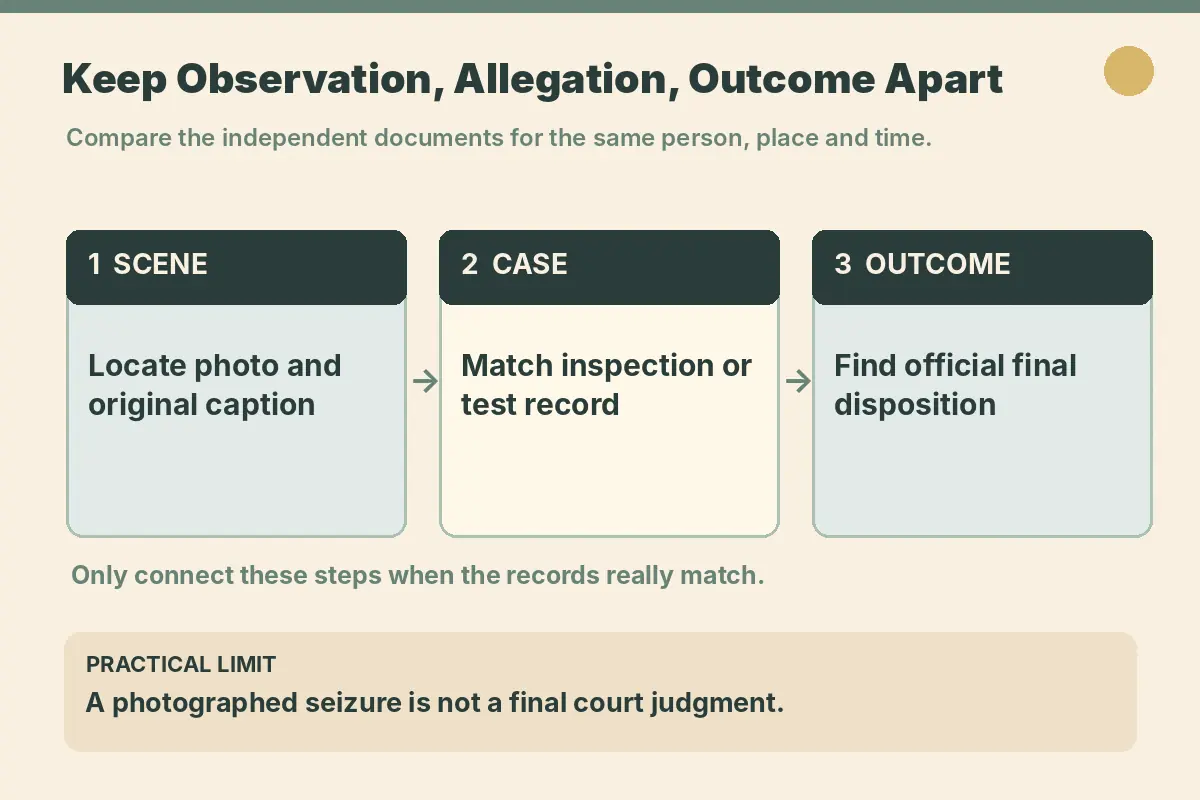
Imagine an unlabeled laboratory slide shown beside a family story about a pharmacist accused of adulteration in 1911. First determine whether it depicts the relevant drug or merely a common analytical technique. Check the historical name and address of the pharmacy and any inspection record from the same period. Then investigate a particular case outcome rather than inferring one from the photograph. If the photo cannot be linked to the case by original identifiers, treat it as contextual illustration and keep the person’s history separate.
A reliable working note has two statements, not one. The first is what the RG 88 GP / GB / GS / GN source directly records or visibly depicts, with all uncertainty retained. The second is a proposed link to a particular family, person, site, transaction, or period; it needs evidence created for that purpose. The same caption repeated in a blog, social post and archive index is still one source. Keep a list of rejected alternatives, and never turn an unsuccessful catalog search into a claim that a historical event did not happen.
Write the Final Caption With Clear Evidence Limits
Use a restrained caption: “Historical regulatory or laboratory scene; RG 88, specified series and original item reference,” adding names or allegations only where the primary source supports them. Avoid claiming the picture proves contamination, professional misconduct or criminal guilt. The newly drawn laboratory cover accompanying this article is not an authentic NARA still picture. Seek the item-level record and the official inspection or case file if the historical question requires findings rather than just a visual illustration.
Check physical context as well as web metadata. A clipped thumbnail can hide a caption, the edge of a building or an original image number. Download or request the fullest lawful reproduction available; transcribe actual inscriptions without silently correcting them. Mark approximate dates as approximate and label any identification supplied by a later cataloger. Keep a copy of the source description used for research because catalog records and access conditions can change. Explain clearly when a newly made illustration accompanies a historical discussion rather than reproducing an object from the named archive.
More Research Method Guides
How We Research Archival Images and Their Limits
We consulted the National Archives RG 88 record-group description for the creator, media, series designation, number of items and date range. The NARA Still Picture Branch guidance describes research paths for original photographic and visual holdings; the general NARA research guide helps track descriptions to records. The supporting images on this page are original explanatory artwork, not facsimiles of the archival sources. See our affiliate disclosure.
NARA groups 4,000 photographs and lantern slides covering FDA and predecessor regulatory and analytical work from 1885 to 1944.
No. It might document manufacturing, examination or agency activity; a specific violation needs a matching case record.
The NARA series description specifically identifies shelf lists for GB and GS.
No. The result and method have to be found in a separate laboratory or case report.
Not necessarily. The original caption and independent trade or government records must support any name.