
The National Archives guide to Record Group 28, section 28.4.6, describes 1,620 architectural and engineering plans: blueprints and specifications for airplanes, hangars and equipment from 1918 through 1925. The same Airmail Service subsection separately lists 120 maps of routes and landing fields and 1,350 photographs in photographic series MS. A drawing, a route map and a photograph answer different historical questions. None is, by itself, a flight log identifying the pilot and aircraft on a particular day.
This collection is especially useful when a family story connects an early airfield, airplane mechanic, contractor or proposed hangar to the growth of postal aviation. First identify the type of object described by the archival entry, then the proposed location and date on its original sheet. The official inventory calls these engineering plans, not a comprehensive list of aircraft actually built. Treat signatures, revisions, approval stamps and drawing numbers as evidence only if visible on the specific item, rather than as fields guaranteed by the series summary.
Select the Drawing, Route Map or MS Photograph

A blueprint answers how a structure or component was drawn. The RG 28 guide explicitly places airplanes, hangars and equipment among the 1,620 plans dated 1918–1925. Record the original title, sheet number, scale, drawing date, revision and any location written on an examined sheet. If a scan lacks its title block, ask for the complete original or container-level citation. Do not turn an undated schematic into an identified aircraft model because it resembles a familiar machine in a museum.
If the question concerns a journey, switch formats instead of stretching the meaning of the drawing. The guide lists 98 maps for landing fields and routes, 1918–1941, plus 22 published airmail maps, 1919–1955. Its MS photographic group covers the broader period 1916–1960. These counts and ranges do not establish identical coverage. A photograph may show a plane at an airfield, while a route map may show an authorized line; neither automatically identifies a particular flight made with that plane.
Distinguish Proposed Hangars From Constructed Facilities
For a hangar, transcribe the place name exactly as it appears on the document and note whether it is called a proposed design, a specification, a contract attachment or an as-built drawing. The published guide does not promise all these labels, so they must be verified sheet by sheet. A planned door opening or workshop bay demonstrates design intent, not that the feature was constructed, occupied or in use by a specified date. Save the scale and orientation before comparing dimensions with later maps.
To establish construction, seek dated procurement correspondence, acceptance reports, field inspection records, local building permits where applicable, and clearly captioned photographs. The Post Office Department records include operating correspondence and airmail contracts, but they are not automatically linked to a particular blueprint by filename. An airport that appears on a route map might have more than one hangar, or none represented by the located drawing. Keep the linkage hypothetical until names, dates, and location details agree.
Use Operating Files to Test a Flight or Mechanic Story

Section 28.4.6 also describes selected personnel records for airmail pilots and supervisors concerning unusual flights, accidents, aircraft tests and operations, 1918–1927. That wording is selective; it is not a complete roster of all mechanics or aviators. The subsection separately identifies performance and efficiency reports, domestic airmail service records, and contracts. For an individual, begin with a known name and approximate service date, then seek a named document connecting that person to the relevant airport or aircraft.
A machine part ordered for a postal airplane is not evidence that the machine flew with the named applicant. Likewise, a pilot in an MS photograph may have been photographed on a different assignment from the route portrayed in a nearby map. A valid claim about a particular flight needs a dated operational record, log, contemporary report or other explicit source. Compare original document dates with later publications: a commemorative photograph can illustrate an event without being contemporaneous proof of every detail in its caption.
Preserve Drawing Provenance and Revisions
When a set contains several sheets, build a version table instead of selecting the newest visible date as the date of original construction. Include the drawing title, sheet identifier, issuing office, creation date, revisions, and the archive citation. Distinguish engineering symbols from handwritten corrections and from marks added during duplication or cataloging. Blueprints can be copied long after a design was first produced; paper color or a modern digital file date is not evidence of original drafting.
A technical comparison is strongest when both drawings refer to the same site, scale and function. If sheet one shows a conceptual floor plan and sheet two shows a later equipment installation, their differences are not necessarily construction errors. State what was altered and where the proof comes from. Record whether a drawing belongs to a series, file unit or item-level description in the NARA Catalog. A broad search hit for “airmail” can contain photographs, maps and reports that must not be cited as the engineering-plan series.
Build a Source Trail That Survives a Missing Scan
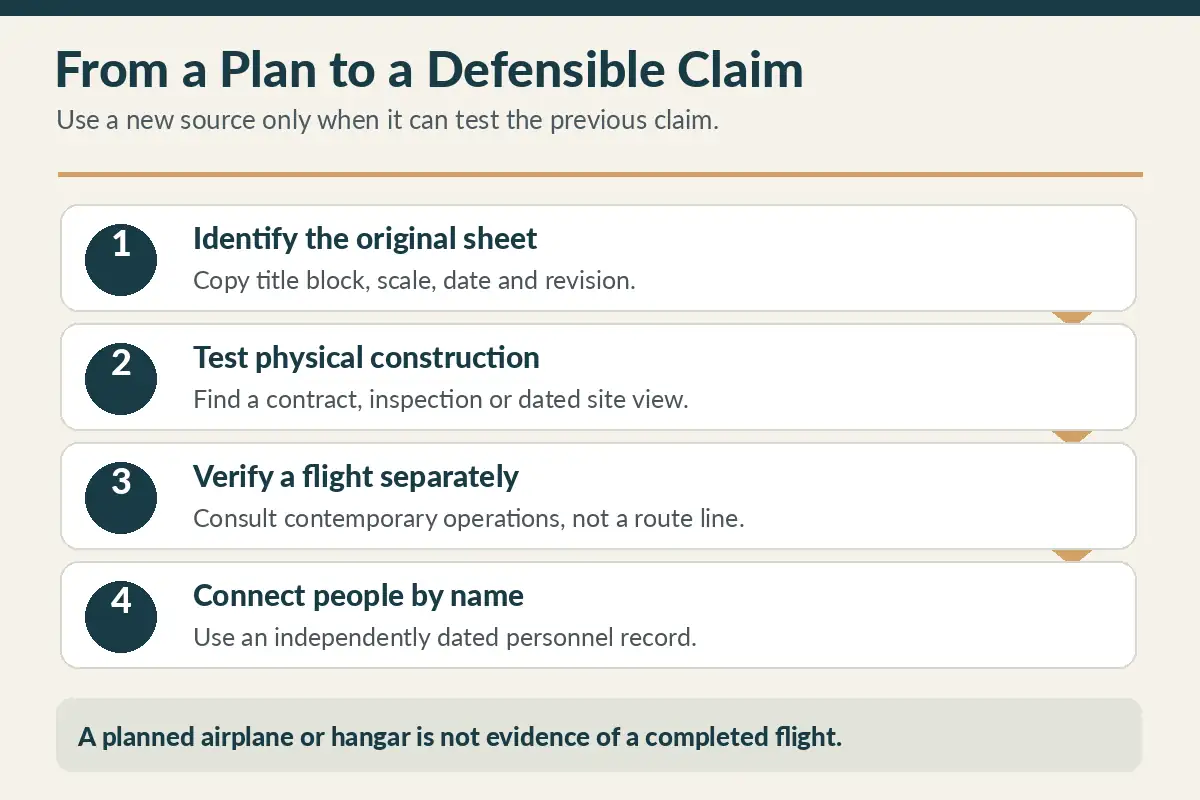
Start with the RG 28 inventory’s section 28.4.6, then search the NARA Catalog for airmail engineering plans and any known location. Capture the hierarchy and original citations, not just the browser link. If the individual drawing is not digitized, a series description may still identify custody and format. Ask NARA for advice about the specific plan using a location, date, subject, record group and any identifier recovered from the finding aid.
When illustrating a family article, clearly label a reconstructed airplane or hangar image as a modern illustration unless the archival original was consulted and appropriately licensed for reuse. A credible caption can say a relative lived near a proposed 1920s airmail facility when local residence evidence supports it, while explicitly not claiming the person worked on the depicted airplane. Avoid turning an attractive technical image into an invented roster, flight schedule or engineer’s signature.
Worked Search: Was an Airport Hangar Built in 1923?
Suppose a local newspaper mentions plans for an airmail hangar in 1923, while a family album shows a building near the field. Search the RG 28 engineering plans for the locality and record any matching sheet’s revision, labeled site and stated function. Then inspect an independent dated newspaper photograph, building report or contract record. The blueprint could support the design of a hangar; the separate construction source must support whether it actually stood in 1923. Similar rooflines alone would be insufficient.
If the story also names a relative as an airline mechanic, create a separate person ledger: name, employer, dated pay or service document, and relationship to the facility. Even a confirmed hangar does not prove the employment claim. Cite the drawing and personnel evidence separately. If no individual record appears, use cautious wording such as “the plans show a proposed hangar associated with this airfield,” not “our ancestor built the hangar.”
More Records and Archives Guides
How We Research and Verify the Archive
We checked the specific RG 28 subsection and kept its engineering plans, maps and MS photographs separate. The inventory dates an engineering group to 1918–1925; it does not guarantee a plan for every airmail station, completeness of digitization, actual construction or identification of all workers. We use plan numbers and titles only when they can be taken from an actual item.
A flight claim requires operating evidence; an employment claim requires a document naming a person. We do not infer either from line drawings. NARA’s catalog and reproduction guidance explain how to seek a specific source when only series-level metadata is visible. Commercial relationships are not presumed; see our affiliate disclosure.
No. The inventory includes airplanes, hangars and equipment; the actual subjects must be checked item by item.
No. Look for a later acceptance, construction, inspection or dated photographic record.
RG 28 section 28.4.6 lists maps separately from the engineering plans.
No. MS is a photographic collection, not a universal employment roster.
Record the hierarchy and location details and ask the custodian about an individual drawing or file unit.