
The most useful Indiana state census finding may be that the sought-after statewide named schedule is not there. Indiana State Archives describes legislative population tallies rather than a continuous name-by-name enumeration of families. Indiana State Library points researchers instead toward scattered county-level alternatives and the distinct federal census. This guide begins by checking the type of record that actually survives and then builds a locality-specific route for the individual or household you want to document.
Understand what Indiana called a state census
Indiana State Archives warns that its state censuses were conducted largely to count the population for legislative purposes. The returns supplied statistical figures, not a statewide list of each household member comparable to federal schedules. Therefore a search promising complete Indiana ‘state census names’ can be misleading. The State Archives census guidance states directly that no equivalent full named record exists. That is the starting fact for a sound search, not an excuse to manufacture a missing index.
The Indiana State Library says a territorial enumeration was taken in 1807 and later counts followed irregularly, often recording only numbers of particular residents. Many state-level returns did not survive; local county auditors sometimes kept related materials. The question is therefore not simply which state census year to enter into a website, but whether a specific county or township created a named record for the desired time. Begin with the historic county and a clearly dated event from an independent source, then inspect the exact local record description. For a related choice, see our guide “Mississippi State Census Records, 1818–1880”.
Use alternate enumerations at the county level
Indiana State Library provides an inventory of state censuses and alternative enumerations organized around holdings and local sources. It can point to a county auditor, local history collection or census-like list, but any particular item must be verified before claiming a named household appears. Read the title, purpose and columns of each local return. A list of taxable men is not a full population census; a register of voters is not a list of every family member; a school-age enumeration samples a different population.
For a hypothetical Eliza Martin living in an Indiana township in the 1850s, an auditor’s tally of eligible men would not exclude Eliza from residence merely because she was not named. Instead seek a deed signed by her family, probate document, church membership, marriage entry or federal population census. Mark whether each substitute reports residence, property, legal responsibility or a different relationship. A good local substitute helps answer a narrow research question rather than posing as the state census page that does not exist.
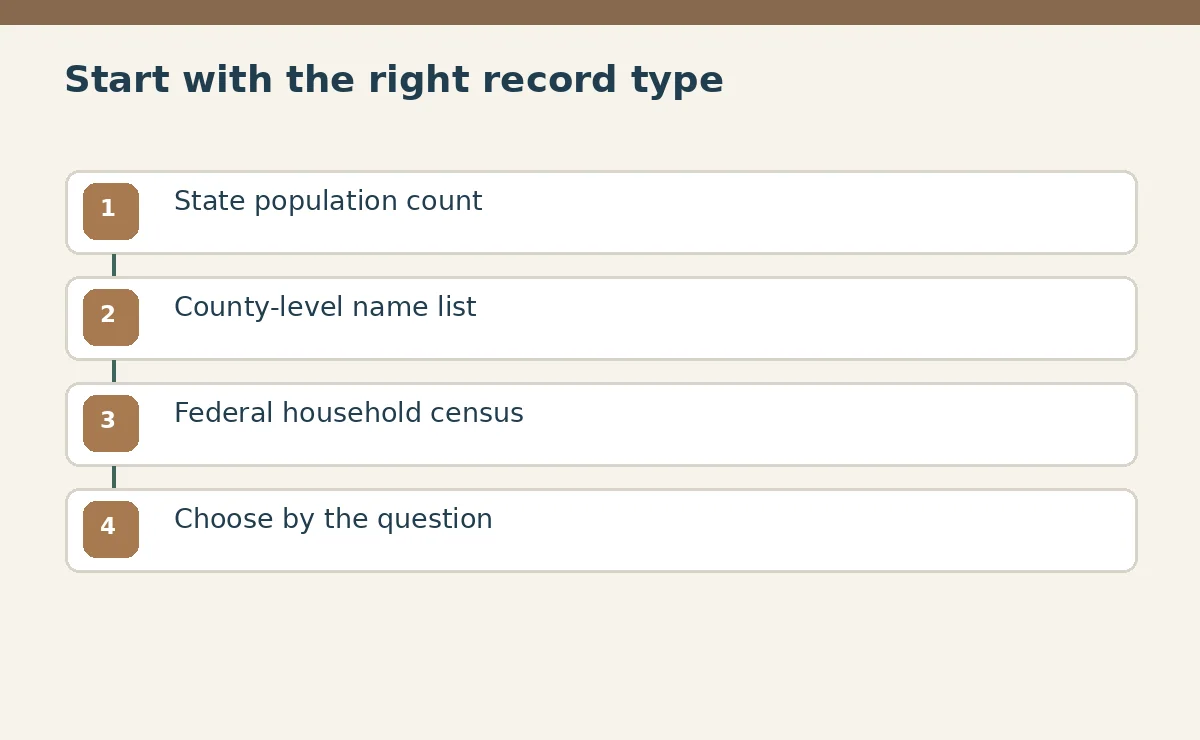
Separate Indiana federal census records from state counts
The federal population census is a different collection from state legislative enumerations. Indiana appears in the federal census from 1820; after 1850, federal population schedules generally list members of households by name. Indiana State Library catalogs federal microfilm, indexes and other related holdings. If your task is to follow a family from 1850 to 1880, begin with the federal schedules, then add dated county documents between those ten-year points. Avoid citing a U.S. federal page as an ‘Indiana state census’ merely because Indiana was the location.
Federal census entries can be wrong too. Being on one household page does not itself establish a biological relationship, especially in earlier years before explicit relationship fields were introduced. A disappearance may reflect death, migration, changed name, enumerator omission or a loss of the relevant original. If a local list of names exists, use it as an independent checkpoint only if you understand its eligibility rules. In your notes, label the creator: U.S. Census Bureau, Indiana state officials, or a county or township office.

| Research checkpoint | Useful evidence | What it does not prove |
|---|---|---|
| Place and date | Original geographic heading | A later address matched automatically |
| Recorded person | Original name and nearby households | A biological relationship by name alone |
| Follow-up test | A separately dated source | Certainty without comparing conflicts |
Choose records that test the precise missing fact
If a researcher needs evidence of Indiana residence around 1845, a tax assessment or deed recorded that year might be much more direct than an aggregate state count. If the question concerns a marriage or parent, a marriage register or probate case may better identify individuals. Indiana’s historical vital-record availability varies with date and county; the State Library’s genealogy guide suggests several alternative record types for early births. Select sources by the field they actually report, not by an attractive keyword match to ‘census’. Our guide “1890 Oklahoma Territorial Census” covers a related question.
Build a source decision table: desired fact, likely creator, original record type, year and jurisdiction, search status, and reason it could help. A county tax roll may establish an assessed taxpayer without naming a spouse; a deed may prove participation in a transaction without proving every child; a cemetery stone can report dates but often has no informed author attribution. This matrix avoids filling genealogical gaps with speculative relatives. It also gives a reader useful progress when the desired state census never existed in the assumed form. Our guide “Rhode Island State Census 1915” covers a related question.
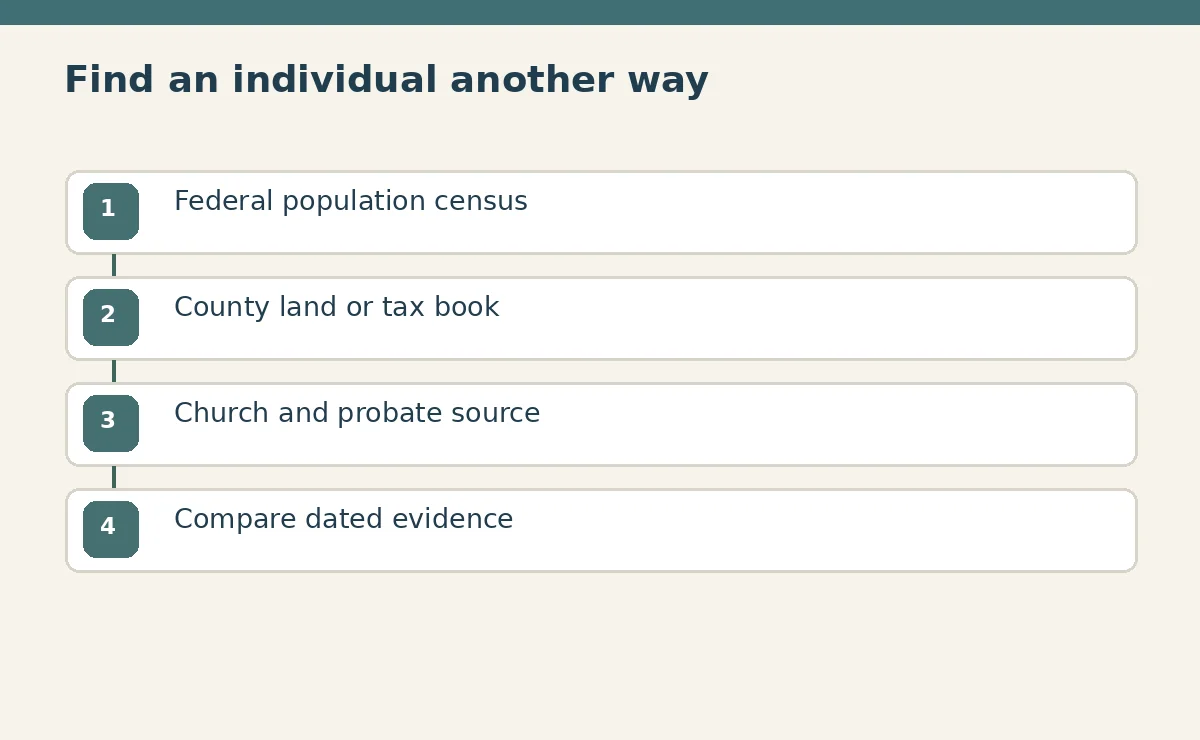
Document the limitation and next archive contact
Cite the Indiana State Archives statement about aggregate enumerations whenever explaining why a named statewide schedule cannot be found. Then cite the specific local material you actually consulted, including the county, office, years and shelfmark or URL. Do not convert an unsuccessful online search into the claim that every local ledger was lost: Indiana State Library explicitly allows for surviving county-level materials. The difference between ‘there was no full named statewide return’ and ‘no possible local name lists survive’ is significant.
The final product should be a realistic research plan, not a fabricated census image. State whether a record was a summary count, an actual local list, or a different source such as federal census or probate. If evidence is insufficient, flag the candidate identity as unresolved and identify the next institution to contact. A careful Indiana census guide saves hours of searching for a source that cannot answer the question, while still showing constructive pathways to family history through genuine documents.
How We Research Indiana State Census
We compared the Indiana State Archives explanation of aggregate legislative counts with Indiana State Library’s genealogy FAQ and its county research guides. These sources agree on the important distinction: broad state population statistics and local alternatives are not one equivalent named census database. Research examples are hypothetical, and the article does not invent missing state-level household lists. Visuals separate three authentic record categories and direct the reader to the particular county, date and repository needed for a repeatable search.
More Records and Archives Guides
Original archives and supporting research sources
Official archive guide — Indiana State Archives explains that state enumerations were legislative totals and no complete named household equivalent survives. Record collection and search guidance — Indiana State Library describes the 1807 territorial count, irregular state enumeration and county-level survivals. Additional institutional documentation — Indiana State Library county guides link to subject research for state censuses and alternate enumerations.
Our title illustration is a newly drawn map-and-document motif with no text and does not pretend to show an Indiana return. The teaching diagrams are modern analytical aids, not archival documents or transcriptions. We do not recommend a paid record service or claim that every county source is digitized. The GenHis relationships and disclosure page outlines the site’s policy. Verify the local holding institution and available record dates before assuming that a name list can answer a family question.
No. Indiana State Archives explains that the state tallies supplied legislative statistics, not a full named household return.
Indiana State Library identifies an 1807 territorial enumeration; its contents should be checked rather than presumed equivalent to later federal records.
Yes. County auditors or local institutions may retain alternate enumerations, depending on place and date.
No. Federal population schedules are separate records even when the household lived in Indiana.
Choose dated federal schedules, county tax or land records, probate, church and civil records based on the particular missing fact.