
A Mississippi state census entry may be a list of people, a set of county categories, or little more than a population count. The state archive’s own arrangement explains why searching only by a surname often fails to answer the question. This guide begins with the county-year inventory, distinguishes the original returns designated Series 100 from numerical abstracts designated Series 102, and offers a source-selection process that avoids attributing family details to an aggregate table.
Begin with a county-year inventory rather than a broad index
The Mississippi Department of Archives and History (MDAH) describes Series 100 as state census returns from 1818 through 1880, arranged by county and date. They were compiled by county sheriffs and tax assessors and vary in completeness and the information gathered. A search for ‘Mississippi state census’ can therefore conceal several different kinds of records. Start by writing the county in which the person was documented, the target decade and the specific fact sought. Consult the official Series 100 finding aid to see which returns survive for that county.
A finding aid is more useful than a name-search blank at this stage: it can show that a desired year never appears under your county. Do not infer a person was absent from Mississippi because a statewide online search returns nothing. Some years or counties lack surviving manuscripts, and some returns record only age or sex categories rather than full names. The original purpose of an enumeration shapes what it can answer. Always distinguish a surviving schedule that you could inspect from a historically documented census year for which no relevant local manuscript is available.
Distinguish Series 100 returns from Series 102 abstracts
MDAH also describes Series 102 census abstracts for 1820–1845. These are county population totals, not a guarantee of individual household entries. If the research question is whether a named ancestor lived in a county, a numerical abstract may confirm population context but cannot identify the ancestor. Conversely, a county return in Series 100 may have personally meaningful content but must be evaluated from its own headings. Do not substitute a printed county total for evidence of a household merely because the documents share a census year.
Design a two-column comparison: left, ‘Series 100: original county returns; inspect listed fields,’ and right, ‘Series 102: aggregate totals; use for context.’ Then note any date mismatch between the series. For an invented example, a researcher looking for 1830 residence of Sarah Boyd could find a county total in Series 102 but no individually useful record for Sarah. That is a documented limit, not a failed database. The next move might be a tax roll, estate file, land deed or nearby county return, chosen because it actually contains identifying names.

Check changing fields and imperfect completeness
The MDAH series description warns explicitly that the content and completeness differ by county and year. An 1818 return should not be assumed to contain the same identifying information as an 1880 return. Before comparing two households, transcribe the original printed or handwritten column labels. If the return classifies persons by categories, do not manufacture names for unnamed spouses or children. Historical enumeration also reflected laws and social hierarchies of its time; a category on the form is a period administrative label, not a timeless description of a person’s identity.
A useful research log lists the archival series, county, date, exact observed fields, whether an original or microfilm was seen, and anything missing from the page. The state archive has fragile originals and describes microfilm-based access in its finding aids. The online digital collection contains selected images from holdings, but digitization cannot by itself guarantee that every county-year record is represented or searchable by every name. Keep a separate note explaining whether the gap is in the historical record, the archive’s holdings or only the online index.

| Research checkpoint | Useful evidence | What it does not prove |
|---|---|---|
| Place and date | Original geographic heading | A later address matched automatically |
| Recorded person | Original name and nearby households | A biological relationship by name alone |
| Follow-up test | A separately dated source | Certainty without comparing conflicts |
Map a household across taxation and neighboring counties
Consider an example family that appears in an 1845 county schedule but is missing from that county’s available 1853 pages. Possible explanations include relocation, death, changing enumeration rules, loss of an original or an indexing issue. Compare county boundaries as they existed on both dates, then identify the same surname in tax lists, land records, church registers and court files. A repeated neighbor or unusual occupation may help distinguish same-name candidates. Never claim the person moved simply because you cannot find them in the later return.
Taxpayer records can be especially helpful because a named household head may appear even where census schedules report only totals. Yet a tax roll proves that a named taxpayer was assessed for a particular item or place, not that every relative resided there. A land conveyance places parties in a transaction, but does not list a complete household. Each alternate source should therefore be selected to test a clearly stated question. The strongest research path uses different record types whose limitations do not all repeat the same uncertainty. Our guide “Indiana State Census Records” covers a related question.
Cite every county return at its correct level
For a found item, cite Mississippi Department of Archives and History, Series 100, the county, year, particular page or film identifier and digital address or archive access date. For a statistical abstract, name Series 102 instead. A generic website citation loses the critical distinction and makes verification hard. Use the MDAH digital Series 100 collection to find a scanned page when available and revisit the official descriptive list when the image search does not give clear locality information.
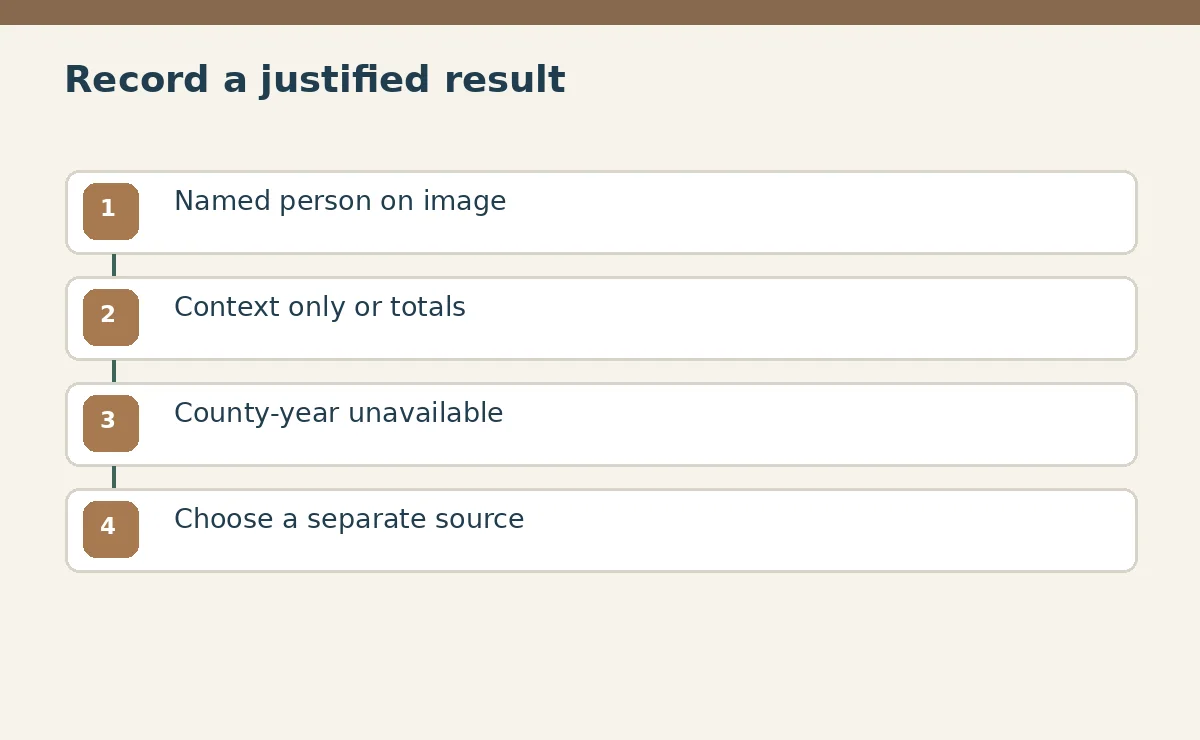
Conclude the investigation with three labeled outcomes: the source directly names the person; the source offers contextual household or population information but not a unique name; or the needed county-year return is not currently demonstrated as surviving. Those outcomes tell another researcher what has really been established. They also protect against the common mistake of turning a surviving state census ‘year’ into an invented statewide, fully indexed family register. In Mississippi research, knowing precisely what a series cannot show is often as valuable as a matching entry. Our guide “1890 Oklahoma Territorial Census” covers a related question.
How We Research Mississippi State Census Records
Our primary comparison used Mississippi Department of Archives and History’s Series 100 finding aid, its digital collection and the separate Series 102 inventory. We retained the archive’s explicit warning that formats and completeness vary by county and year. For this reason no claim is made that a person should appear by name in every listed return. Example research decisions concern hypothetical households; their purpose is to teach when tax, land or probate evidence is required after a county-level count gives only population context.
More Records and Archives Guides
Original archives and supporting research sources
Official archive guide — Mississippi State Archives finding aid explains Series 100, county/year variability and preservation. Record collection and search guidance — MDAH separates Series 102 census abstracts of population totals from manuscript returns. Additional institutional documentation — MDAH digital archive provides historical context and images of variable Series 100 state census returns.
The featured illustration depicts generic archival research materials and deliberately contains no writing. Three diagrams compare source series, coverage and decision outcomes; they are not facsimiles of Mississippi originals. This guide neither promises universal name-index access nor includes sponsored archival services. The GenHis disclosure page explains general site policy. The state archive’s preservation rules apply to fragile records and should be checked before planning an in-person visit or requesting copies.
Yes. MDAH describes Series 100 returns spanning 1818–1880, with coverage and fields varying by county and year.
No. MDAH Series 102 contains county population totals for 1820–1845.
Do not assume so. Consult the county/year finding aid and inspect available images or microfilm.
Records may not survive or may not have been compiled in the same way; the archive inventory controls the claim.
Use it as context, then seek tax, land, probate or church records for individual identification.