
Mauritius correspondence in Colonial Office series CO 167 can document how British colonial officials described, regulated and debated Indian indentured labor. The National Archives identifies CO 167 as original correspondence for Mauritius and points to CO 326 and CO 356 for registers that help locate relevant papers. These sources primarily preserve administrative decisions, reports and communications. They are not a comprehensive register of every laborer who arrived, worked on an estate or departed the island.
Research into indenture requires careful attention to who created the record and whose experience is missing. The National Archives explicitly warns that its colonial records usually contain little person-level information, and names of individual workers are not searchable in its catalogue. A despatch stating the number of migrants, the terms of a contract or a reported complaint should not be presented as a verified biography of an unnamed person.
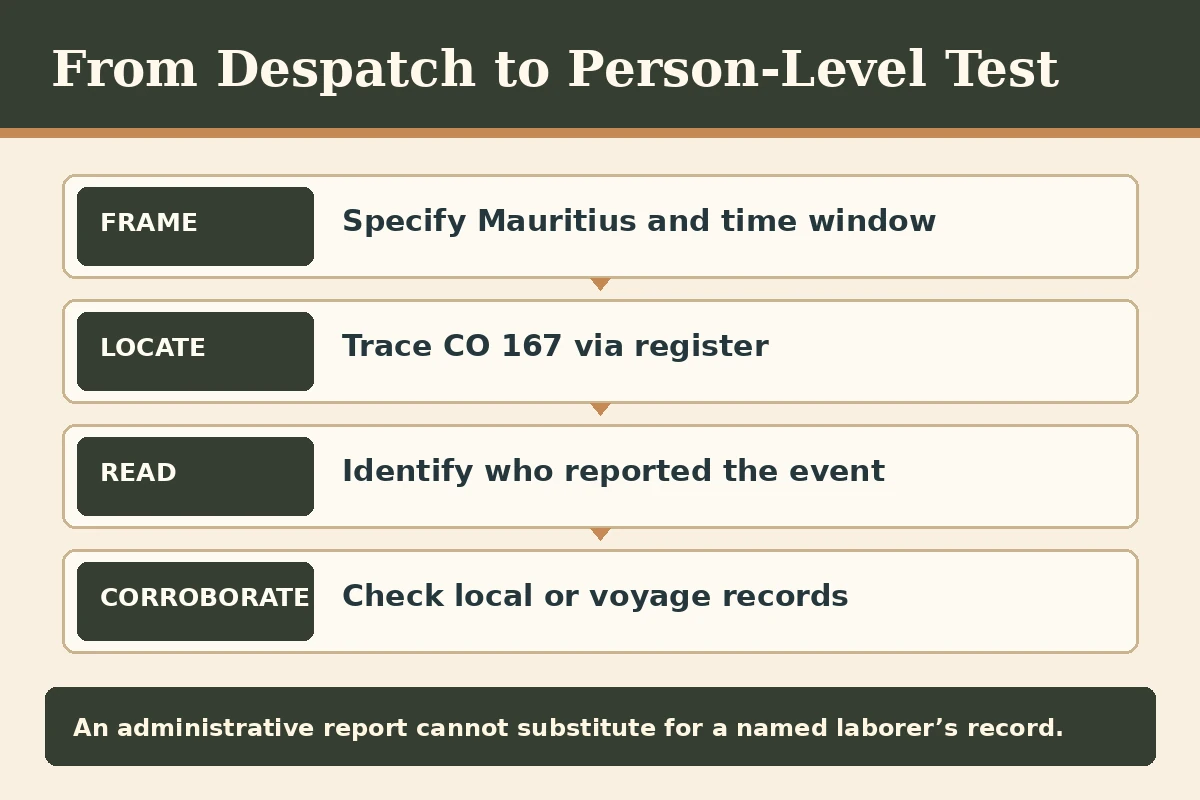
Identify the colonial paper and register before searching names
Start with Mauritius, an approximate year and a topic such as immigration regulations, labor recruitment, estate conditions, a reported death or a dispute over contracts. Search Discovery within CO 167 using those terms and any relevant place or sender. Some descriptions may identify a despatch more precisely than others. A narrow unsuccessful keyword search does not establish that no correspondence exists; many names and details remain buried in manuscript files.
The official guide recommends entry books and registers to locate original correspondence. For Mauritius, the CO 167 series description points to CO 326 and CO 356. The Institute of Historical Research’s Colonial Office records handout gives a practical distinction: registers before 1850 are in CO 326, and later registers are in CO 356. Use the applicable register to follow the date, number or heading into the corresponding original paper, rather than treating the register summary as the entire source.
Record the despatch number, official date, creator, recipient, registration number and full piece reference. Administrative files might include enclosures, statistical returns or copied letters written on different dates. A governor’s accompanying cover letter may give a different account from an enclosure. Keep those voices distinct. The register can be a road map; the original correspondence must be read for a claim about what was actually reported.

Distinguish immigration policy from a named person’s contract
CO 167 can help explain government policy toward indentured recruitment, transport and employment on Mauritius. But a statement that a recruitment practice was authorized is not proof that any particular migrant was recruited under that rule. Colonially imposed categories such as “coolie” appear in historical records and often erase individual identities. When quoting discriminatory administrative language, identify it as terminology of the source rather than adopting it as a neutral modern description.
The National Archives notes that Colonial Office correspondence is mainly about government administration and that many records name only the first names of laborers, or no individual laborers at all. A count of arrivals does not identify travelers; a report of mortality does not give a complete list of the deceased. For claims about a single person, look for a dated name, ship or estate in a separate surviving register, contract, civil record or local collection.
Be alert to the difference between official assertions and the circumstances they describe. A report might say a worker entered an agreement voluntarily, while the conditions of recruitment, debts, coercion or enforcement require other sources to assess. Do not turn administrative wording into a definitive judgment about the worker’s choices. Preserve the date, quoting authority and any conflicting evidence, with respectful attention to the people affected.

Follow immigration reports to other official series carefully
The National Archives identifies CO 571 as Colonial Office General Department correspondence concerning immigration, and CO 384 or CO 386 for other emigration-related administration. These can provide policy context for the movements of indentured workers. They should be selected by the type of question, not presented as a mandatory sequence that every individual appears in. A relevant government series may document expenditure or recruitment arrangements without recording a complete passenger list.
For events aboard ships, the National Archives also points to certain births, marriages and deaths at sea in BT 334 for 1891–1972. This is a limited record type with its own coverage and access issues, not a general voyage register. The guidance warns that parental details may be generic or omitted. A match in a sea-register entry needs a compatible date, vessel and independent identity evidence before it can be linked to someone in Mauritius.
Archives in Mauritius and other relevant jurisdictions may hold local immigration, estate, religious or civil records that are closer to the individual than correspondence sent to London. Search each repository’s catalogue and access policy. Names, ages and spellings may have been recorded inconsistently, and plantation documents may carry severe biases. Use several contemporary identifiers rather than inferring identity from a first name or a broad ethnic label.
Write a transparent, ethical account of colonial evidence
Create separate columns for government policy, reports from officials, statements attributed to workers and individually corroborated events. Cite the exact source at every transition. An official despatch saying a measure was introduced can establish that it was announced or reported, but not that every estate followed it. Records of complaints or inquiries can document allegations without establishing their final resolution. Look for the decision or an independent later report.
Do not treat the preservation of government paperwork as equivalent to preserving the voices of people under indenture. When personal papers are missing, say so. Avoid inventing surnames, relationships, voyages or motives. A defensible case description might state that CO 167 shows how an officer described a recruitment problem in a given year, while the identity and experiences of specific workers remain unverified.
The final research log should include every CO 167 piece, any CO 326 or CO 356 register reference, the specific language of the document and its limitations. List local archives or additional series searched and their results. If a worker can be identified independently, show the identity bridge clearly, including date and place. This produces a useful family or community history without turning colonial categories into personal facts.
More Place and Jurisdiction Guides
How We Research CO 167 Records
We follow The National Archives guidance on Indian indentured labor for its warning about limited personal information and the CO 167 register crosswalk. We check the period distinction in the Institute of Historical Research Colonial Office records guide.
We preserve historical terminology when necessary to analyze a source but do not adopt degrading labels or infer an unnamed worker’s identity. External links are explained in our affiliate disclosure.
It is original Colonial Office correspondence relating to Mauritius, including administrative matters relevant to indentured labor.
No. The National Archives says individual laborer names are not indexed in its catalogue and are uncommon in many files.
CO 326 and CO 356, with the applicable range determined by the date and catalogue guidance.
No. Statistics and policies do not replace a nominal list or a personal migration record.
Investigate surviving local Mauritius records and relevant voyage or civil sources, documenting limits of coverage.