
A genealogy research plan is a short decision document for one unresolved question. Instead of searching every website that mentions a surname, you define the question, list what is already supported, name competing explanations, and rank the records that could discriminate between them. The plan should say why each record matters, where you expect to find it, and what result would send you in a different direction. A useful plan can be a single page. It does not need decorative boxes, a subscription service, or a promise that the first record will answer everything.
This article supplies a practical six-part plan you can copy into your notes, and a worked fictional case to demonstrate how to stop searching once a source proves irrelevant. Your research log documents what you actually searched. Your citations identify the records. Your plan determines which search to attempt next. Separating those functions helps you change direction when a hypothesis fails without rewriting the record of work that already happened.
Write an Answerable Question With Clear Boundaries
Begin with one relationship, identity, residence, or event. `Which documented household contains the fictional Samuel Reed in the period when he was a child?` can be investigated; `trace all the Reeds` cannot. Record the precise name forms already observed, the location as the source describes it, and the narrowest justified date range. If the relevant locality changed its administrative boundaries, put jurisdiction verification in the plan rather than assuming a modern county map gives the correct historic custodian.
The plan’s first field is a plain statement of success. For a proposed parent-child relationship, success might mean locating direct evidence of that relationship and checking it against other identifying facts. Finding a person with the same name is not the same outcome. If you do not know whether the person is your ancestor, define the question as an identity test rather than beginning by calling them a relative. This protects later decisions from an unsupported premise.
Summarize What the Existing Evidence Actually Says
Write a two-column inventory: established observations and unresolved claims. An observation is something you can point to in a specific source, such as a recorded residence or named witness. A claim is the broader conclusion you hope to evaluate. Add citations to each observation, and label facts taken from an index as index-derived until you inspect the underlying record where possible. Include material that conflicts with your working theory rather than hiding it in a later appendix.
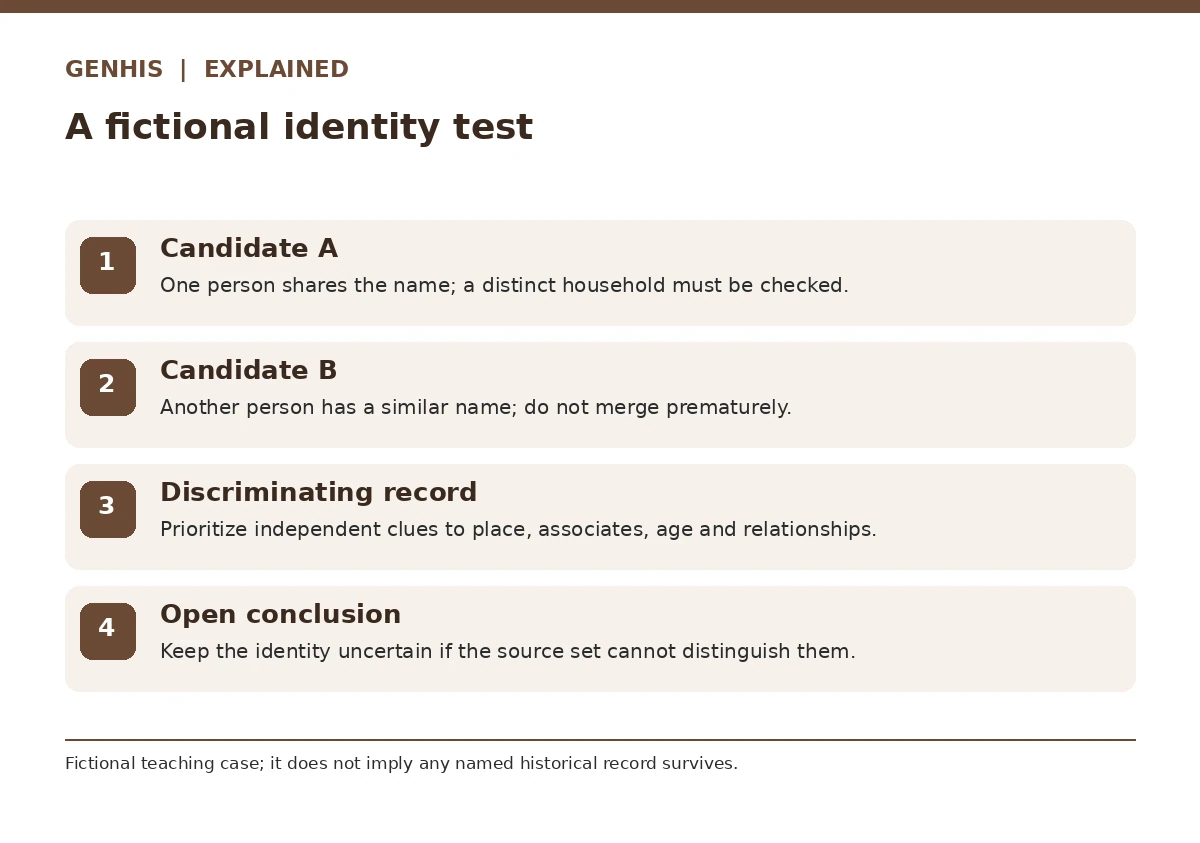
For a fictional example, suppose an unnamed index suggests two people called Samuel Reed were in nearby communities. This does not establish that they are the same person or either is the sought child. The evidence inventory should list each candidate separately and note every missing comparison: age, relatives, neighbors, occupation or a second locality. Your plan’s job is to choose records most likely to resolve those differences, not to repeat the index with increasing confidence.
Form Alternative Hypotheses Before Choosing a Collection
State at least two plausible explanations wherever ambiguity exists. Perhaps Samuel Reed of East Parish moved to a neighboring area, or perhaps the later entry belongs to an unrelated namesake. Each hypothesis should make a different prediction about the documents: a transfer record, linked household members, consistent occupation, or a marriage naming a parent. If a possible record would produce the same result under every hypothesis, it may be less useful as your first search than a record that separates them.
Avoid turning assumptions into invented records. Record types differ across countries, dates, jurisdictions and custodians. A baptism register, civil certificate, tax list or school record may be relevant in one context and unavailable in another. The FamilySearch Research Wiki explains how to search by locality and learn what record types and collections might exist; use a locality guide as a route to a custodian, not as proof that a specific entry survives.
Rank Searches by Discriminating Power and Availability
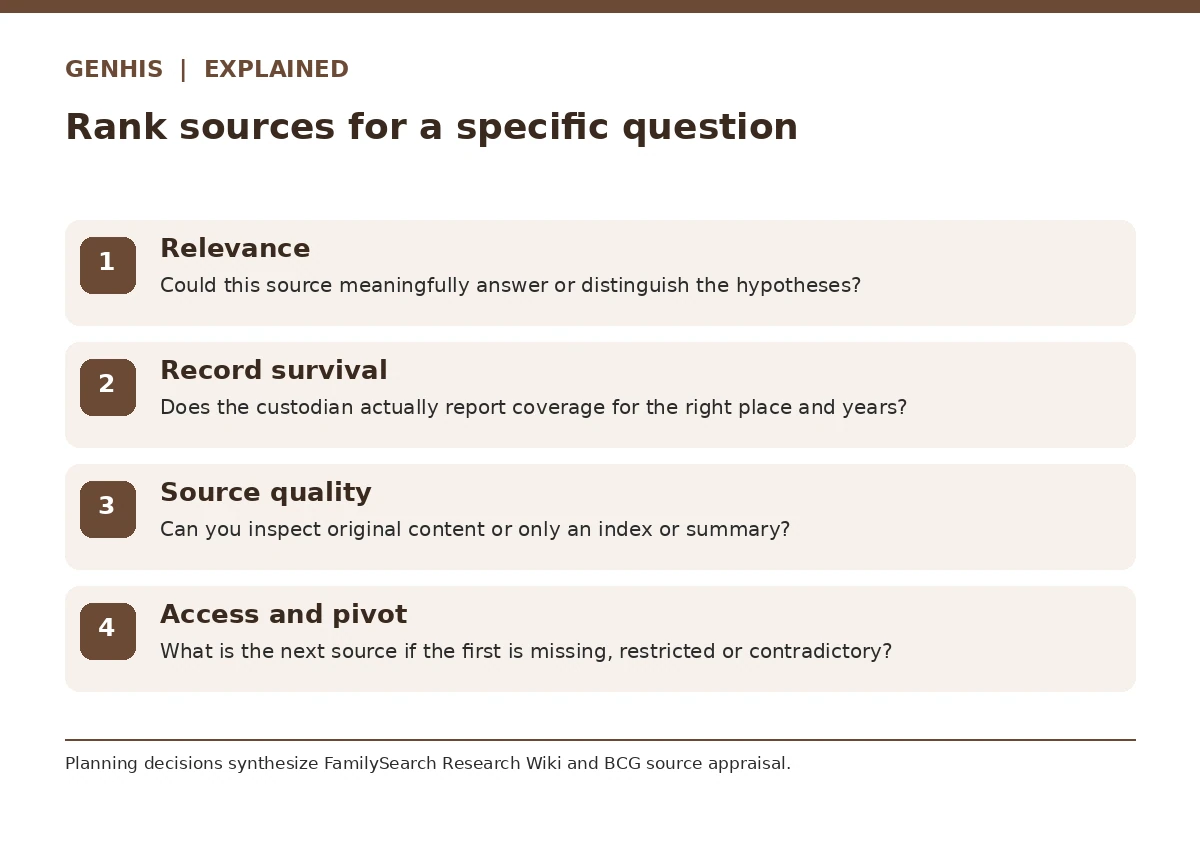
List potential sources in priority order with a reason. A record that names the exact relationship or places the candidate in the same household near the relevant event may have high discriminating power. A public family tree repeating a surname may offer a lead but rarely decides a disputed identity by itself. For each priority, record the custodian, catalog link or search route, relevant coverage, access restriction if known, and a realistic action such as `browse volume descriptions` before guessing that the volume contains the answer.
Use an explicit stop-or-pivot rule. If the first catalog shows no coverage for the target period, record that limit and move to the next repository rather than continuing name searches against a collection that could never answer the question. If a candidate document contradicts your dates, do not simply discard it: check whether the dates came from an unreliable informant, an indexing error, or a different person. Research plans should change as evidence changes, while the log retains the original attempt.
Walk Through a Fictional Three-Search Plan
In the teaching scenario, your objective is to distinguish two possible households for Samuel Reed. Search A checks whether a relevant civil or church record type is available for the correct place and years; before looking for names, confirm the record series and its coverage. Search B examines a suitable household source that might associate Samuel with known relatives. Search C looks for a later independently created record that might connect an identified Samuel to a parent or locality. No specific historical register or entry is asserted to exist in this illustration.
After each search, update the plan’s evidence inventory with the actual document and its exact citation, or record the scope of an unsuccessful attempt. Suppose Search B turns up a namesake but no corroborating details. Mark both identities unresolved and choose Search C based on which hypothesis it could test. The right end product might be a narrower question rather than a new ancestor. A plan succeeds when it directs efficient research and makes uncertainty explicit, not only when it yields a positive record.
Use a Reusable Six-Part Planning Template
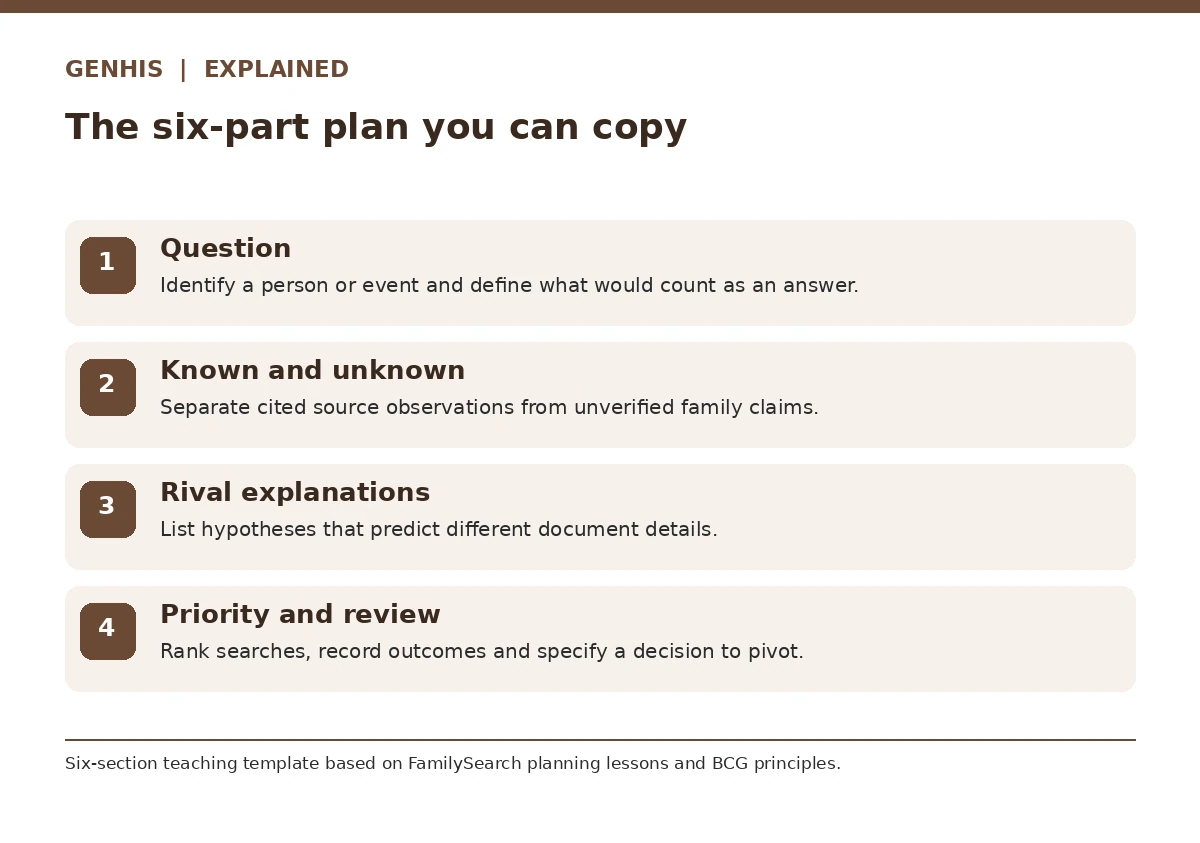
Copy the following headings into a blank document: `Question and identity boundary`; `Established observations with citations`; `Unknowns and conflicting clues`; `Alternative explanations`; `Prioritized sources and access routes`; and `Results, pivot rule, next review`. Under prioritized sources, make one row per proposed search with columns for source type, likely relevance, catalog or custodian, coverage check, expected discriminating information, and status. A blank field is a signal to investigate it, not permission to fill it with a guess.
Before ending a research session, put a date beside the plan version and the next action. Keep old versions when a hypothesis changes so you can see why you abandoned a path. Share a redacted copy with relatives when it is helpful, but remove unnecessary living-person details. A plan differs from a research log because it is prospective; once you perform an action, write the exact parameters and outcome in the log and then update the plan’s ranking.
How We Research and Why the Example Is Limited
FamilySearch’s research-planning lessons and Research Wiki guidance support the focus on a defined question, locality research, and adaptable search strategies. The Board for Certification of Genealogists describes planning as inquiry guided by source reliability and independent evidence. The six-field template and Samuel Reed scenario are our instructional synthesis, not a statement about a real family or the survival of an actual collection. Archive coverage, restrictions, fees and jurisdiction boundaries always require individual verification. We do not offer case-specific genealogical proof or assert affiliate partnerships. See our affiliate disclosure policy.
FamilySearch Research Plan Lesson — FamilySearch lesson teaches research planning and its role in a reliable family history research process.
FamilySearch Research Wiki Help — FamilySearch explains using the Research Wiki by locality and topic to learn record types, strategies and source locations.
FamilySearch Library Research Basics — FamilySearch Library research essentials includes a lesson on building a focused research plan.
BCG Source Appraisal — BCG explains how to assess original and derivative records, informant knowledge, source independence and evidence roles in genealogical analysis.
Often one page is enough for a single focused question if it captures existing evidence, competing hypotheses and next source priorities.
The plan states what you intend to search and why; the log preserves the searches actually performed and their outcomes.
Yes, but verifying the period jurisdiction and record custodian becomes a first-priority task, not an assumed fact.
Define rival identity hypotheses and prioritize records that could distinguish them through associations, places or other attributes.
Revise it when reliable findings contradict its predictions; preserve the old plan and document the reason rather than hiding the conflict.