
You can begin researching a family tree without paying for a subscription. Gather family evidence, use free charts, search publicly available records and catalogs, and check official archive and library guidance before spending money. But “free search” does not guarantee that every record image, certified copy, local register or research-room service is free or available remotely. The sensible approach is free-first, not the unsupported claim that a complete family tree can always be assembled at no cost.
This guide is a practical access decision route rather than a ranking of commercial genealogy brands. It distinguishes looking up an index, examining an original document, consulting a public collection at a particular location, and paying to obtain a specific record. You can use the same process in other countries, but the institutions named here primarily illustrate research in the United States. Always check the custodian’s current terms for the actual place, collection and date of your search.
Build a Free Starter File From What You Already Have
Write one documented family group on paper or in a locally stored document. Collect names, event locations, date ranges, relationship claims and the exact source of each detail. The National Archives provides blank ancestor charts and family group sheets that can help structure the results. A worksheet is a recording aid, not evidence in itself: cite the certificates, letters, documents, or interview notes that supplied its entries. Separate uncertain claims from established ones to avoid paying to chase an invented connection.
Ask relatives whether they have older correspondence, birth or marriage papers, family registers, albums, or previous research. Obtain permission before copying and keep living-person identifiers private. Do not spend money on an online tree merely because its surname looks familiar; find the specific relationship that needs testing. A narrow question—such as the marriage location of a documented deceased relative—helps you compare free and paid routes intelligently. You can often learn which custodian should hold a record without buying any image.
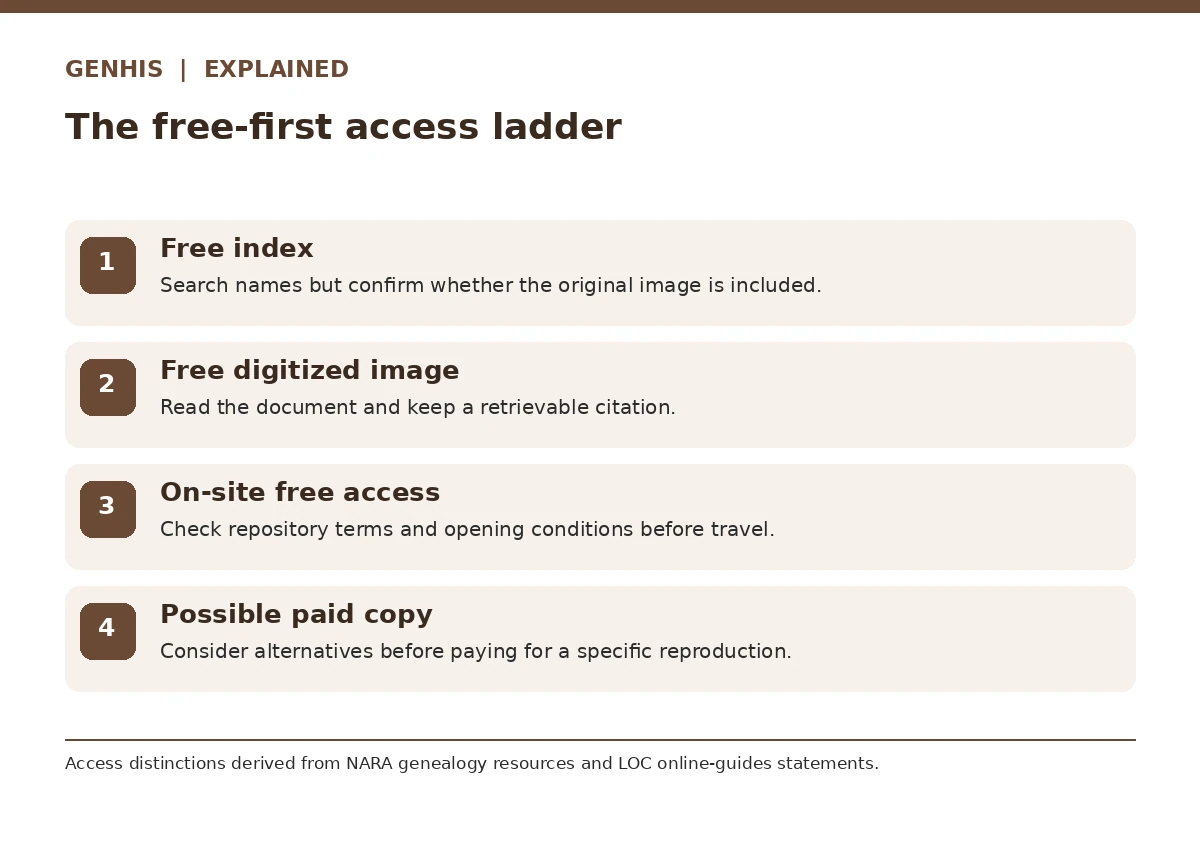
Know the Four Different Meanings of Free Access
A searchable index may reveal a name and reference but not the document itself. An openly viewable scan may let you inspect the underlying record from home. A subscription database may be available without an additional charge inside a participating research room, subject to that facility’s current conditions. A physical record may require a paid copy or visit even though its catalog entry is public. These are distinct situations, and their conditions can vary even within one website or archive.
The National Archives lists research-room access to some commercial tools while distinguishing access from outside its facilities. That is not a promise about every branch, date or collection. FamilySearch offers free tree and record services, yet the exact image viewing or account arrangements can depend on a collection. The Library of Congress says many useful materials are not available for at-home research. Check a specific collection notice before claiming that an image or certificate is included for free.
Match the Record Type to the Right Custodian
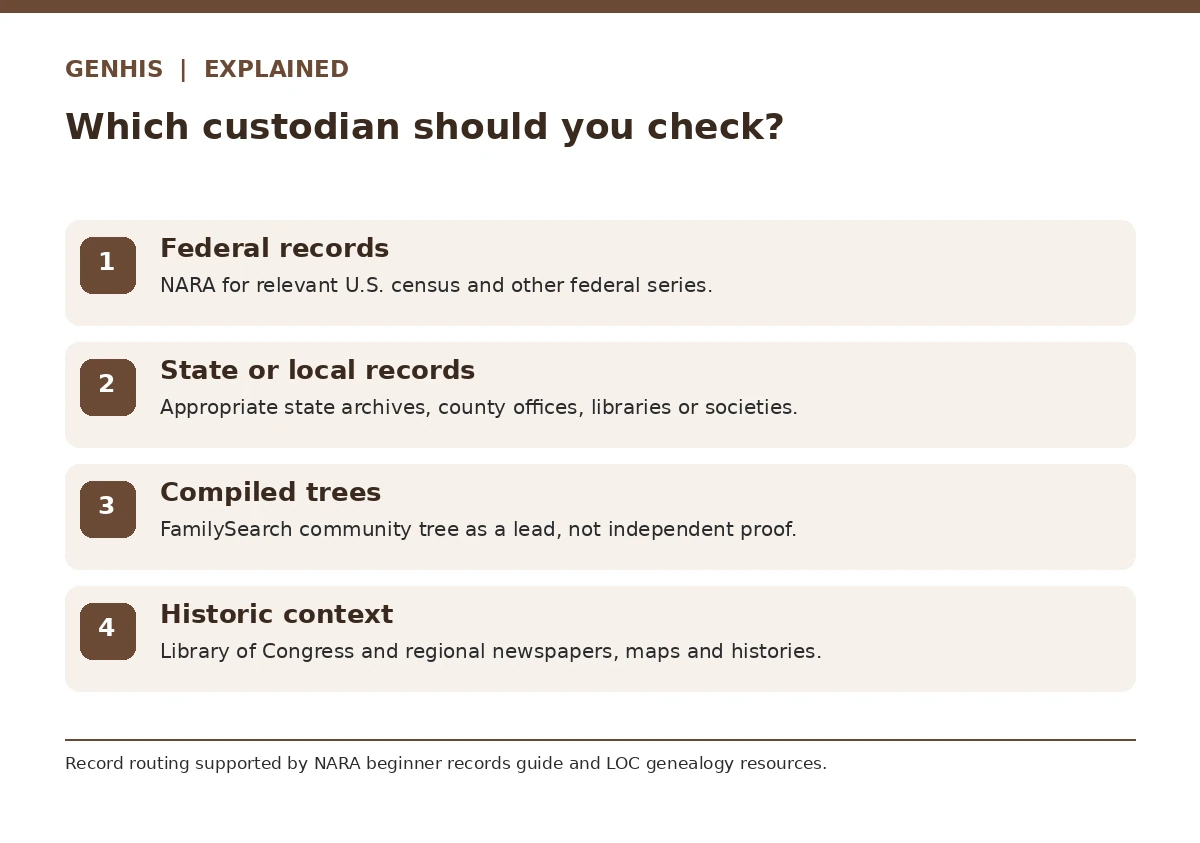
For U.S. federal census and related federal series, start with the National Archives’ research pages and catalogs. NARA identifies census, immigration, naturalization, military and land sources among frequently used categories. Birth, marriage, death, property, probate and local religious records often require other custodians whose jurisdiction depends on where and when the event occurred. Do not assume the U.S. federal archive is a complete national register of vital events or that every U.S. state used the same system.
Look for a state archive, county office, local library, historical society, church archive or other responsible institution when a federal search cannot answer the question. Libraries may offer local history books, newspaper guides, maps, and catalogs at no charge online or at a branch; borrowing and access policies vary. For an ancestor outside the U.S., substitute the relevant governmental, religious, community and cultural repositories. Document why a collection plausibly covers your event before spending hours entering names into unrelated databases.
Search Free Records Without Mistaking Hints for Proof
Use FamilySearch historical record search for a known deceased relative, beginning with a defensible name, period, and place. Try reasonable spelling variations, then inspect what a matching item actually reports. If the result is only an indexed transcript, investigate whether a source image is available and where. A record hint or shared family-tree link is a proposed match; it is not the same as an authenticated parent-child relationship. Compare events, locations, household ties and contradictory details before attaching the item.
The most recent publicly accessible U.S. federal decennial census is currently 1950, as described by NARA. For an appropriate earlier ancestor, moving backward through available census years can generate location and household leads. It cannot establish every relationship in every period, nor does it fill gaps for people who were missed, excluded or recorded in a misleading way. A record’s actual headings and jurisdiction determine what may be inferred. Avoid treating a missing search hit as proof that the person never lived there.
Check Alternative Free Routes Before Paying
If the index is free but the image is restricted, note the collection and reference precisely. Investigate the responsible original custodian, an authorized digitization partner, or a publicly accessible research-room option. Ask a local library whether it offers relevant databases under current patron rules, rather than assuming all library systems have the same contracts. Look for a cataloged physical volume if the item was never digitized. These alternatives may take more time, and none guarantees that access will be possible at zero cost.
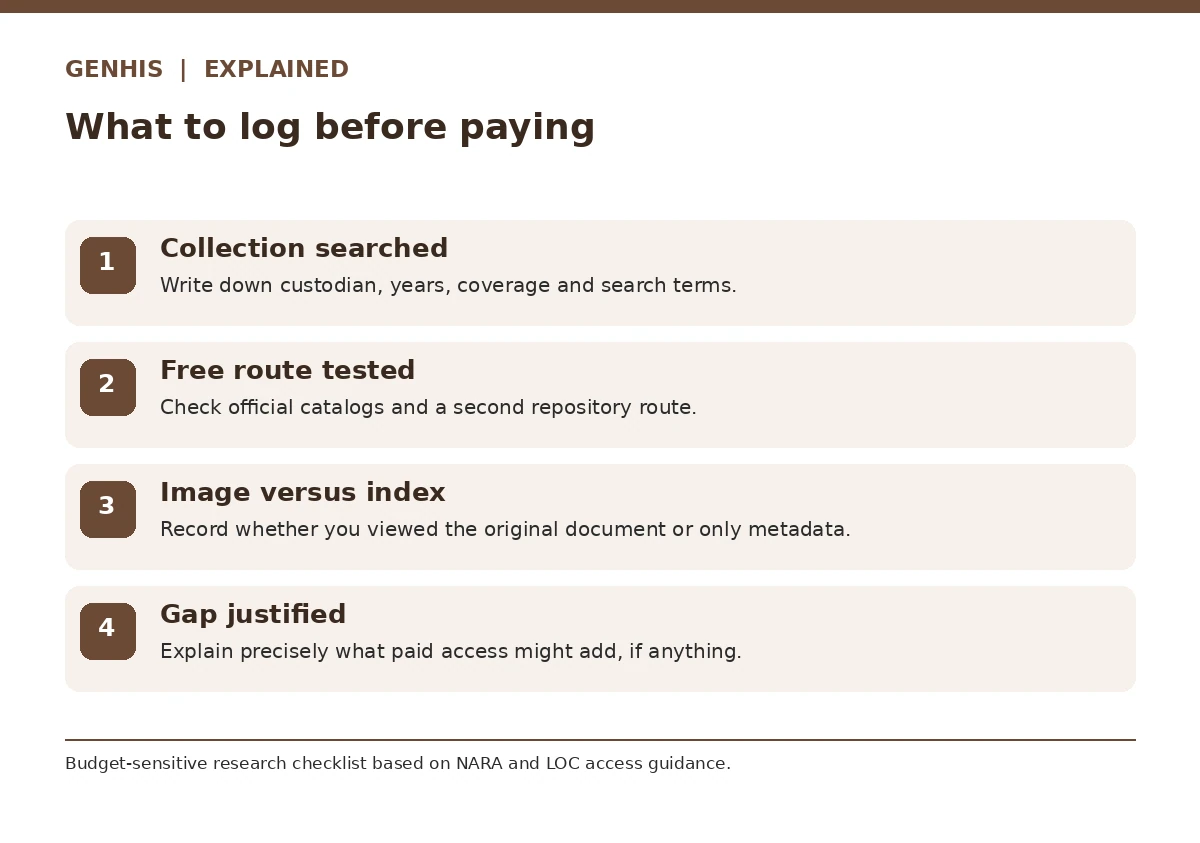
If a copy fee remains, define the question that the document could answer. Is it likely to distinguish two namesakes, substantiate a parent-child relationship, or document an otherwise unsupported event? A paid image that duplicates a free transcription without adding context may not justify the expense; another document with a different informant might be more informative. Keep a budget note with item sought, verified custodian, free routes attempted, current cost if independently checked, and what evidence would justify paying. Do not insert made-up prices into a guide.
Log a Fictional Budget Decision Step by Step
Suppose an entirely fictional researcher seeks a deceased ancestor’s marriage record in an unspecified U.S. county. The researcher has a family note and a possible date range, but no verified place. The first free task is to validate the county and determine which office maintained marriage records for that period. Next search its public catalog and relevant library guide, documenting what collections and dates were actually checked. No charge or record availability is assumed in this scenario.
If a web index produces a possible entry, label it a candidate pending examination of the underlying record. If the image is unavailable online, record the repository contact and ask about access rather than guessing the fee. If two candidates exist, compare independently sourced details before obtaining a paid copy. The outcome is an actionable decision record even when no ancestor can yet be attached. A zero-dollar search is useful only if it leads toward better-supported answers.
Recognize the Honest Limits of Free Genealogy
No single free platform holds all surviving church books, state registrations, family papers or historical newspapers. Records may be unindexed, privately held, restricted for privacy, lost, located in another jurisdiction, or available only at a repository. A government-created record can also contain inaccurate details. Do not guess that a missing online document was destroyed, that a specific scan exists, or that an archive will permit unrestricted photography. Coverage claims must come from the actual collection description.
A responsible free-first project ends each session with a source citation, a record of the search limits, and an identified next custodian or document. Keep private data about living people out of public working trees. Free databases provide access, not an automatic guarantee of identity. When a reliable conclusion needs materials unavailable from home, you can stop with a documented uncertainty rather than buying a subscription under pressure. That is a sound research outcome, not a failed project.
How We Research and What These Sources Establish
Our examples are deliberately fictional teaching cases, not identified historical people. We distinguish what a source reports from a reasonable hypothesis and what is unknown. This guide is informational, not a determination of family identity. Links below lead to the custodians or authors of the methods described; source availability and site interfaces can change. No paid partner relationship is asserted. See the affiliate disclosure policy (verified on GenHis on October 19, 2026).
Archives.Gov: Nara Resources — NARA distinguishes its federal record holdings from vital, church and family-tree material, and explains research-room resource access.
Archives.Gov: Nara Start — NARA describes common categories of federal genealogy records and its research resources.
Familysearch.Org: Fs Tree — FamilySearch describes its free community family tree, shared profiles for deceased persons and the limits of record hints.
Guides.Loc.Gov: Loc Guides — Library of Congress clarifies that not all relevant collections are available from home and identifies digital and nondigital research pathways.
Archives.Gov: Nara Forms — NARA provides ancestral charts, family group sheets and census forms for recording findings.
Loc.Gov: Loc Free — Library of Congress makes a selection of genealogy-related historic images and resources free to use and reuse.
Yes. You can record relationships and use several free catalogs and resources, but evidence quality still depends on examining suitable records.
Do not assume so. Check each collection’s viewing notices, account requirements, and any restrictions on images.
No. Holdings and digitization vary by custodian, place, time and record series, and copies or visits may have costs.
They are useful clues, not independent proof. Examine the underlying documentary evidence for each relationship.
Only after identifying the exact document, confirming no suitable free access route, and deciding what question the copy can answer.