
Search a Sun Fire Office policy by insured person, occupation, address or policy number. The London Archives keeps several different series, and endorsements can change the original details. A policy links a named party with an insured risk and date; it does not necessarily prove that the person owned the building. Read our affiliate disclosure for the site’s disclosure policy.
Begin With a Policyholder, Trade or Known Address
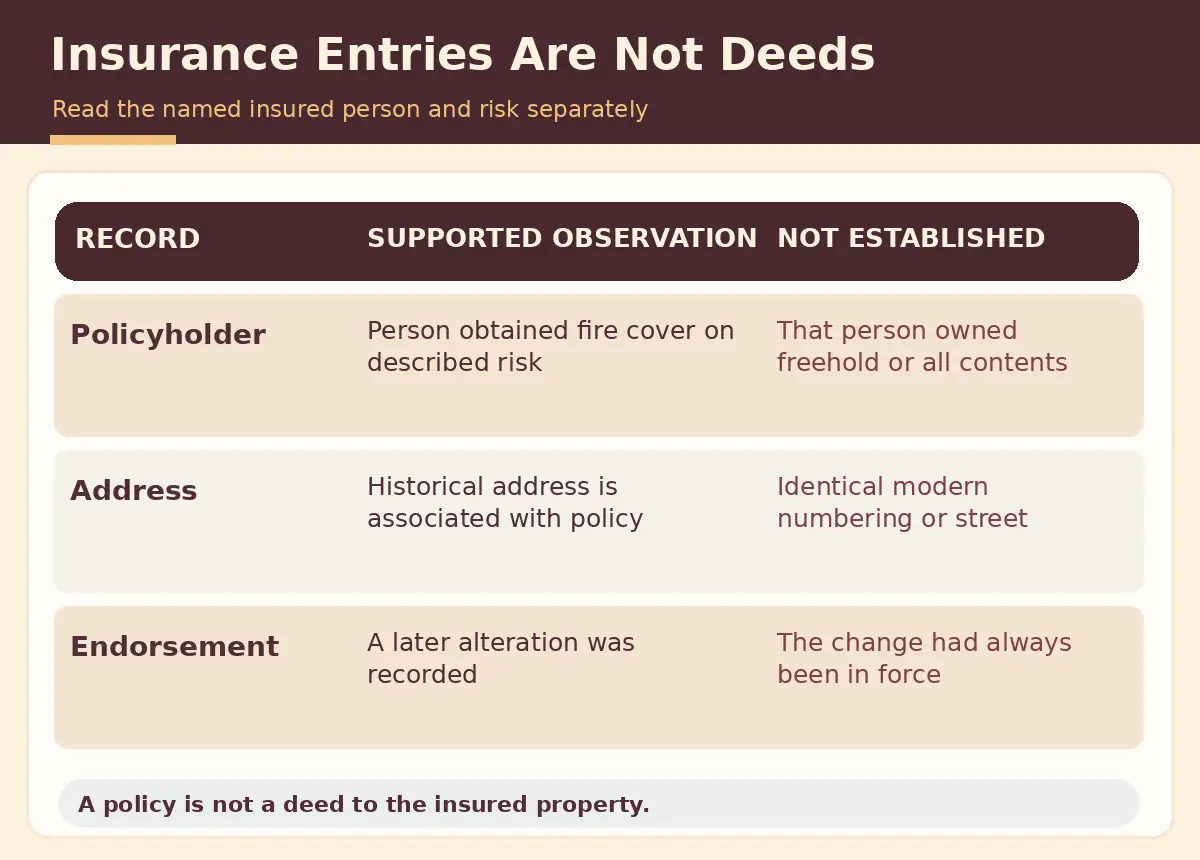
Sun Fire Office policy registers can identify an insured person and a business or building at a particular date, but they do not by themselves establish legal ownership. The London Archives’ fire insurance research guide lists the usual fields: policy number, date, policyholder’s name, occupation, address, property description and premium.
Start by spelling out what you hope to verify: a family trade, an address, an insured structure or a change in premises. Enter the date and street-name variations from a directory or other independent document before searching. Names may appear under occupational and business forms rather than the name expected in a family tree.
Choose Town, Country or Endorsement Books
The core Sun Fire Office Town and Old Series policy registers are in CLC/B/192/F/001 for 1710–1863. The Country Department, CLC/B/192/F/003, covers 1793–1863; later specialist series include endorsement books. The same institutional name on two archival series does not mean entries were filed as one chronological run.
Select a route according to place and policy date, and check whether a policy was altered. An endorsement recording a changed name, premises or business activity should be cited with its own date; it should not be silently projected back into the original insurance date. The archive also has fire-loss records, which are not automatic proof of a specific claimant’s loss.

Use Indexes Without Mistaking Them for Policies
The London Archives recommends catalogue searches using the word “insured” with a person’s name, occupation or address, because many Sun policy entries have been indexed. It also identifies older manuscript name indexes for 1711–1731 and further multi-insurer indexes.
For a narrow 1777–1786 search, the London Lives project offers a distinct compiled index based on Sun and Royal Exchange material. An indexed name is a direction to the original policy book, not a facsimile of everything the insurer recorded. Capture the register reference, policy number, spelling, date and exact address before reading the manuscript.
Read an Entry and Its Property Description
A person insuring goods in a shop may not have insured the whole building. A householder could insure contents while someone else owned the freehold. Interpret language about warehouses, stock, outbuildings or particular construction materials in light of the actual policy wording.
If a sum insured is stated, it is an insured value or cover level in an historical business agreement, not necessarily a building’s full sale price. Note endorsements and subsequent renewals before comparing two apparent addresses. The goal is to turn a descriptive register line into a dated statement about a policy, rather than an unsupported story about who lived there for decades.

Interpret a Fire Mark With a Verified Policy
A numbered fire mark can provide a valuable search clue when its provenance is clear. For example, London Museum’s documented Sun Fire mark links a 1791 policy taken by baker Sarah Reeves to specific Lambeth premises and gives a detailed archive reference.
The marked number and archival number make the object auditable, but an unprovenanced plaque on a different building should not be assigned to an ancestor without a corresponding policy. The museum’s example shows why a physical emblem and a dated policy are two sources that should be reconciled rather than blended into a single unverified identification.
Test Address Changes and Same-Name Traders
London streets were renamed, renumbered and rebuilt. Verify an address with its date, nearby features and a historical directory or map. Two traders with the same name and occupation may appear at different premises in the same decade; compare partners, shop descriptions, policy numbers and successive entries.
If an endorsement adds a partner, record what the document states and when. A fire insurance entry can support a link between a named business and premises, but not a biological relationship between similarly named persons. Keep addresses in original spelling in one column and tentative modern equivalents in another.
Cite the Complete Archive Location
A reproducible reference identifies The London Archives, Sun Fire Office, the exact CLC/B/192 subseries, manuscript volume, policy number and date. Add page or image detail and the catalogue permalink when available. This is particularly important because a finding may derive from a modern searchable catalogue, a manuscript index, a primary register or a later museum interpretation.
Label those layers separately. If images are unavailable remotely, state that you inspected a catalogue description instead of presenting the original handwriting as checked. A carefully framed index-only result can still be a useful research lead.
Worked Example: A Baker and a Changing Street Address
London Museum describes a Sun Fire mark related to baker Sarah Reeves and a dated 1791 policy for premises in Lambeth. This is a useful demonstration of what a reliable lookup includes: a named policyholder, occupation, date, address and a traceable policy reference. It is not a license to infer from the word “baker” that Reeves owned both buildings, employed everyone there, or resided on the site every year.
A family researcher should next compare a directory or rate book near 1791 and a later edition, then see if a policy endorsement documents altered premises or insured parties. A fire mark surviving on a modern facade may have been moved. Unless provenance links its number to an archival policy and the same property, the plaque is a clue rather than a confirmed address record. Keep the original historical address, its uncertain modern location and any later street renumbering in separate columns.
More House and Local History Guides
How We Research Historic Fire Insurance
Our method starts with an independently dated address or trade, routes it to Town or Country records, and searches an appropriate index before inspecting the underlying policy when possible. We classify fields as insured person, described risk, insured sum and date.
We then search endorsements for changes and test the address against directories, maps or deeds. We explicitly mark the difference between coverage purchased and ownership of real estate, and we document gaps in indexed periods. The reliable conclusion is often a dated business or property association rather than a complete ownership or residence history.
Not necessarily. The recorded policyholder may be an occupier, tenant, business operator or other insured party; compare leases and deeds before claiming legal title.
The London Archives lists Old Series and Town Department policies for 1710–1863 and Country Department policies for 1793–1863.
Typically a policy number, date, insured person’s name, occupation and address, a brief property description and premium; detail varies by record.
The archive recommends searching for “insured” combined with a name, trade or address; only many, not all, Sun entries are indexed online.
Check applicable endorsement books such as CLC/B/192/F/004 and F/005 and cite changes separately from the original policy.