
A rustic shelter, bathhouse, overlook or recreation lawn can illuminate how Americans used public landscapes in the 1930s, but a facility photograph does not reveal the identities of its visitors. NARA describes 3,200 photographs of state recreational facilities in the United States, dated 1935–1936, in National Park Service Record Group 79 series SP. These are useful starting points for facility history and historic-place identification. The record-group label should not tempt a researcher to assume every SP picture shows a federally owned national park or a building constructed by a particular New Deal program.
The word “state” matters. RG 79 covers the National Park Service and predecessor records, while the SP photographic series is specifically described as state recreational facilities. The same still-picture section includes broader NPS files, historic sites, park visitors and other specialized collections with different letters and dates. Search SP deliberately and retain the precise series designation. A photograph passed around as “old national park” may be from another branch or from a state property; an archive’s custodial record group does not by itself establish a land title.
Choose an Archival Route That Matches the Claim
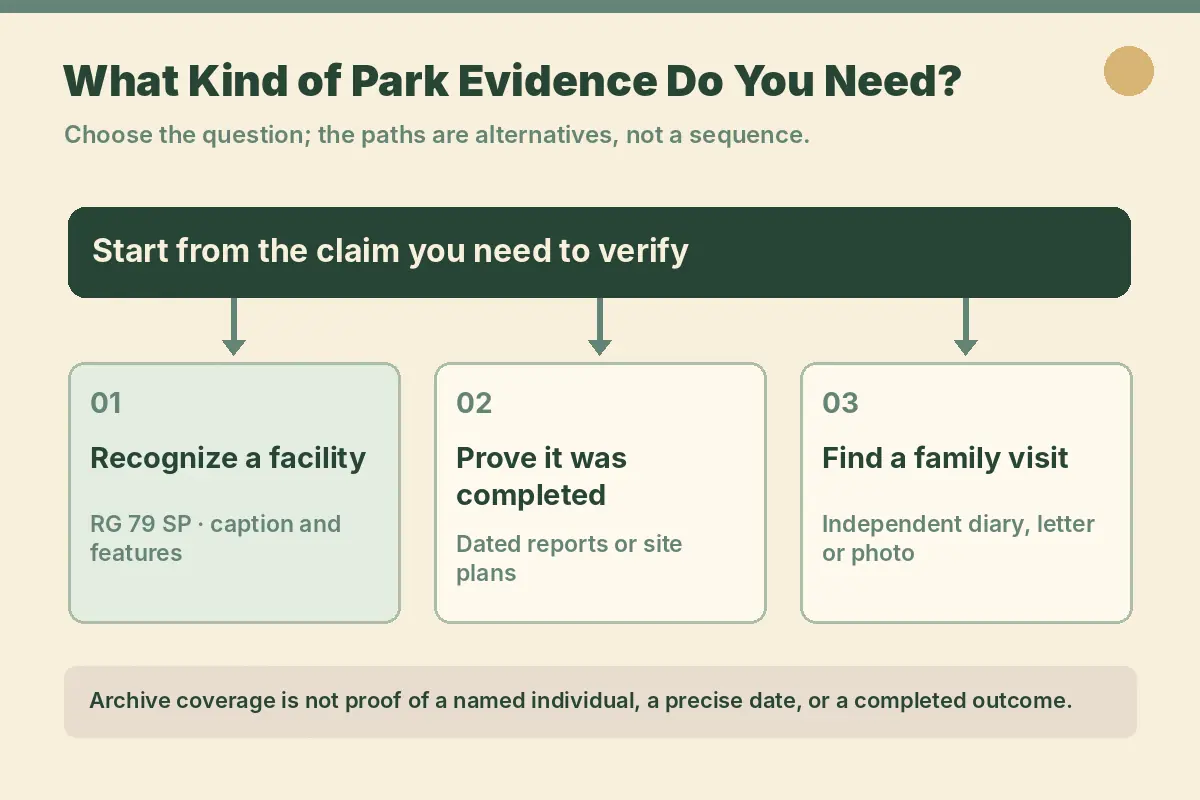
If the question is “Where was this stone pavilion?”, start from an original SP caption, compare rooflines, path geometry, landscape features and period maps, and track uncertainty. If the question is “Was it built in 1935?”, check construction or opening records. If the claim is “My grandparents attended an opening ceremony,” a park landscape is background material, not attendee evidence. A local newspaper, dated family photograph, invitation, journal entry or event program may identify a visitor, although each has its own strengths and limits.
Use the photograph to build a site inventory: shelter style, road entrance, water access, trail junction, sign wording and apparent state jurisdiction. Then test place names with maps appropriate to 1935–1936. Parks can be renamed, enlarged, transferred or reorganized; an area labeled a “reservation” or “recreational demonstration area” in one decade may later be called something else. Do not transfer a present-day visitor map backward without reviewing the intervening administrative history. Even a convincing visual resemblance needs a matching written location clue.
The National Archives guide identifies 3,200 photographs in RG 79, series SP, for 1935–1936. That is series-level information. It is not an item-by-item inventory, proof that everything is digitized, or confirmation of a particular person. Record the archival hierarchy before copying a citation: repository, record group, series, actual item identifier and the original descriptive wording. A photograph, lithograph or publicity artifact may have been reproduced or annotated later; those later actions are not identical to the historical event represented.
Date the Source Before Dating the Historical Event
The 1935–1936 dates describe the reported photographic coverage. The object may be older than the photograph, and the print may have been reproduced after exposure. Separate date built, date photographed, date of any repair, and the date a caption was added. A newly poured walkway next to an old picnic shelter might represent maintenance rather than original construction. Where no contemporary date exists, explain how you inferred the time range and why that inference should remain provisional.
A national program may have influenced park improvements during these years, but the presence of log walls or stonework does not prove that the Civilian Conservation Corps built the structure. If such an attribution matters, locate project lists, work records or corresponding plans naming the park and construction task. State parks could employ contractors, local agencies or several funding sources over time. Avoid conflating a photograph’s creator with the agency that actually owned, designed or maintained the facility.
Separate What the Image Shows From What It Suggests

When comparing two images of the same location, choose stable features such as shoreline shape, terrain, foundation geometry or prominent rock formations over movable benches and signs. Annotate the visual match and the archival source that supports the identification. A retouched publicity image or reversed print may confuse left and right; confirm orientation with other views. Keep the observed photograph separate from a present-day image so readers can see which changes are documented and which are suggested by appearances.
A rigorous facility ledger records RG 79 SP, item caption, repository identifier, state, park name as stated, probable coordinates, date confidence, visible construction details and independent sources. Put competing identifications in their own rows. If a state agency inventory gives a later opening date, ask whether the photograph shows a predecessor facility rather than assuming one source must be wrong. Do not list a named guest, ranger or builder unless that name comes from a record actually supporting that person’s involvement.
Build an Independent Chain of Evidence

Suppose a family album contains an undated picnic with a stone overlook. An SP item may help identify the same overlook, but the two pictures need shared landmarks and a convincing chronology. Next compare a park map and construction dates. Even if the site matches, the SP picture does not prove who attended the family picnic; the family album’s provenance and other biographical evidence carry that question. Describe the result as “probable location, pending confirmation” if the setting remains uncertain.
A reliable working note has two statements, not one. The first is what the RG 79 SP source directly records or visibly depicts, with all uncertainty retained. The second is a proposed link to a particular family, person, site, transaction, or period; it needs evidence created for that purpose. The same caption repeated in a blog, social post and archive index is still one source. Keep a list of rejected alternatives, and never turn an unsuccessful catalog search into a claim that a historical event did not happen.
Write the Final Caption With Clear Evidence Limits
Publish a defensible caption: name the facility and state only if the original item or an independent site record supports them, and cite RG 79 SP and the available image identifier. Do not add invented visitors to a landscape or infer historical ownership from agency custody. The forest pavilion depicted in this guide’s newly drawn cover is explanatory artwork, not a reproduced SP photograph. To obtain or examine an original item, use NARA’s still-picture research route and preserve the caption wording available at the time of consultation.
Check physical context as well as web metadata. A clipped thumbnail can hide a caption, the edge of a building or an original image number. Download or request the fullest lawful reproduction available; transcribe actual inscriptions without silently correcting them. Mark approximate dates as approximate and label any identification supplied by a later cataloger. Keep a copy of the source description used for research because catalog records and access conditions can change. Explain clearly when a newly made illustration accompanies a historical discussion rather than reproducing an object from the named archive.
More Place and Jurisdiction Guides
How We Research Archival Images and Their Limits
We consulted the National Archives RG 79 record-group description for the creator, media, series designation, number of items and date range. The NARA Still Picture Branch guidance describes research paths for original photographic and visual holdings; the general NARA research guide helps track descriptions to records. The supporting images on this page are original explanatory artwork, not facsimiles of the archival sources. See our affiliate disclosure.
The NARA guide describes 3,200 photographs of state recreational facilities in the United States for 1935–1936.
No. The SP description says state recreational facilities; RG 79 also holds other NPS photographic groups.
Not from appearance alone. Link the specific structure to a dated project, construction or administrative record.
No. A family visit needs separate dated personal or event evidence.
No. Catalog and digitization coverage are not an exhaustive inventory of every historical structure.