
Thousands of drawings entered federal art competitions during the New Deal period, but an attractive submitted sketch is not the same thing as a mural placed inside a post office. NARA’s Record Group 121 identifies FES sketches from the “48 States Competition” and a broader MS group of competition artwork from 1934–1943. The group also describes separate photographs of commissioned murals and sculptures in CMS, PS, and GA. For artists, descendants, and local historians, the problem is choosing the correct stage of the evidence: submission, selection, execution, or installation.
Begin with the actual FES or MS item, its caption and any credited artist. Do not label every competition submission as a finished mural, and do not claim an artist won because their sketch survives. A building photographed years later may have a different design, or the selected artist may have revised the composition. The distinctive research value is the comparison between a candidate drawing and independent commission and site records, rather than an invented success story for a striking image.
Distinguish FES and MS From Completed Work

The National Archives lists sketches submitted in Section of Fine Arts competitions, including FES submissions in the “48 States Competition,” alongside a larger MS group of competition designs. Both are sources about proposals. Some sketches can have an identified artist, place, title, or competition; others may lack the details needed for a secure interpretation. Check the original image or card before transcribing a name, especially where a work was attributed later. Record what appears on the artwork itself separately from the modern finding aid.
For completed art, the NARA guide points to CMS, PS, and GA photographs of murals, sketches, paintings, and sculptures commissioned for federal buildings, dated 1934–1943. These series do not guarantee that every FES proposal has a corresponding completed-art image. They represent different archival arrangements and purposes. A crosswalk becomes useful only when a documented artist, project, building, design title, or correspondence identifier bridges the records. Avoid drawing an automatic arrow from every submission to CMS.
Trace a Documented Decision in Correspondence
RG 121 section 121.3 also lists correspondence of the Section of Fine Arts, including embellishment case files, artists’ letters for 1939–1942, and records concerning completed murals and sculpture. These are promising files for tracing a proposal’s administrative fate, but the holdings do not provide a universal artist-by-artist result in the web overview. Search a surname alongside the post office or other proposed federal building, and verify whether the letter concerns competition entry, an invitation, a commission, revision, delivery, or payment.
Use the writer’s exact terms. “Approved for consideration” is not identical to “awarded,” and an award may be canceled or changed. A payment entry can document a disbursement but not physical installation. Even a finished canvas or a contractor invoice is not necessarily evidence it was displayed in the specified building. Where correspondence is absent or inaccessible, describe the administrative outcome as unconfirmed instead of extrapolating it from an enthusiastic contemporary newspaper account.
Verify the Particular Post Office and Its Artwork

To test an installation claim, identify the precise building and its period name, street address, and jurisdiction. Post offices can move or change names, and a community may have multiple federal facilities. A photograph of a mural in a building establishes its presence at the photograph’s date if the place and subject are reliable, not automatically the installation year. Compare original interiors, local historical society records, preservation files, correspondence, and dated newspaper descriptions. Distinguish an initial commission from later relocation or conservation.
Local histories sometimes credit a beloved mural to a competition artist whose early design was not used. Start with the signed or captioned final work and seek a matching commission, not just visual similarity. A proposed subject might be revised for size, historical content, or architectural fit. Document every transition with a dated source. If you cannot substantiate a match, publish the FES sketch as an archival contest entry and treat the connection to the existing artwork as a hypothesis, clearly flagged.
Research an Artist Without Confusing Identity
Some competitions drew many entrants with similar names or initials. Cross-check an artist with correspondence, biographical data on artists in RG 121, exhibition records, dated addresses, and established catalogs or museum descriptions where available. A surname on a drawing is not proof that the creator is a particular relative. Verify first and last name, signature style only as corroboration, geographic activity, and documented commissions. A repeated theme in multiple artworks is not sufficient identity evidence.
If a descendant owns a sketch, letter, or portfolio image, compare dates, paper annotations, and documented provenance without assuming it is the very piece photographed by NARA. Distinguish a copy, study, submission version, and later reproduction. The Archives’ image count describes photographs and sketches, not the number of unique artists, built murals, or post offices served. Keep the question being answered explicit: who submitted, which design was selected, and what was actually installed are separate historical inquiries.
Write a Defensible Mural Caption
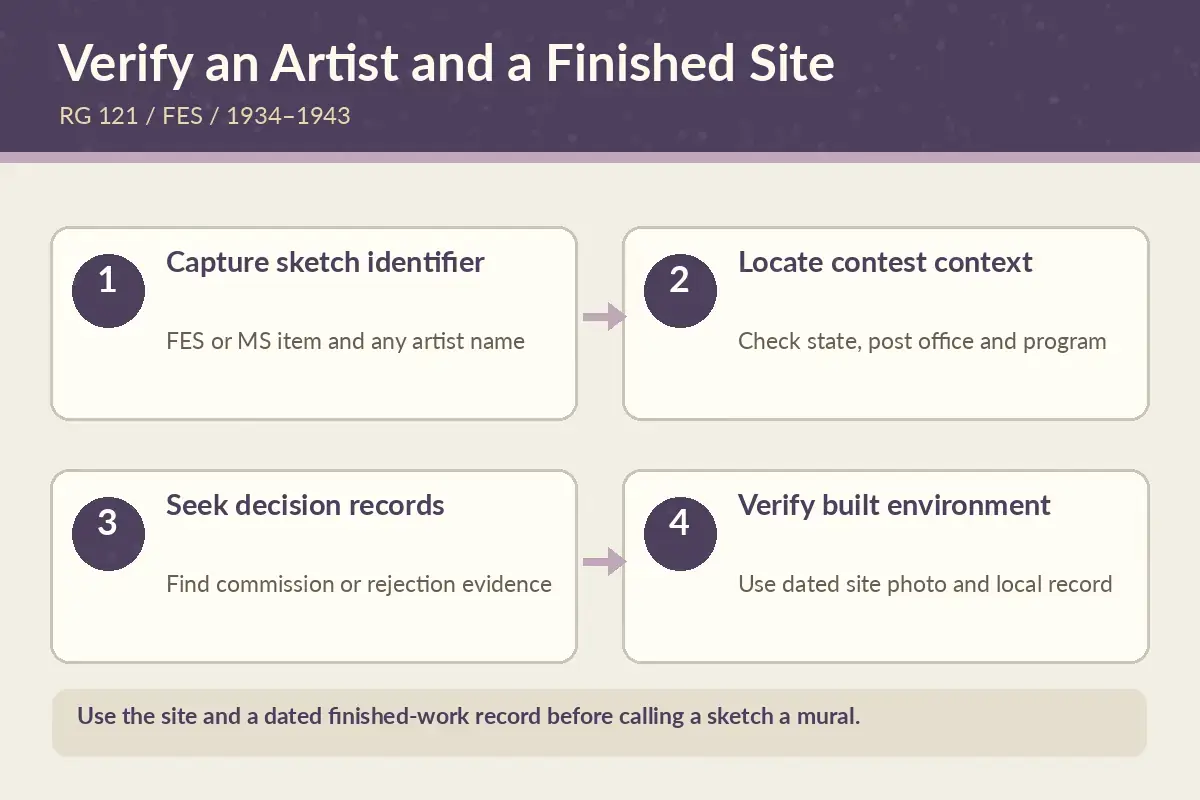
A careful caption might say “FES photograph of a design submitted to the 48 States Competition, RG 121, approximately 1934–1943; individual submission date to be checked.” If original evidence supplies an artist, contest, and precise date, add those details with the item identifier. Do not rename the sketch as a completed mural until supported by independent commissioning or site documentation. Label the modern illustrative diagrams on this page as explanatory art rather than photographic reproductions of the actual federal artworks.
For a fuller article, present an evidence table with three columns: series, what the record states, and what remains unproved. This helps readers understand why an artist’s entry, a favorable letter, and a photograph in a post office do not collapse into one event. Ask NARA about the relevant FES or MS finding aids and RG 121 correspondence arrangements, then verify local building histories through primary records. A precise account of an unselected design can be every bit as valuable as the story of an installed one.
More Family Story and Preservation Guides
How We Research This Evidence
This guide is anchored in the official archival description: RG 121 section 121.3 describes competition sketches including the “48 States Competition,” 1934–1943, in FES and MS, and separate photographs of commissioned art in CMS, PS, and GA. That supports the existence, arrangement and broad dates of records as described, not the accuracy of claims about an unseen individual item. Check a specific identifier, original caption or register line, date, creator and physical arrangement before using the material in a family or place history. Where archival descriptions conflict with an event timeline, preserve both and explain why they answer different questions. Each schematic image in this article is an original modern educational illustration, not an image of the record itself.
We checked the source information on 2026-11-14; that is an access-check date, not the historic creation date. Follow NARA’s Still Pictures guidance for image requests or research preparation guidance for questions about original holdings and access. Exact availability, digitization, use rights and individual identities must be established at item level. Consult the affiliate disclosure for site transparency; mentioning a repository does not imply a paid relationship. We use this method to test a contest submission against a documented artist decision and physical installation, making explicit what remains uncertain.
NARA uses FES for sketches submitted to the federal “48 States Competition” for post office murals.
No. It proves only the documented submission or sketch as described.
NARA describes MS as broader competition submissions and FES as the 48 States Competition; inspect item-level descriptions.
RG 121 sections 121.3 and 121.8 refer to series CMS, PS and GA.
Not without a verified decision or commission record linked to that artist and design.