
The 1874 Michigan state census is not a single, intact statewide database of residents. The state conducted a census that year, but surviving manuscript returns are fragmented by county and schedule. Start with the place where your ancestor lived in the early 1870s, then ask whether an 1874 return for that county actually exists. This prevents the most damaging false negative: assuming a missing search result means the person had moved. The Archives of Michigan identifies state census materials in its digital collections, while the Library of Michigan recommends dedicated survival guides. A published statewide statistical volume cannot substitute for a manuscript schedule naming a household. This guide uses the documented collection description to keep search results separate from verified genealogical conclusions.
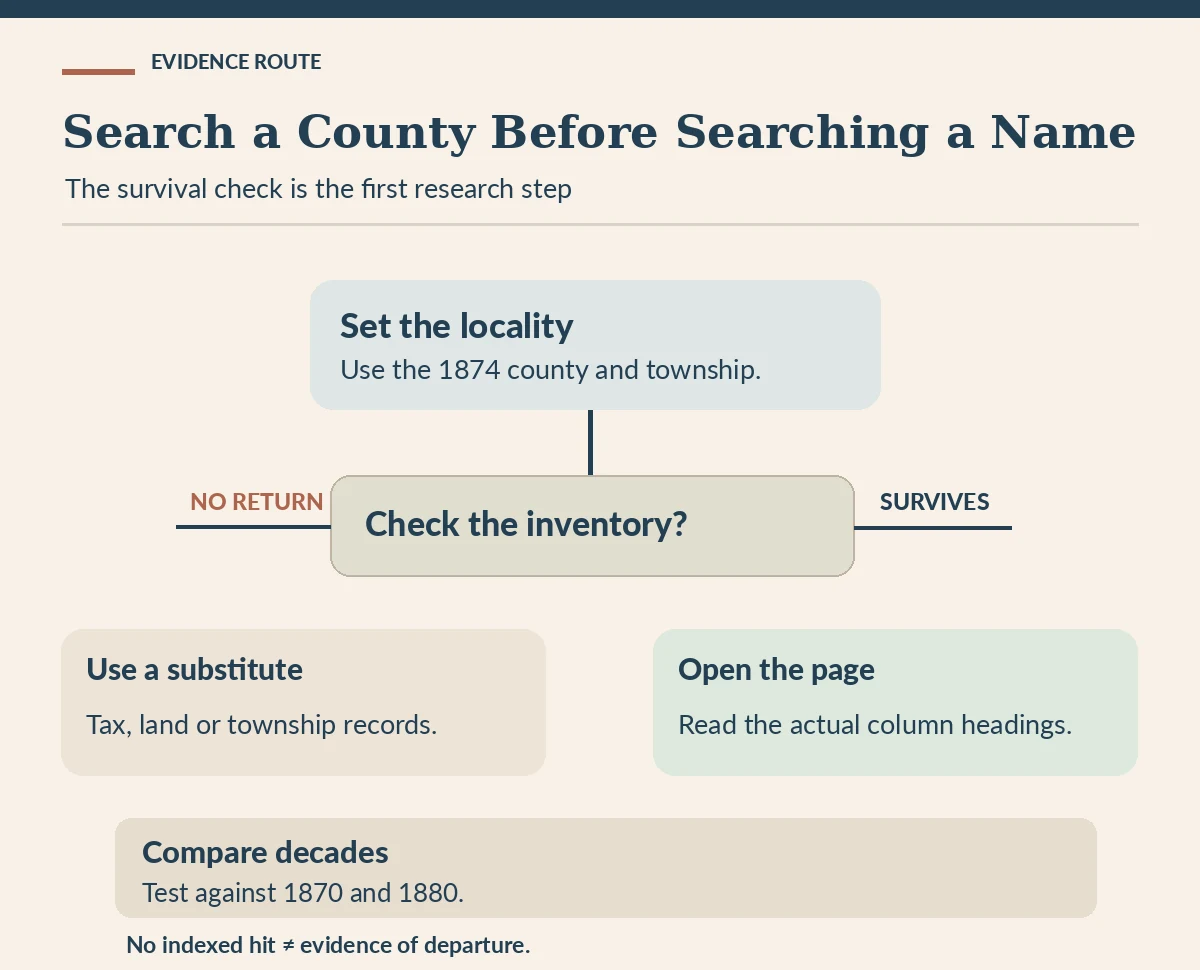
Test the county’s surviving 1874 records before searching names
The practical objective is to find the relevant archival series, capture the original source context, and identify the next independent record before making a family claim. Record your search terms and the exact fields supplied by the document.
Use the archive’s Michiganology holdings as the principal route
The Archives of Michigan collections guide identifies Michigan state census records from 1827–1894 among its digitized holdings on Michiganology. Search within the appropriate historical census collection, not every result labelled “census” across multiple years. Browse geographic organization when a name search fails or when a collection is only partially indexed. Note township, county, enumerator’s page heading, and the census year visible on the original. Do not assume a modern county boundary reflects the precise geography of an 1874 township. A county and a manuscript year are essential constraints before considering the surname.
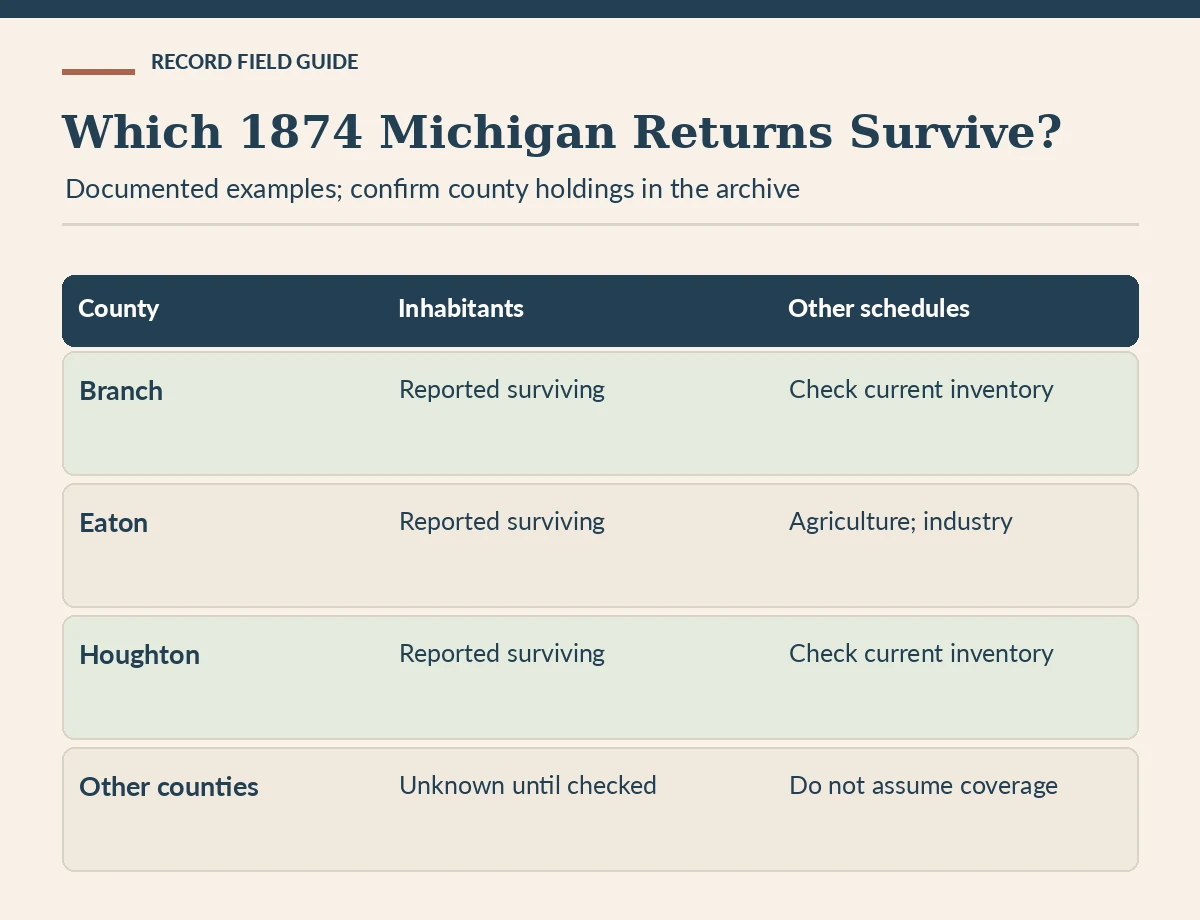
Compare Branch, Eaton, and Houghton as documented examples
A county-by-county historical listing from Michigan volunteer researchers reports surviving 1874 inhabitant schedules for Branch, Eaton, and Houghton counties. Eaton is also listed with agricultural and industrial schedules for that year; the other counties’ surviving schedules may not be the same. These examples are search leads, not a claim that every other county lacks an 1874 record. Verify current holdings with the state archives and any county repository because catalogs can expand or refine classifications. Log the county, township, schedule type, and exact archival reference. A missing agricultural return does not invalidate an existing inhabitant schedule, or vice versa. To go further, our guide “1884 Michigan State Census” shows how to find surviving county schedules and verify families.
Distinguish inhabitant returns from farm and industry schedules
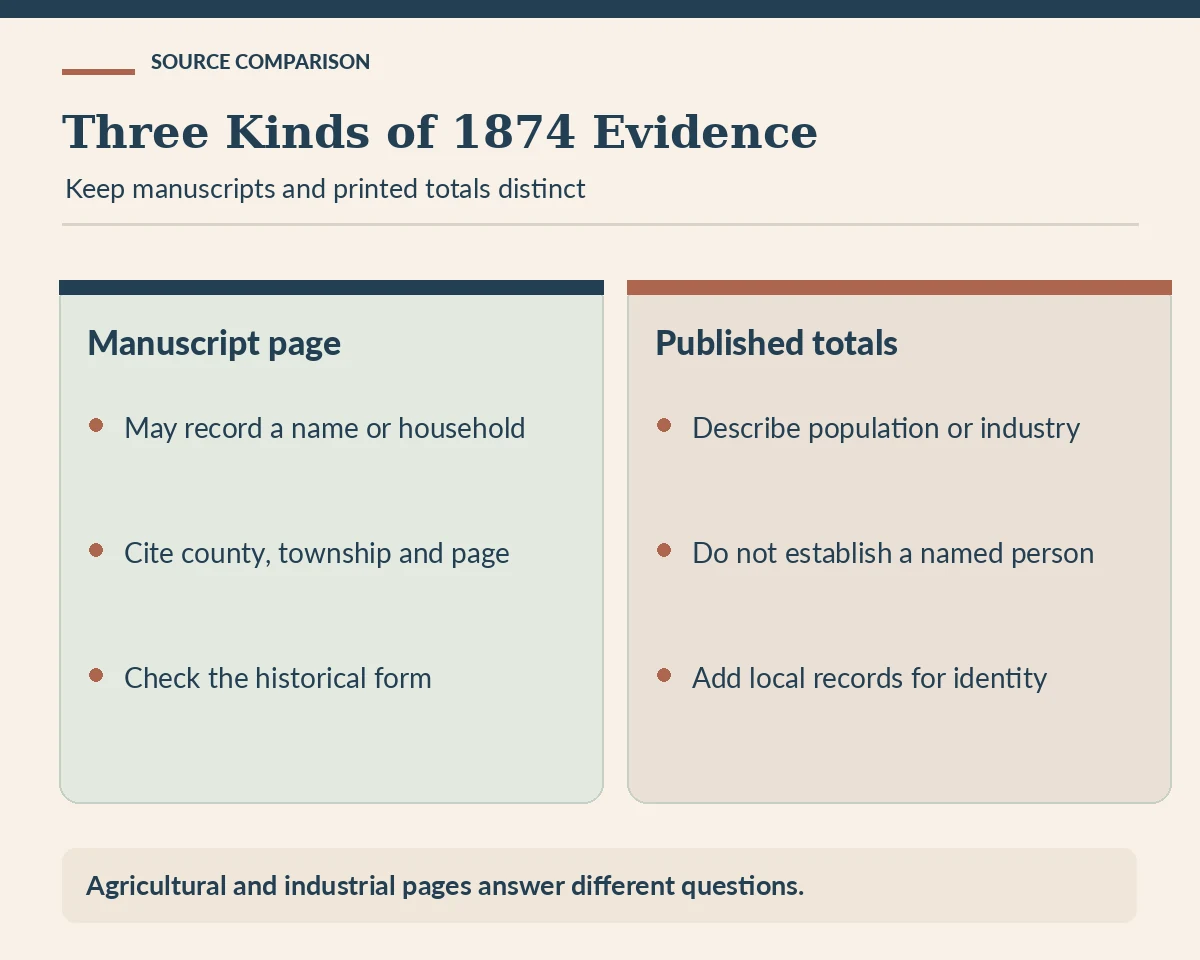
An inhabitant schedule addresses people or households, while agricultural and industrial returns document particular categories of farming or production. A common surname on a manufacturing return cannot by itself be assigned to the household of a person bearing that name. Determine whether the page records a named individual, a householder, a business or farm operator, or merely aggregated totals before using it to construct genealogy. Older state enumerations differ in their printed form and information fields, so read the year-specific column labels directly. Never import the far richer 1884 or 1894 field list into an 1874 transcription just because all are Michigan censuses. For the fuller picture, see our guide “Michigan State Census Records”.
Treat the printed 1874 census as contextual evidence
Michigan issued contemporary printed results from the 1874 enumeration. Statistical summaries can help establish the size and character of a county, but they rarely prove that one named ancestor lived in a specific household. Keep the printed statewide report separate from an original local enumeration sheet. If only aggregate totals survive for your target area, the correct outcome may be historical population context rather than an individual identification. State the difference in a research log: published figures, manuscript population return, and collateral local sources. Do not cite a statistical table as though it contained the names absent from its printed columns.
Transcribe only the questions actually printed on the 1874 page
The University of Michigan catalog identifies the original 1874 census law and instructions, a useful way to understand how the enumeration was intended to work. Actual preserved sheets can still vary by category. Copy the column headings in order, including any abbreviated household totals, and retain unclear ticks or struck-through entries. If only the householder is identified, unnamed people on that line cannot safely be given names from later censuses without corroboration. Do not translate a reported occupation or household tally into a deed, marriage record, or proven parent-child relationship. Keep reported facts and family hypotheses in separate worksheet columns.
Bridge the federal census gap without merging namesakes
The 1874 return falls between the 1870 and 1880 U.S. federal population censuses. Build a three-date table using an independently identified 1870 resident, the available 1874 location and household information, and a plausible 1880 candidate. If the ancestor moved, county and township details may be more informative than a repeated surname. Compare ages, occupation, neighbors and other fields only where the actual source supplies them. Differences can signal two namesakes, a boundary change, or a transcription issue. A missing 1874 manuscript page creates an evidence gap; it does not establish a departure from Michigan.
Find alternatives when your county return is missing
For a county not represented in the known surviving 1874 manuscripts, seek contemporary county tax rolls, land deeds, township records, city directories, school lists or probate material according to the ancestor’s circumstances. Be specific about the question each substitute answers. A tax entry might identify someone assessed for a parcel; a directory may report a residence or business; a deed shows a transaction rather than continuous occupancy. Do not call every alternative a “census substitute” without stating its limits. Record the failed archival search with precise county, year and collection coverage, then pursue a different record type that could test the same residence hypothesis. Our guide “Pomeranian Parish Records” covers a related question.
Record conflicting county coverage claims without inventing precision
Independent county lists are useful starting points but are not the final authority over an evolving state archive catalog. One website may list a partial inhabitant schedule while another highlights a microfilm reel or township subset. Reconcile such statements by identifying exactly what survives: named pages, a single township, or a separate schedule. If the archival description lacks enough detail, describe the scope as uncertain and contact the repository. Never publish a statewide percentage of coverage without a documented inventory. The responsible conclusion is often that a specific volume was checked and did or did not contain a target township, not that the entire 1874 census is “lost.”
Cite the physical page and write a narrow conclusion
For a surviving 1874 page, cite Archives of Michigan or the actual custodian, the census year, county, township, record type, volume or film reference, page, and observed name or household. For published statistical material, cite its printed title and page separately. If the archive gives a stable image or digital identifier, save it with the consultation date. Conclude only what the record supports: presence of a named householder, a recorded tally, or an occupational category. Before declaring identity proven, compare a distinct 1870 or 1880 record. If the evidence remains ambiguous, set out the next document that could resolve it.
More Records and Archives Guides
How We Research Michigan 1874 State Census
We compared collection descriptions, holdings notes, and documented source limitations using archive catalog; repository guidance; archive catalog. This is an independent educational research guide, not an endorsement of a paid service. Read the affiliate disclosure for site-level policy.
Yes. The Census Bureau includes 1874 among Michigan state census years, but surviving named schedules are incomplete.
No. Michigan state census holdings have significant county and schedule gaps; check the actual archive inventory.
Historical county listings identify inhabitant returns for Branch, Eaton and Houghton, with additional types of returns reported for Eaton.
No. A farm or production entry needs separate deed or title evidence to establish legal ownership.
Describe the precise county, township, volume and pages searched; do not treat the failure as proof the person had left Michigan.