
A medieval writ was a formal command, not the verdict of a case. The National Archives identifies JUST 4 as surviving writ files from a small number of general eyres, the itinerant royal courts that visited English counties in the medieval period. A writ can reveal a procedural instruction, party, place or court context. It does not by itself prove that the instruction was executed, the named person attended a hearing, or the underlying allegation succeeded. Start by asking what step in the process the document actually records.
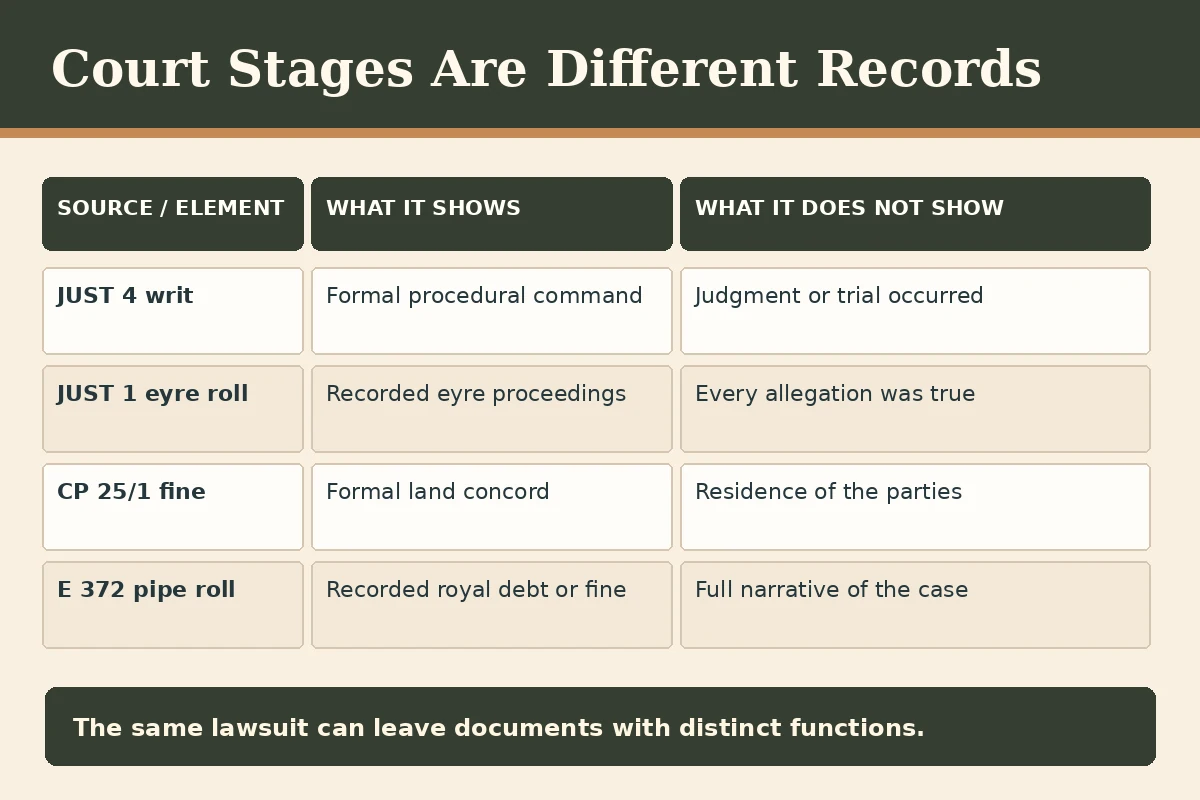
The relevant general eyre research guide covers courts from 1194 to 1348, but that span must not be mistaken for complete coverage in JUST 4. Writ survivals are exceptional. The practical search begins with a historic county, an approximate eyre date and the document’s procedural role. A case’s progress may instead be reflected in JUST 1 court rolls, a CP 25/1 land concord, or Exchequer financial entries. These can intersect without forming a guaranteed sequence in every lawsuit.
Locate a county eyre before looking for a surname
Search JUST 4 using the word “eyre” and the historic county name, as the National Archives recommends. The aim is first to find relevant files, not to obtain a person-indexed biography. County boundaries, alternate spellings and Latin forms complicate searches, so note the form used in the catalogue. If the county or approximate court visit is unknown, consult general eyre calendars, local studies and related court records to narrow the opportunity for a surviving writ.
A catalogue-level date may cover an eyre session or bundle rather than the exact day a writ was issued. Transcribe the individual writ’s dating formula where possible. Medieval records often use regnal years and court terms, so do not silently translate them into a modern calendar date without checking the conversion. When a document mentions multiple officials or parties, record each role separately. A royal justice, sheriff, litigant and witness are not interchangeable figures.
If no JUST 4 item fits, it may mean only that writs for that eyre have not survived or are not described with the terms you used. The guide stresses their limited survival. Broaden the search to court rolls and other documentary types before making a negative assertion about a named dispute. A gap in the surviving procedural paperwork is neither evidence that the event did not happen nor permission to supply a reconstructed hearing from imagination.

Read the writ as a specific legal instruction
Identify the command verb, the issuing authority, the official addressed, the object of the action and the applicable place or deadline. A writ directing a sheriff to act may document that the court initiated a step, but whether service, seizure or attendance followed needs evidence elsewhere. Medieval legal formulae can be highly standardized. Do not let the impressive seal or formal Latin wording exaggerate what a surviving piece of parchment actually establishes.
The parties named in a writ might be litigants, recipients of an order or people mentioned in the process. A surname match is not a genealogical link, and a reference to land is not proof that a party lived on it. Record which relationships are explicitly stated and which are inferred. A person acting for a community or monastery may have been an official agent rather than a relative of the property owner. These distinctions are crucial in early family reconstruction.
Use a transliteration or translation if necessary, but mark any uncertain readings. If only a printed calendar is available, cite the edition and state that the original was not examined. Sometimes the exact wording of a directive changes its significance: “inquire,” “summon,” and “deliver” point to different tasks. Keep the original legal term beside your plain-English summary so later readers can reassess the interpretation without having to trust a loose paraphrase.
Test the case against other court and fiscal records
General eyre proceedings can appear in JUST 1, while related cases adjourned from Westminster may be traceable in other central court series. Check dates, county, litigants and the precise cause of action before linking records. It is possible to have a writ but no surviving final proceedings, or a proceeding without the initial writ. Treat each source as an independent survival. An attractive narrative is no substitute for a shared person, case detail or explicit cross-reference.
Some disputes resolved through formal agreements known as final concords. These appear among CP 25/1 feet of fines, but a concord is not the same record as the writ or trial. It records a settlement or conveyancing form and cannot by itself prove the earlier accusations. Keep the agreement’s parties, land interest and date distinct. Likewise, a reference to a judicial amercement in Exchequer E 372 may show a financial obligation without disclosing everything said at the hearing.
Suppose a fictitious writ mentions a disputed field and a sheriff’s summons. The writ establishes that the instruction existed. A later eyre roll entry might describe an appearance or decision; a pipe roll might register a debt. Only when their dates and named parties connect can the researcher reconstruct the sequence. If one link is missing, state the gap in the working chronology rather than claiming the sheriff executed the writ or the claimant won.
Publish a precise claim with an explicit survival limit
An adequate citation gives the full JUST 4 reference, county, date as written, and the manuscript portion used. Note whether you saw a complete original, scan, transcript or brief catalogue description. Record damaged text and ambiguous Latin in a separate field rather than normalizing it into a confident factual statement. A source abstract may omit a qualifying word or identify a person under a standardized spelling, both of which can alter your conclusion.
For local history, sketch a jurisdiction map without assuming that a modern town was governed by the same court procedures. Identify the eyre county and the offices relevant to the writ. A royal court instruction should not be conflated with a manorial court act or parish record. If searching for a particular family, use charters, manorial rolls and other dated sources to establish residence or descent independently. Court participation can be an important clue, not a complete pedigree.
Conclude with two statements: what the writ directly supports, and what remains unverified. For example, “the writ directed an inquiry concerning the specified property,” not “the inquiry found the person guilty.” Write the exact repositories and years searched for further evidence and preserve alternative spellings. This leaves a research path that another historian can repeat and prevents an archival procedural step from becoming an invented trial, conviction or permanent transfer of land.

More Place and Jurisdiction Guides
How We Research JUST 4 Records
We rely on The National Archives’ general eyres guide for the limited scope of JUST 4, its feet of fines guide for distinct agreements, and its pipe rolls guide for fiscal consequences. These guides explain record systems rather than verifying any particular surviving case.
We mark every proposed link between a writ, a hearing, a concord and a fiscal entry as conditional until its references match. Our affiliate disclosure states the site’s editorial transparency; no unverified paid genealogical service is necessary to follow the methodological distinctions explained here.
Writ files surviving from a small number of medieval general eyres.
The National Archives recommends searching for “eyre” plus the county name.
No. It is a command; inspect other court records for subsequent proceedings.
Depending on the case, inspect JUST 1, a CP 25/1 concord or a separate relevant account.
Only a small sample of the eyres’ original writ files survives.