
A nineteenth-century blue-toned photograph of a wharf can help reconstruct the physical waterfront, but it is not a title deed. NARA lists 490 cyanotypes from the Fish Commission and Bureau of Fisheries material in RG 22, labeled CA through CL, showing wharves, fishing vessels and communities from 1882–1892. The states named in the archival description include California, Connecticut, Maine, Maryland, Massachusetts, New York, Rhode Island and Virginia, with Great Lakes scenes also represented.
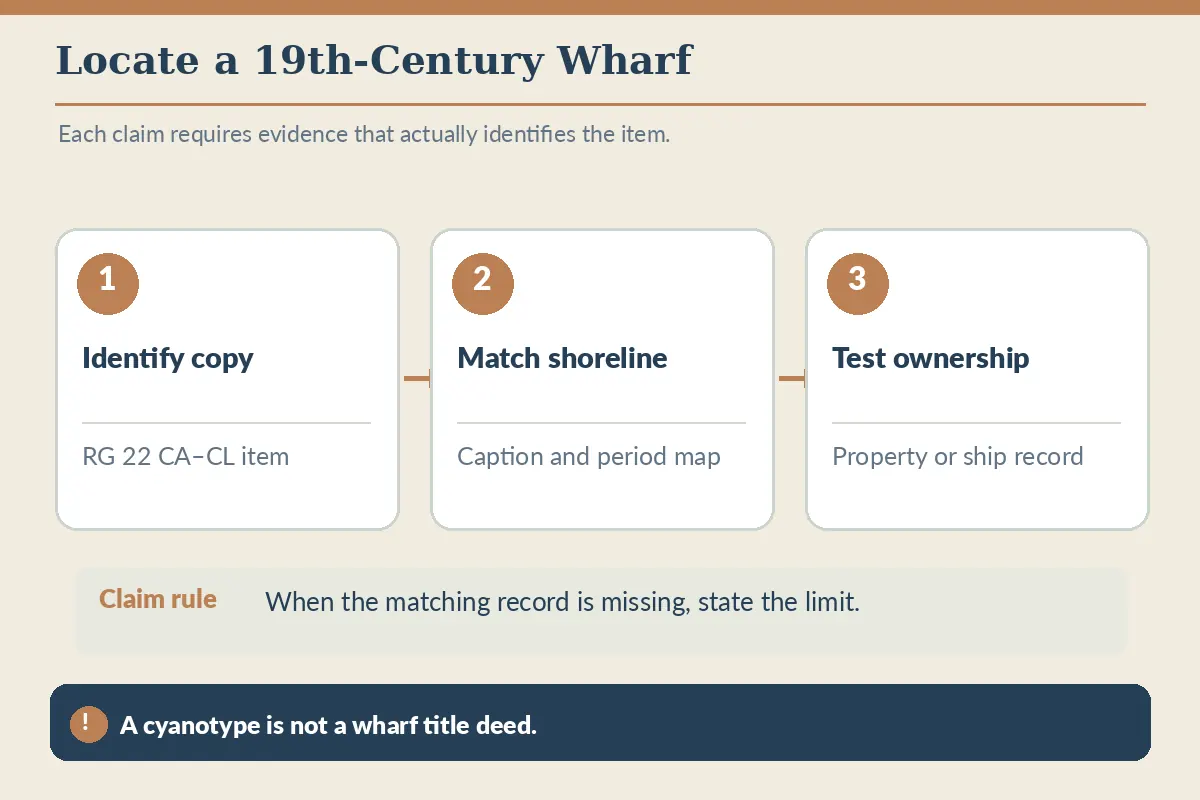
Find the exact CA–CL image identifier before making a port identification. The letter series and time span do not guarantee that every photo shows one state, that a boat was locally registered or that anyone shown owned the photographed dock. Treat the cyanotype’s original caption, visible structures and independent property or port records as separate evidence.
Keep the CA–CL Cyanotypes Separate From FCB–FCF Prints

NARA lists the blue-toned cyanotypes as 490 images from 1882–1892, with codes CA, CB, CC, CD, CE, CF, CG, CH, CJ, CK and CL. The same RG 22 guide separately describes 600 commercial fish, oyster, crab and shrimp operation photographs from 1891, labeled FCB, FCC, FCD, FCE and FCF, with a keyword index. These are different groups even when both depict maritime work.
Do not assume the letters CA–CL correspond one-to-one to states or years. The published overview does not define such a simple lookup, and a fabricated crosswalk can wrongly move a boat from the Atlantic coast to the Pacific. Use an original item caption or a series-level finding aid to identify locality. Record whether an image was described as a cyanotype, a print or a copy of another photographic form.
A cyanotype’s blue color reflects the photographic printing process, not the color of the original harbor water, boat hull or buildings. If a version was later converted to black and white, it may be a reproduction of the same view rather than a separate exposure. Save the negative or original print identifiers wherever available so that visually similar derivatives are not counted as different visits.
Identify the Wharf Through Fixed Historical Landmarks
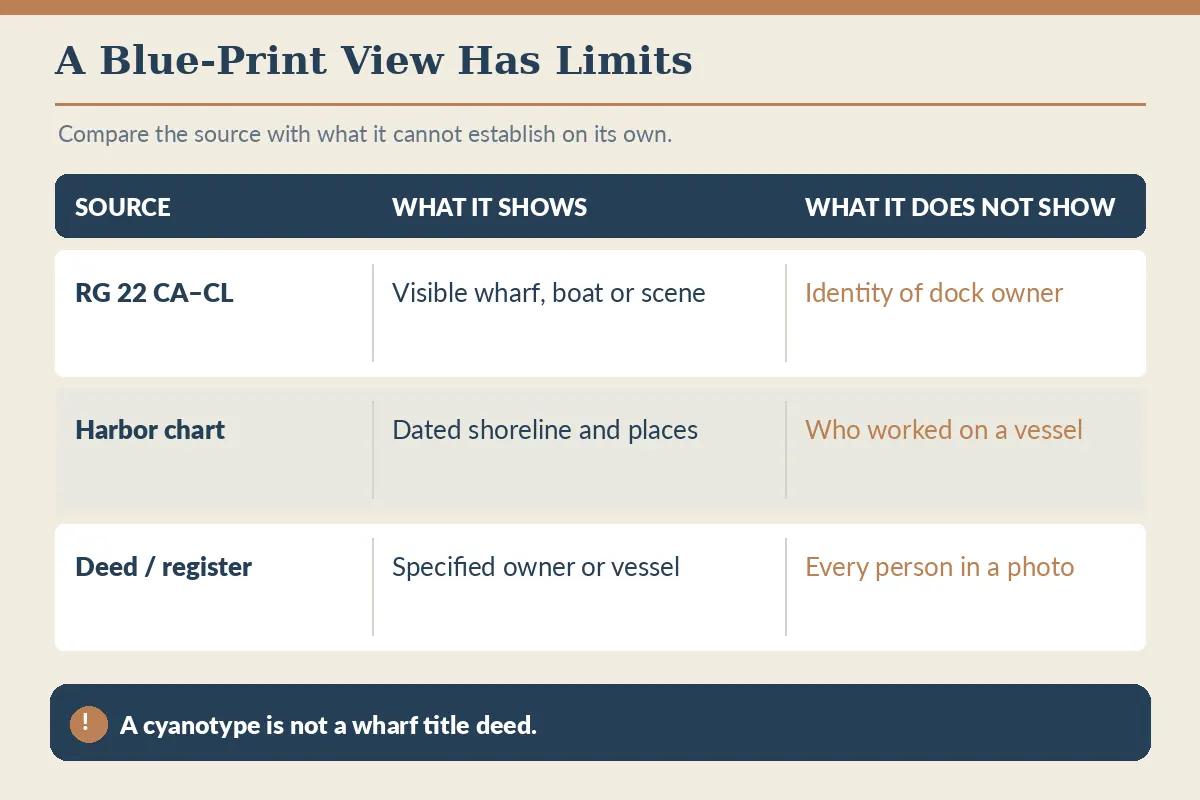
Begin with features that can be described without inference: piles and decking, sheds, smokehouses, hoists, slipways, fences, railway tracks, church spires, shoreline profile or a readable sign. Those details may help pair the view with a period harbor chart or city atlas. But a wharf that resembles a modern marina should not inherit its present-day name automatically; land reclamation and rebuilding often changed waterfront edges.
Create a locality hierarchy: exact captioned wharf, named port or municipality, county or state if applicable, then unlocated coast. Attach the source for each step. Where the original caption gives an obsolete settlement spelling, retain it alongside a separately evidenced modern place name. Photograph dates matter when interpreting businesses and industrial structures that might have moved within a decade.
A visible vessel name or registration number is a valuable clue, not a complete ownership statement. Search contemporaneous registers or port documents tied to that identifier and the appropriate year. A boat in front of a wharf may be visiting, undergoing repairs or being unloaded. Its presence cannot alone prove the dock owner, its home port or an employment relationship among figures on the deck.
Distinguish Photograph Content From Fishing Industry Statistics
The cyanotype group includes fishing-community environments as well as working vessels. A picture can support claims about building form, fishing gear or how vessels were moored when photographed. It cannot establish annual landings, wages, species totals or a fishery’s profitability. For numerical economic history, find the correct contemporary Fish Commission tables or local port returns and cite the reporting period separately from the picture.
People in the foreground might be workers, merchants, passengers, bystanders or family members. Period clothing and activity are contextual evidence but do not make names. For a relative allegedly shown in a coastal photograph, seek a named caption and compare a documented address, work record or other dated personal evidence. Even a correct match to the port and year is not sufficient to identify a face in an uncaptioned group.
Location can also be overstated through an attractive caption added decades later. Distinguish the original photographer’s notation from catalog description and modern interpretation when possible. If two archival copies offer conflicting place names, preserve the disagreement and test each with maps and structure clues. Never substitute a modern photograph of a remodeled waterfront for evidence that the nineteenth-century buildings survived unchanged.
Prepare a Harbor Photo Ledger Before Publishing
Write down RG 22, exact CA–CL code, item number, the original caption, photographic medium, date type, and repository. Add a column for the coastal state or Great Lakes location and the evidence that supports it. The broad 1882–1892 date range applies to the group, not necessarily to a single undated cyanotype. Avoid implying complete online access simply because the NARA guide gives a count of 490.
If the question is wharf ownership, attach a deed, tax assessment, lease or other parcel record from the right jurisdiction; do not rely on a caption that merely names the dock. If the question is a vessel, seek a registration or maritime record dated close to the exposure. If the question is a family, require direct person-level evidence. These are alternative research paths chosen by the claim, not sequential steps required for every photograph.
A defensible short caption reads: “Nineteenth-century cyanotype of a wharf in the place stated by the original archival description,” followed by the full citation. Add only independently established owner, vessel or crew names. This allows a visually rich source to inform local history without attributing unverified commerce, ownership or family relationships to people who happened to be present in an old harbor scene.
More House and Local History Guides
How We Research These Archival Sources and Claims
The NARA RG 22 record guide is our source for the 490 CA–CL cyanotypes, 1882–1892 coastal and Great Lakes scope, and the distinction from 1891 FCB–FCF photographs. We use the Still Picture Branch guide and photograph research instructions to plan item-level verification.
Those guides cannot establish the owner of an unidentified dock or the names of people in a frame. We would verify such details with a dated original caption, property records or vessel registers before publication. See our affiliate disclosure.
They are archival designators for the cyanotype series; do not assume that each letter is a particular state.
NARA lists 490 images dated 1882–1892, including fishing communities, vessels and wharves.
No. NARA describes FCB–FCF separately as 600 images of commercial operations with a keyword index.
No. The blue tone is produced by the cyanotype print process.
Only if a reliable caption or independent property record identifies the same wharf, date and owner.