
For an English or Welsh name change by enrolled deed poll between 1904 and 1944, The National Archives directs researchers to Supreme Court of Judicature Enrolment Books in J 18. Start with the likely year and both the old and new names, locate the corresponding physical index, and follow its part-number reference to the deed. Enrolment was optional and uncommon, so an absent J 18 entry cannot establish that a person never changed their name.
Decide Whether an Enrolled Deed Poll Is Likely
A deed poll is one form of documentary name change. Not every change required enrollment with the court, and many people adopted a new name in ordinary records without leaving an enrolled deed. The National Archives estimates that fewer than one percent of changes of name by deed poll were enrolled. Therefore J 18 should be treated as a targeted source for formal enrolments, not a comprehensive name-change register.
Separate the identity question from the registration question. If you have a marriage record under one surname and a later census or directory under another, first establish that both refer to the same person. A court enrollment, when it exists, may document an additional step, but ordinary evidence of continued use can be relevant whether or not a deed poll survives.
The date range matters. The National Archives’ guide sends pre-1904 enrolled deed polls to C 54 Close Rolls and 1904–2003 enrollment material to J 18. This article concentrates on the historical 1904–1944 route, for which the guide specifies onsite indexes and enrolment books. Do not apply that process mechanically to current living-person cases or documents after 2003.
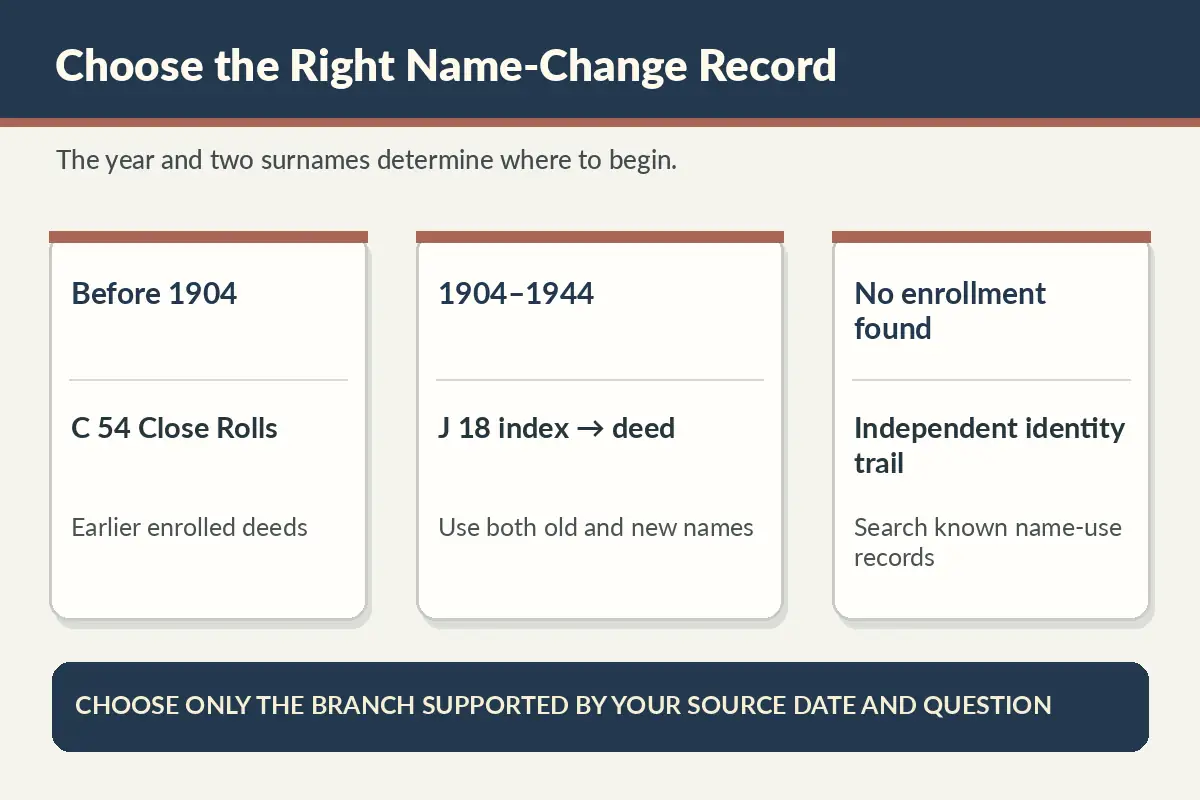
Locate the J 18 Index for the Suspected Year
Begin with the narrowest defensible date window, using correspondence, records issued under the new surname or a family notice. In the J 18 catalogue listings search for the exact phrase “index to” and a year or year range. That finds references for the court indexes; it does not yet find a person’s deed or prove that the named person is included.
The National Archives states that the 1904–1944 index volumes must be ordered for consultation at Kew. Their finding aids may link old and new surnames in either direction, sometimes by cross-reference. Search both identities and spelling variants. Record every letter section or page searched, not only a final result, so the search can be repeated.
When a matching index entry is found, transcribe its part number exactly. Then locate the appropriate J 18 volume by the range of part numbers in the catalogue. This creates a two-stage chain: index entry to numbered enrollment item. A citation to the index alone is insufficient if the claim concerns the wording of the signed or enrolled deed.

Read the Enrolled Deed and Test the Identity
Capture both the former and assumed names, the enrollment date and wording used in the deed. Check any identifying addresses or occupations actually present, but do not invent fields: formats and supporting information can vary. An enrollment date is evidence that a document was entered in the court record; it need not be identical to the first date a person used the new name socially.
Treat identity as a matching problem. Compare a known birth or marriage date, occupation, address, spouse or other linked facts against independent historical records. A name shared by two people is not enough. If the deed is inconsistent with an earlier census age or location, preserve the conflict and investigate rather than choosing the more convenient identity.
Distinguish a deed poll from a change caused by marriage, a baptismal name variation or a spelling error by a clerk. A legal name-change document cannot automatically reconcile every past reference. Prepare a timeline showing where each form of the name appears and who supplied it, and mark which transitions are actually documented.
Understand Gazette Notices and Later Periods
The Gazette can supply useful notice evidence for enrolled changes after 1914, but publication of a notice is not the same document as the original enrollment. For 1945–2003, The National Archives describes an alternative route using Gazette notices and archive enquiries; do not merge that later procedure into the 1904–1944 onsite index workflow.
Some court enrolment books contain instruments other than name changes, including charitable trust or other deeds. A J 18 reference alone therefore does not establish that a piece is a deed poll. Read its contents, document title and legal purpose. Keep separate searches for property history and for a person’s name, especially if the same surname occurs in more than one court instrument.
If the name appears in newspapers or family documents but not in the court index, do not pronounce the change invalid. The family may have made an unenrolled deed poll, adopted a new name without one, or lived under variant names. Consult original civil, electoral, professional and directory records where legally and historically appropriate.
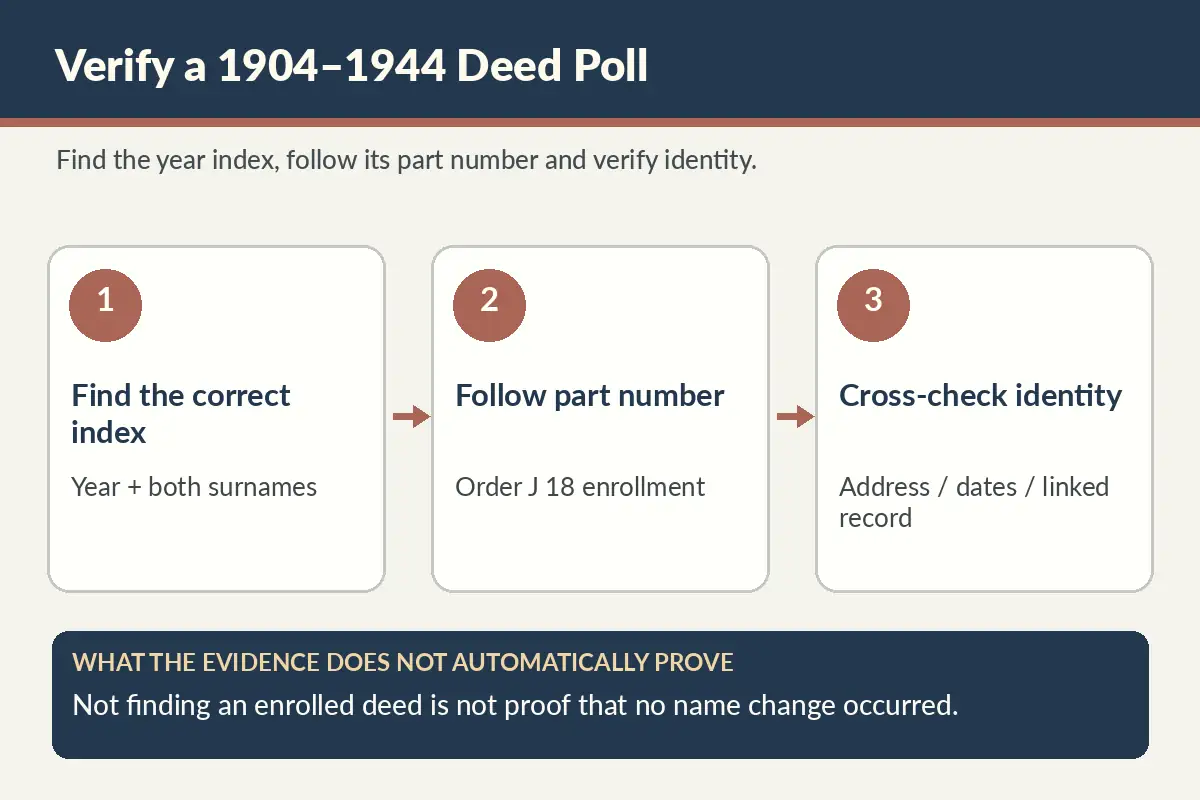
Turn a Negative Search into a Reproducible Finding
Document the exact J 18 index year, reference, initial-letter sections, former-name variants and new-name variants examined. If the time window is uncertain, search adjacent years systematically. Only then write a carefully limited conclusion such as “No enrollment was found in the examined 1912–1914 index volumes under these variants.”
The low rate of enrollment makes absence especially weak evidence for disproving a change. A negative result cannot answer whether a private deed was signed, a person began using another surname, or the spelling changed gradually. The next useful source is often a dated record under each name linked by address or household, not another generic database search.
Respect privacy and access restrictions when a record may concern living people. This guide is for historical research on early twentieth-century records, not for locating someone who does not wish to be found. Use the archive’s current access and copying instructions instead of assuming that a historic catalogue description grants unrestricted reuse of personal documents.
More Research Method Guides
How We Research Enrolled Name Changes
Our workflow follows The National Archives’ change-of-name guide for the physical J 18 indexes, part-number references, 1904–1944 date gate and the crucial distinction between enrolment and ordinary name use. The separate land-enrolment guide clarifies that J 18 is a court-record series containing more than one kind of deed.
A finished evidence note should cite the index, the corresponding J 18 enrollment, and at least one independent document connecting the old and new identity. If no enrollment is located, publish only the precisely scoped negative search. A surname change, a particular family link and a formal court enrollment are three different propositions and may require three kinds of proof.
Authoritative repository guidance used for this article: The National Archives: Changes Of Name. The National Archives: Enrolment Of Deeds Registration Of Titles Land. Confirm current piece-level access restrictions and ordering routes in Discovery before making a research visit or requesting a copy. The original record—not a search hit or a printed summary—must support every contested detail.
For our editorial and affiliate-policy statement, see the affiliate disclosure. This research plan does not require paid services; archive and document-copy costs depend on the repository and the material requested.
No. Enrollment was optional and uncommon; many changes of name have no surviving court enrollment.
The detailed workflow here is for 1904–1944. J 18 continues later, but access and finding procedures differ by period.
The National Archives directs researchers to order the relevant index volumes for consultation at Kew.
It leads to a range within another J 18 enrolment volume, which must be consulted to read the deed itself.
No. It only limits the search for a formal enrolled deed within the indexes and variants actually examined.