
Finding a family in Alabama between 1850 and 1870 requires more than a duplicate surname in a state-census index. The state archive identifies separate 1855 and 1866 enumerations that answer different questions and may survive unevenly by county. The practical starting point is a documented place, followed by a check that the expected year and place actually appear in the collection. This article shows how to compare an 1855 index clue with a postwar return without inventing kinship from a numbered household.
Choose the Alabama census year by the research gap
Alabama family research often stalls between the named federal population schedules of 1850 and 1870. A state enumeration may supply a useful additional observation, but it must not be treated as a substitute containing identical names and questions. The Alabama Department of Archives and History specifically identifies state censuses for 1850, 1855 and 1866. Build a timeline that marks the household in 1850, the relevant state entry, and the household or neighboring families in 1870. The question is whether the same family plausibly occupied the same locality across those dates, not whether three search results carry a familiar surname.
Begin with a county known independently from a deed, probate paper, federal schedule or church entry. Record the historical county and the county shown by each census source. If the county changed or a family moved, a surname-only statewide search may hide the evidence. Treat county identity as part of the citation and ask whether the targeted schedule is represented in the database you are using. Census Bureau guidance notes that state enumerations were not uniform nationwide and that survival and access vary; there is no guarantee of a searchable entry for every resident. Our guide “North Carolina State Census, 1784–1787” covers a related question.
Search the 1855 collection without assuming statewide coverage
The FamilySearch collection called Alabama, State Census, 1855 is described as an index, not a complete transcription of all people in all counties. Its collection description identifies participating counties and explains the limitations of the surviving returns. Read that description before typing a name; it tells you whether an apparent omission may arise from geography rather than a missing ancestor. Use a surname with spelling variants, but combine results with county and neighboring household names where available. Indexing can distort a surname or normalize a locality differently from the handwritten page. For a related choice, see our guide to Massachusetts state census.
Record exactly what the result says: the recorded name, administrative location, index reference and any image or film identifier shown. Do not inflate the index entry into evidence of a spouse, parent or child whom the record does not name. Ask whether an original image is accessible and whether it contains numbered categories or further columns that the index omitted. If an image is inaccessible, keep the result provisional, identify the holding archive, and make the image request a specific outstanding task rather than silently treating the abstract as complete proof.

Treat the 1866 enumeration as a distinct source
The 1866 enumeration belongs to the post-Civil-War period, so it addresses a different social setting from 1855. A search result or household count may help locate a family after the disruption of war and emancipation, but the exact categories must be checked on the original schedule. Do not equate a tally with a list of named children, and do not assume a similarly named head in 1855 is the same person in 1866. The period is historically sensitive: categories imposed by census officials reflect administrative practice, not an adequate description of anyone’s identity or family history.
Create a comparison sheet with columns for year, county, named household head, recorded categories, neighboring entries and what remains unknown. If names change spelling, describe the phonetic correspondence rather than replacing the original. To distinguish unrelated people with common names, compare land tax records, probate files and later federal entries. The Alabama Archives also holds county deeds, wills and guardianship records, although individual counties and series vary in coverage. Those independent records are the tests that transform a useful location clue into a stronger identity argument.
| Check | Evidence to record | Claim to avoid |
|---|---|---|
| Year and locality | Exact record year and historic jurisdiction | Same place equals same family |
| Original or index | Page or index reference and custodian | Search result includes every person |
| Identity test | Matching neighbors, ages and independent sources | One matching surname proves ancestry |
Use a negative search result carefully
An empty result can mean at least four different things: the county’s returns do not survive, the record has not been indexed, the ancestor was not present, or the name appears under an unexpected spelling. Those explanations are not interchangeable. Write down which catalog, collection and county you searched, whether it contained images, which variants you tested and why the search should have found the person if the record exists. A database advertising an Alabama census does not necessarily represent every Alabama county or all associated record types.
When a state schedule is absent, search a tax list or a probate docket close to the target year, or build a neighborhood reconstruction using documented associates. The archive’s research request identifies Alabama voter registration in 1867 and 1875 separately from state census holdings; those are different records with different creation purposes and possible eligibility limits. Never rename a voter list as a census simply because it fills the same chronological gap. Keep the negative finding and the substitute source in separate research-log entries. Our guide to Illinois state census records covers a related question.

Build a short, testable Alabama household conclusion
A sound working conclusion might be: a person of this recorded name appeared in a specified Alabama county in 1855, and a similarly named person appeared there in 1866. That is an observation. The inference that these represent the same family needs positive comparisons, including neighbors, an independent residence record and an age-consistent person named in a later enumeration. The parent-child relationships inside the household remain unknown when the state page reports only counts or categories. Explicitly label each layer as recorded fact, interpretation, or unproved proposal.
Cite the record with year, state, county, page or image identifier if available, original custodian and the online collection used for access. Keep the displayed index transcription and your own reading of the image separate. Before publishing the family-tree connection, ask another researcher to repeat the search from the citation and try to disprove the match. A reproducible modest conclusion is more valuable than an elaborate family story that rests entirely on one name.
How We Research this state census question
We began with the Alabama Archives’ own descriptions rather than interpreting the statewide keyword results as a complete collection. We compared the searchable 1855 index description against the separate 1866 year and distinguished demographic tallies from named relationships. The checks we consider decisive are county coverage, the wording of the actual field, provenance of the index and the presence of an independent county record. We did not infer any family’s identity from a search snippet.
For the Alabama comparisons, the decisive questions are whether the county is represented in the 1855 index, whether an 1866 image or custodial description can be obtained, and whether the recorded categories name anyone beyond a head. A proposed same-person match should be tested with an independently dated land or estate document. The source might establish residence; the family relationship remains open until a document actually connects the people.
More Records and Archives Guides
Primary sources, limitations and disclosure
Alabama Department of Archives and History provides guidance on its census and county holdings. The 1855 collection description gives the scope of its surname index, while the Census Bureau explanation of state enumerations warns against blanket assumptions about local survival. Compare those distinct roles before citing a digital result. A name-only abstract must never be expanded into an unrecorded child or spouse.
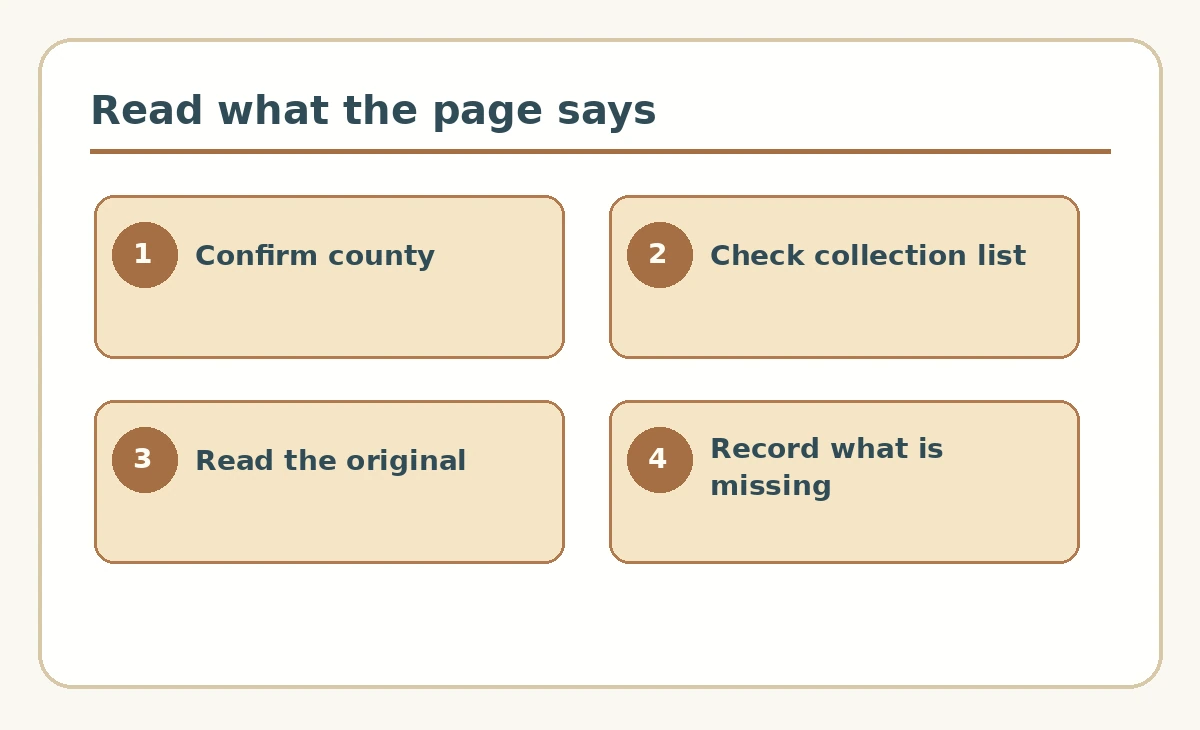
The sepia cover is a newly drawn representation of archive research, not a digitized Alabama census image. The three explanatory panels convey a sequence of checks rather than transcribe anyone’s record. GenHis receives no declared compensation from the public custodians cited here; our affiliate-disclosure page explains the site’s general policy. For the historical period covered, use exact wording for source classifications and avoid making conclusions about identity or enslaved families without separately documented evidence.
No. Its collection description identifies included counties; check that coverage before interpreting an empty search.
The archive identifies 1850, 1855 and 1866 among relevant state enumerations.
No. A count or classification does not name or establish family relationships.
It can supply a separate clue but was created for a different purpose and must be cited as voter registration.
Preserve its exact details and seek the original schedule or custodial record description before stronger conclusions.