
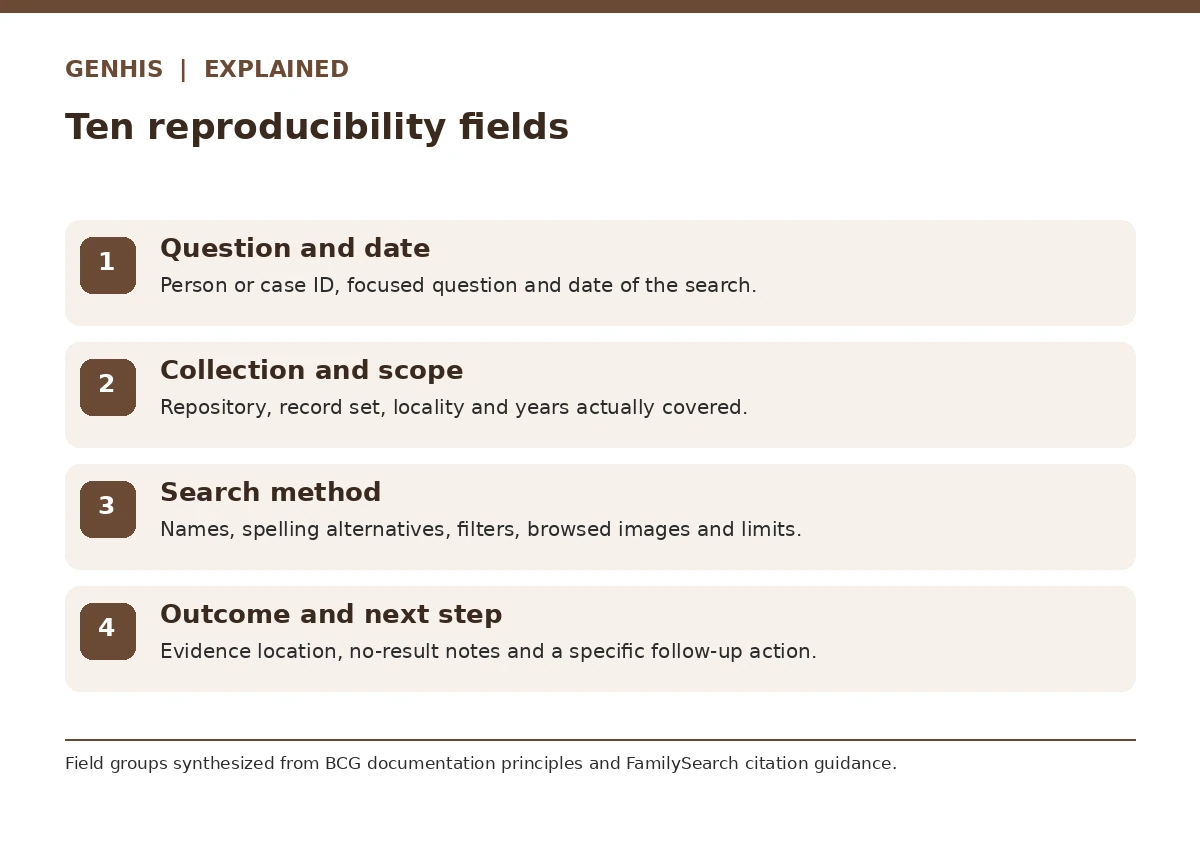
A genealogy research log is a record of searches, not a scrapbook of discoveries. A useful entry tells a future reader exactly what question you were investigating, which collection you searched, how you searched it, what you found or did not find, and what you will try next. This is especially important when a website returns no results. Without dates, collection scope and search settings, a blank result can look like evidence that a person never existed there. A properly logged failed search usually means only that the particular search did not locate the person.
This guide gives you a reproducible ten-field log and a fictional example of three searches that produced different outcomes. It does not prescribe a particular spreadsheet program or replace a source citation for a document you find. Your research plan decides what is worth searching; the log remembers what you actually did; your evidence assessment decides what any result can support. Keep those three jobs distinct so that the same answer is not recorded in three inconsistent places.
Start Each Entry With a Single Research Question
Write the question before running a search. `Who were the parents of the fictional Clara Bell of Eastfield?` is testable; `find everything about Clara` is not. Attach a person identifier or case number that remains stable when you discover a spelling variant. Include a time window and locality when known, but distinguish documented dates from estimates. If you are searching a name found in somebody else’s tree, label that identity as a candidate rather than a confirmed person in your line.
One research question may generate many log entries. Searching a named census year on a website, browsing unindexed district images, and checking a county register are separate actions, even if all attempt to answer the same question. The log must capture enough detail for you to repeat each action rather than merely saying `checked census`. If the question changes after you find a new clue, open a new question or note the change instead of rewriting the old search record.
Record the Collection and Its Coverage Precisely
For each search save the date, repository or website, named collection, locality, record years, and the access route. If the site offers a catalog title or collection identifier, preserve it. The collection’s stated coverage is not necessarily a guarantee that every parish, town or year survives. Write down what the catalog actually claims and flag gaps you have not checked. When you browse pages manually, note the volume, page range, or image sequence viewed, not just the site’s home page.
A reproducible search also saves your input: exact spelling, alternative surnames, approximate date filters, geographic limits, and any wildcard or phonetic option. Search technology can change, so the observation should identify the interface used at the time. If results are sorted or paged, note whether you reviewed only the first screen or all relevant hits. `Searched for Clara Bell` is not enough information for a later researcher to assess your conclusion.
Separate an Unsuccessful Search From Negative Evidence
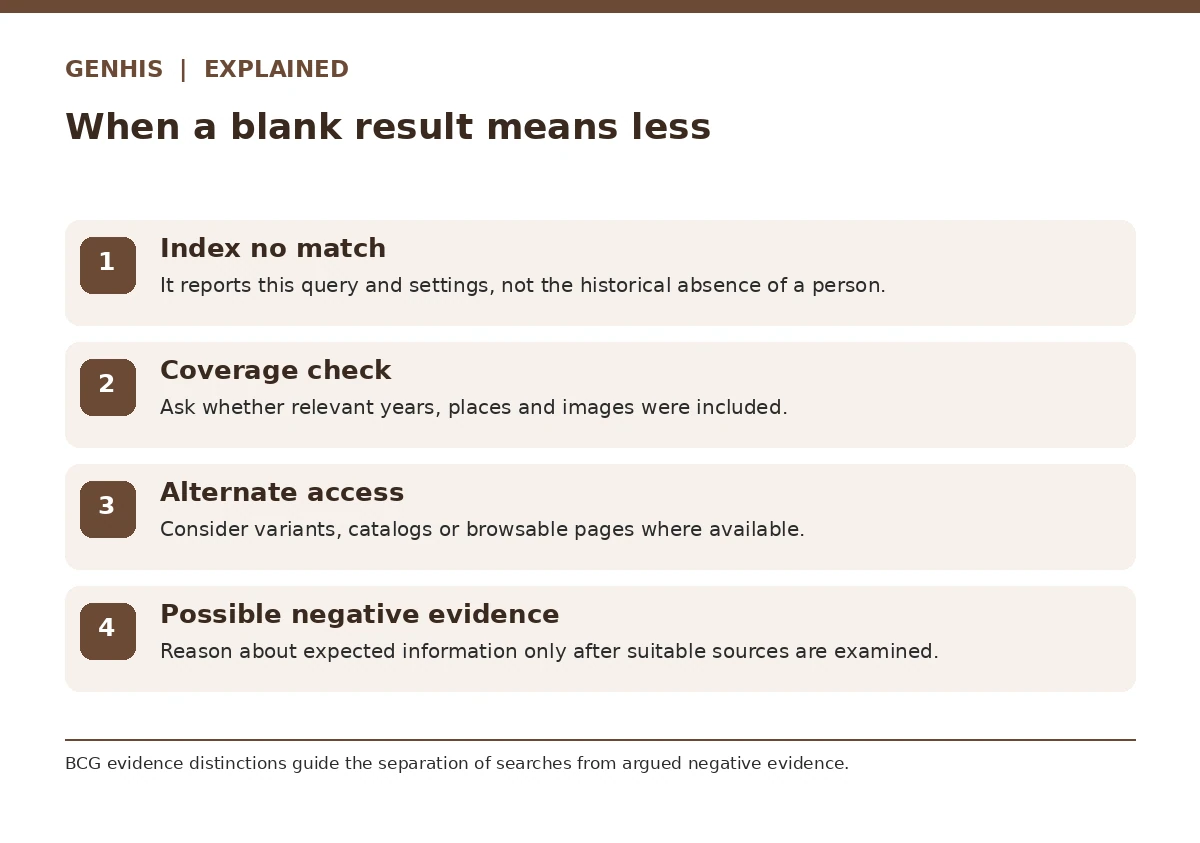
Log unsuccessful searches just as deliberately as positive finds. Write `no matching entry returned with these settings`, not `Clara was not born in this county`. The first is a verifiable statement about your search; the second is a claim about the historical world that requires much broader support. An index may omit names, a page may be unreadable, the collection may begin after the relevant event, or a surname may be recorded differently. Reconsider coverage before treating any absence as informative.
Negative evidence has a stricter meaning: an expected entry is missing from a surviving and suitably examined record set, and that absence bears on a specific research question. The Board for Certification of Genealogists distinguishes negative evidence from mere empty search output. A strong negative-evidence argument often requires several appropriate sources and an explanation of why the missing record should have appeared. Your log can preserve the raw search observations without overstating them as proof.
Use a Fictional Three-Row Log to See the Difference
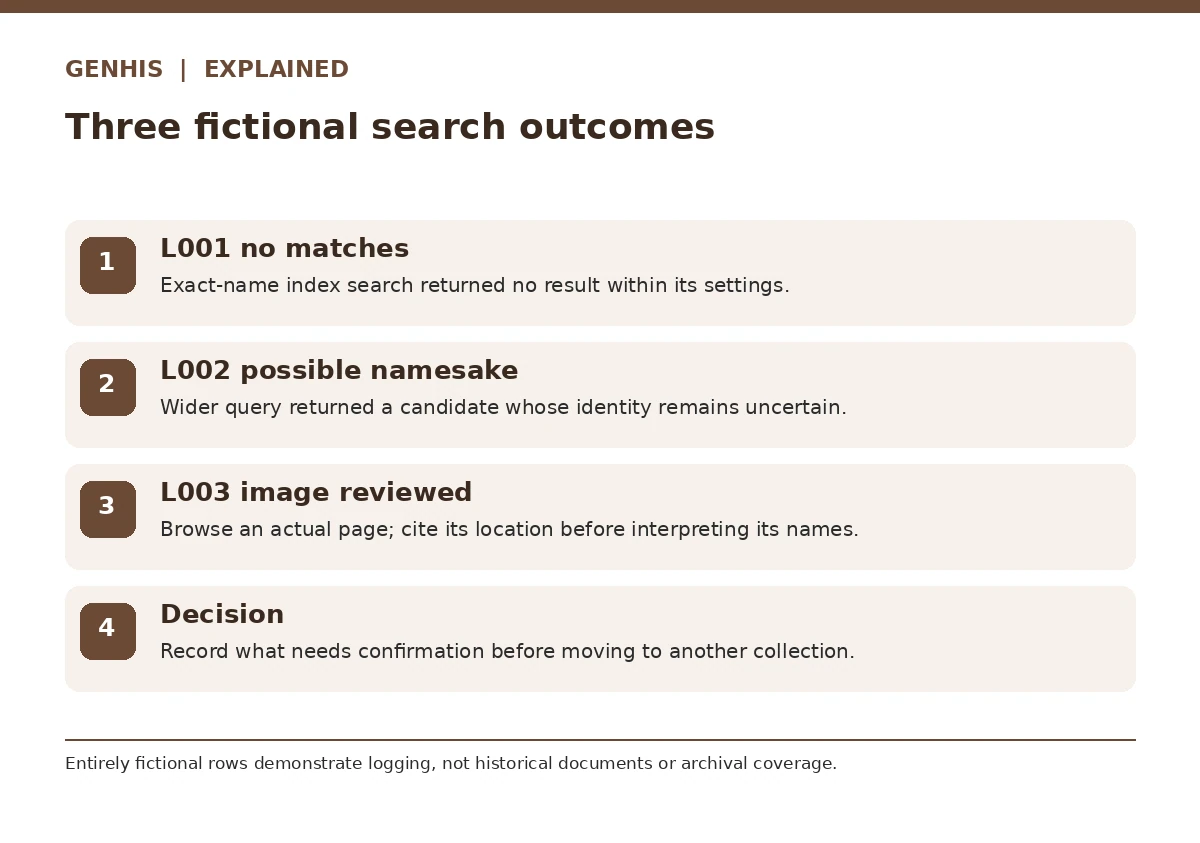
Imagine that your question is whether Clara Bell appeared in a town during an unspecified decade. In row L001, record an online name-index search with an exact spelling and a five-year limit; result: none returned. In row L002, widen the date range and search a documented spelling variation; result: one possible entry for a different Clara, but identity unconfirmed. In row L003, browse images in the relevant register volume; result: a line that may relate to the target, awaiting full transcription and an independent identity check. These are teaching outcomes only, not reports of actual holdings.
The final column should specify a decision, not an aspiration. For L001: `check indexed years and browse if images exist`. For L002: `compare household and locality details before attaching`. For L003: `capture page-level citation; review neighboring entries`. The dates and search filters in an actual log need to be literal values, not these illustrative labels. By preserving the route and limits, you can stop repeating unproductive steps and see which untested route has the most information value.
Connect Results to Source Citations and Images
When a search produces a record, add a citation or a stable file ID that points to a full citation and saved image where permission allows. An isolated screenshot without the collection name, page, and repository is likely to become a mystery later. FamilySearch’s help explains how historical-record pages can provide citations; use those as a starting point and correct or expand them to identify the exact item you actually examined. If you saw only an index, say `index entry viewed` rather than implying inspection of an original register.
Record the content relevant to the question in a short observation column, then reserve a separate interpretation field. For example, `entry names Clara’s residence as Eastfield` is what a fictional image might say; `therefore this is our Clara` is a hypothesis demanding comparison. If handwriting is uncertain, include the ambiguous letters and an image reference. Do not alter the transcription later to match a preferred family story; record a corrected reading and explain why you changed it.
Review the Log Before Searching Again
Sort the log by research question and search date, then look for missing attempts, repeated databases, filters that were too restrictive, and unresolved candidate matches. Distinguish a fully browsed source from one where only an index was queried. When a collection is unavailable, record the restriction and a possible alternative repository; do not invent the cost or assume that a digital copy exists. Before paying for access or arranging travel, the log should show which free and remote paths have actually been exhausted.
The log is complete enough when another researcher can reproduce a search to the extent that the same source and interface still exist, understand the limits of any empty result, and trace a found item to its full citation. It does not need to include every casual internet click. Prioritize searches that informed or could have informed your stated question. A concise, accurate log with consistent fields is far more valuable than a long list of unidentified links.
How We Research and Distinguish Logged Observations
The search-field design draws on FamilySearch guidance for retrieving record citations and the Board for Certification of Genealogists’ treatment of source evaluation, negative evidence, and research documentation. Our example log entries are wholly fictional and contain no actual ancestor, record image, collection coverage claim or repository identifier. An unsuccessful search is not inherently negative evidence; the article intentionally keeps that distinction visible. The guide is educational and does not establish a relationship or promise access to any archive. We assert no affiliate arrangement; read the GenHis affiliate disclosure.
FamilySearch Historical Record Citations — FamilySearch Help Center describes where to locate source citations for historical records and images in its search interfaces.
BCG Source Appraisal — BCG explains how to assess original and derivative records, informant knowledge, source independence and evidence roles in genealogical analysis.
BCG Evidence Tutorial — BCG categorizes original, derivative and authored sources; primary, secondary and undetermined information; and direct, indirect and negative evidence.
FamilySearch Add a Source — FamilySearch explains creating manually entered sources with identifying titles, citations and contextual notes in Family Tree.
No. A spreadsheet, paper form or text document works if it preserves a question, scope, method, outcome and next action.
Yes. Record the exact collection, years, filters and outcome, so you can distinguish a limited search from genuine negative evidence.
No. The log records what you searched and why; the citation identifies a particular consulted source or item.
State that limitation explicitly. Never label a collection exhaustively searched unless the relevant scope has actually been examined.
Yes. Give each question and person a stable ID, then filter or group entries to avoid mixing candidates with proven relatives.