
Genealogical evidence is not another word for a document. A document is a source, statements within it are information, and only information relevant to a particular research question becomes evidence for that question. One census image can therefore support a residence question, offer only indirect clues about a parent-child relationship, and say nothing about a date of birth. The same record may contain firsthand and secondhand information from different informants. Separating these layers helps you avoid treating a convenient record as proof of everything in an online family tree.
This guide uses the three-part appraisal described by the Board for Certification of Genealogists: source category, information quality, and evidence type. It then applies the distinctions to a fictional case where several people share a name. It will not certify a relationship or convert an absence in a search box into historical proof. Its purpose is to help you write a defensible statement such as `the record supports this limited fact, but the proposed relationship remains unknown`.
Classify the Source Without Ranking People or Websites
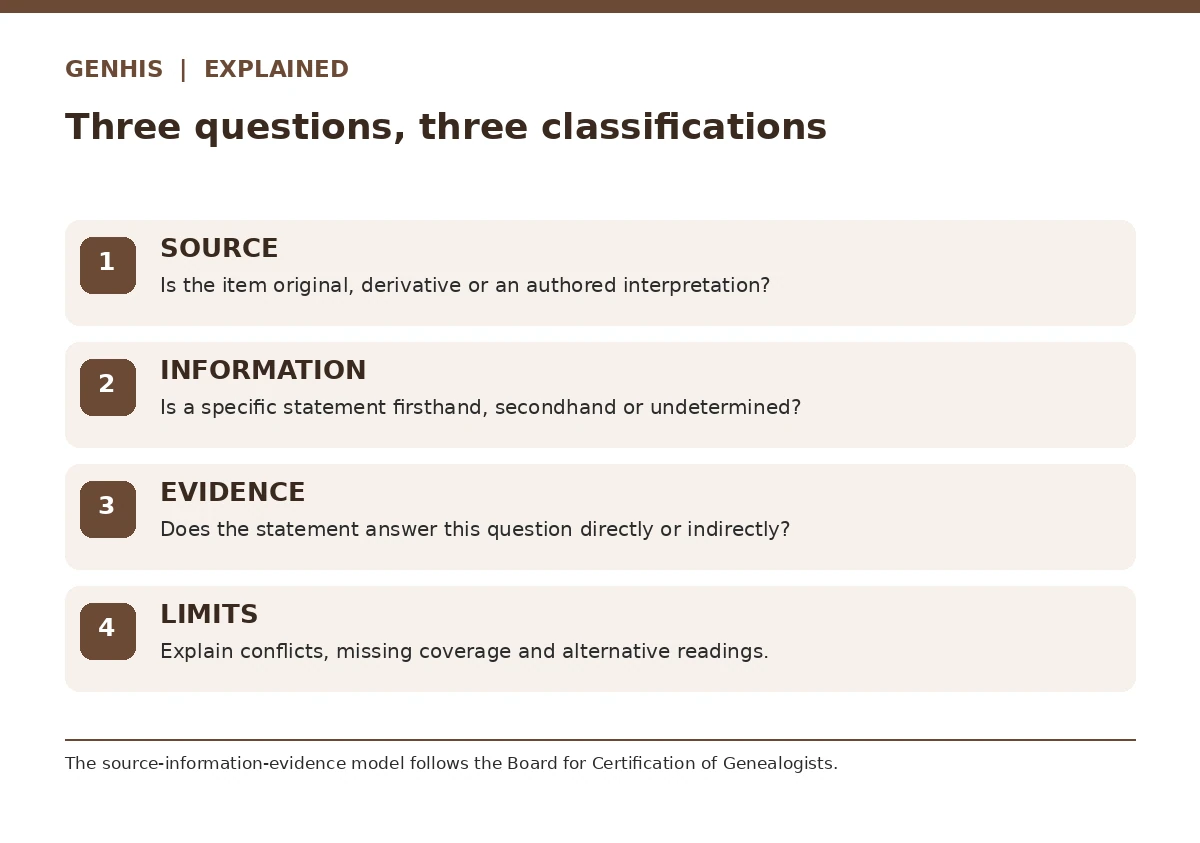
An original source is not derived from another surviving account in the way a transcript, abstract or index is. A derivative source reworks information from a prior source, and an authored work synthesizes accounts or arguments. A photograph or faithful digitized facsimile can give access to an original record’s content, although an image may omit context. An online index is generally derivative, even when the original book was created close to an event. Neither a beautiful website nor an archive logo tells you, by itself, whether the particular item being viewed is original or derivative.
Prefer examining the underlying record when feasible, but do not assume every original statement is correct. A recorder could misunderstand a surname or copy a date incorrectly. A derivative might accurately transcribe the surviving source when the image is currently inaccessible, yet it still deserves labeling. Authored trees can offer excellent leads, but a page listing a parent and child is a compiled claim until the specific relationship is supported. Note the source form before judging how much weight its statements deserve.
Judge Each Information Statement by Its Informant
Primary information comes from someone with firsthand knowledge of the particular event or detail; secondary information comes through another person, and sometimes the informant cannot be determined. These labels apply to statements, not permanently to the entire certificate or record. In a death record, someone present at the death may know the date firsthand while another person supplies a birth year or parents’ names from stories told decades earlier. The document can therefore contain different information qualities side by side.
For each significant statement, ask who reported it, when they learned it, why the record was made, and whether there is a reason for error or bias. `Recorded soon after an event` can strengthen a detail but does not eliminate all mistakes. Likewise, later testimony may be sound when the speaker has direct knowledge. If the informant is unspecified, classify that information as undetermined rather than inventing a firsthand witness. The BCG discussion of evidence appraisal specifically separates these informant-level questions from the physical source type.
Decide Whether the Evidence Is Direct or Indirect
Evidence is direct when a relevant statement appears to answer the research question without combining it with other pieces of information. A record explicitly identifying a named parent might offer direct evidence of the claimed relationship. Evidence is indirect when individual details do not answer alone but may contribute to a conclusion when correlated with other evidence. Shared addresses, associates and naming patterns could supply indirect clues; none automatically creates kinship. Direct evidence is not necessarily true, and indirect evidence can be highly persuasive when independent records form a coherent explanation.
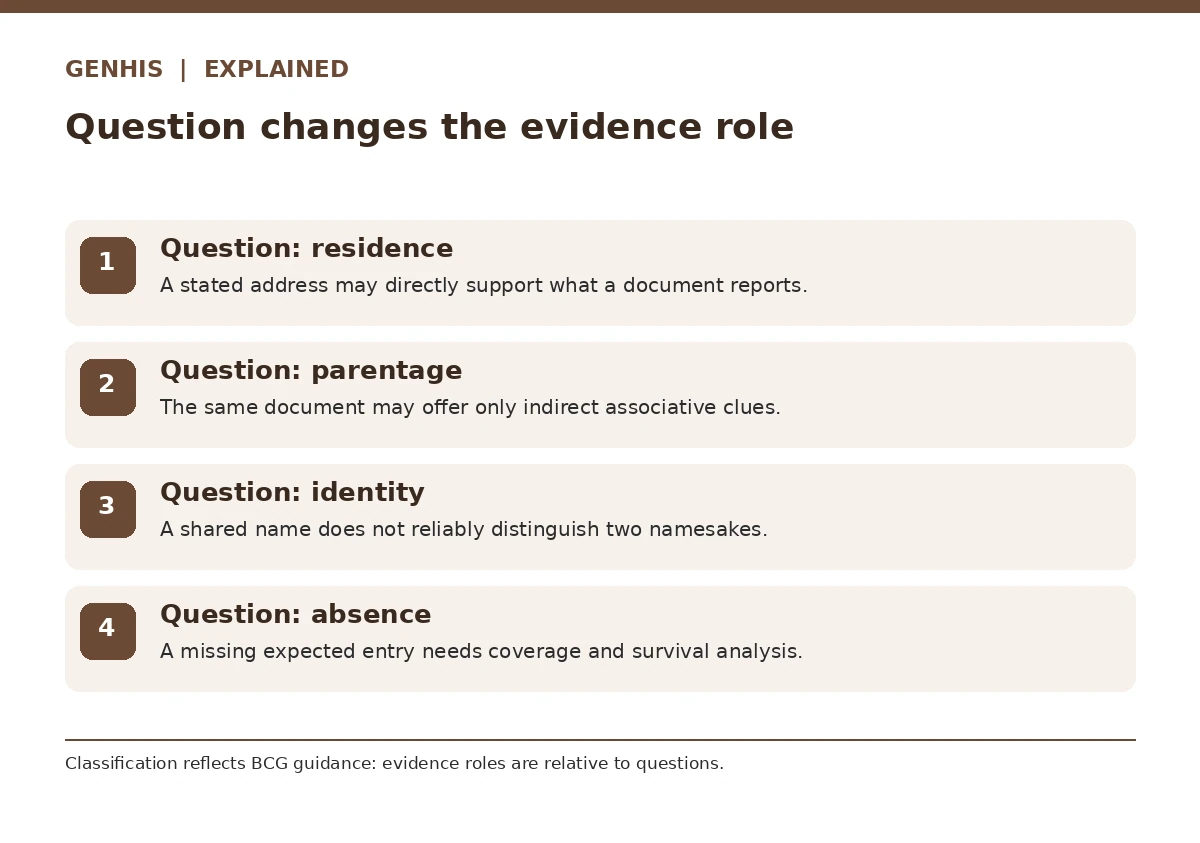
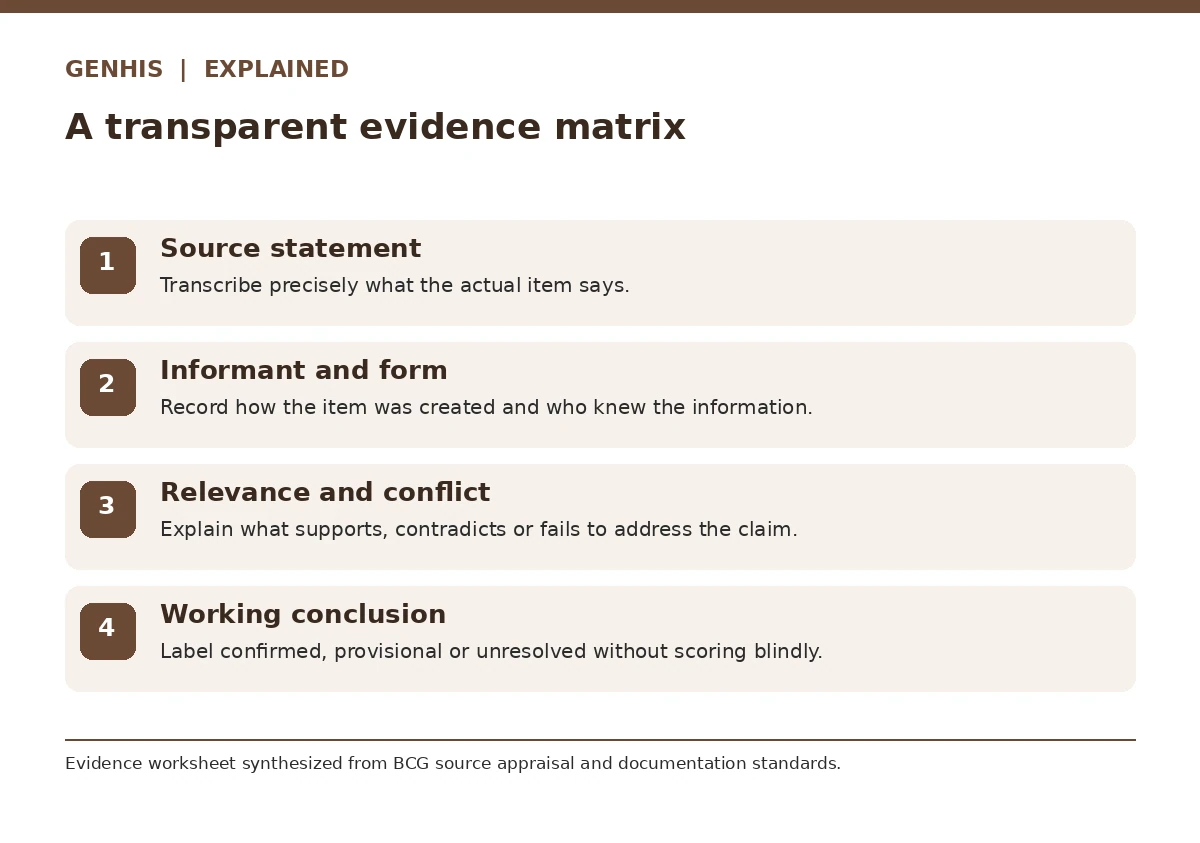
Keep the research question visible. A birth entry can directly state a date but only indirectly identify an adult with the same name in a later town. For example, a child’s recorded father could be directly named while the identity of that named man among three local namesakes still requires separate proof. Changing the question changes the role of the information. A useful evidence table therefore begins with the question and records each relevant item, what it expressly says, what it suggests, and what it cannot establish.
Distinguish Negative Evidence From a Failed Search
Negative evidence can arise when information that should appear in an appropriately surviving and sufficiently examined record set is absent. This requires a reasoned expectation. A missing person from one keyword search is not, by itself, negative evidence because spelling, record survival, indexing, dates or jurisdiction may account for the result. You need to establish why the type of record would reasonably be expected to include the person, what coverage actually survives, and which relevant material was examined before drawing an inference from an absence.
Suppose an imagined household appears in a source where all listed residents should be enumerated, but one alleged resident is missing. Even then, the absence may have several explanations: travel, enumeration practice, an overlooked page or a mistaken proposed household. Log the observation and evaluate alternatives. Do not claim `this absence proves the person is unrelated`. The BCG distinguishes negative evidence from the everyday frustration of an unproductive search, and the difference belongs in your written reasoning.
Test a Fictional Namesake Case Without Inventing Ancestors
Imagine a researcher trying to identify which of two fictional residents named Ada Mercer belongs to a later household. A later document states that Ada lived in Westford; this is direct evidence for what the document reports about residence, assuming that wording appears there, but it may not distinguish the women. Another imaginary record contains an occupation and an associated witness that match the earlier candidate. Those clues may become indirect evidence for identity when combined with reliable, independent sources. No such historical documents or residents are asserted to exist.
Build a four-column case table: question; precise record statement; evidence role; limitation or competing explanation. Do not count two online trees copying one another as independent corroboration. Ask whether an obituary and a certificate might share the same informant. If contradictory dates emerge, investigate the origins of each date rather than choosing the one that fits a preferred pedigree. Your conclusion may remain tentative even after several records, and that is more useful than pretending the comparison was decisive.
Write a Conclusion That Exposes Conflict and Limits
A well-reasoned conclusion explains the question, the relevant source set, which evidence is direct or indirect, how conflicts were addressed, and why an alternative explanation is less convincing. When the research is incomplete, say which sources remain unexamined and what additional evidence might discriminate among possibilities. Record identity as provisional when the comparison does not justify certainty. A paragraph of transparent limitations is more responsible than a confidently attached relationship derived from a single name match.
You can use a short evidence matrix while researching, but it is not a mechanical point system. Ten copied index entries may trace back to one ambiguous original, while one well-contextualized independent document can clarify the question considerably. Do not assign numerical weights to source labels and call the result proof. Source independence, information reliability, relevance to the question, and resolution of genuine contradictions all require contextual judgment.
How We Research and Apply Evidence Terminology
Our definitions follow the Board for Certification of Genealogists’ published tutorial and its analysis of sources, informants and evidence. FamilySearch guidance on attaching and describing sources provides practical context for preserving a trail back to individual records. The Ada Mercer case is entirely fictional, and the scenarios do not claim real archive coverage, record fields or kinship. An evidence label describes a relationship between information and a question, not a guarantee of truth. This is educational material, not a professional determination or private-person identification. No affiliate relationship is asserted; see the GenHis affiliate disclosure.
BCG Evidence Tutorial — BCG categorizes original, derivative and authored sources; primary, secondary and undetermined information; and direct, indirect and negative evidence.
BCG Source Appraisal — BCG explains how to assess original and derivative records, informant knowledge, source independence and evidence roles in genealogical analysis.
FamilySearch Add a Source — FamilySearch explains creating manually entered sources with identifying titles, citations and contextual notes in Family Tree.
BCG Citing Your Sources — BCG source-citation discussion explains identifying an exact item and preserving enough contextual detail to understand and relocate it.
No. Original status concerns source form; an informant might be mistaken, and its information may not answer your question.
Yes. Distinct statements can come from different informants with different levels of firsthand knowledge.
No. Direct evidence can be inaccurate; corroborated indirect evidence may be compelling when independently sourced and logically analyzed.
Usually not by itself. Reasoned negative evidence requires suitable coverage and a justified expectation of the missing information.
Not if they repeat the same unsupported claim. Inspect original source trails and determine whether the information is independent.