
Tracing family history means more than identifying people on a pedigree. It asks what a person’s life was like in a particular place and time, which stories are remembered, and which details can be corroborated by documents. Start with a willing relative, a specific recollection, or a family-held object. Record its provenance, place the claim on a timeline, and find the institution that might hold relevant records. Explain the difference between testimony, documentary evidence, historical context, and an unanswered question.
This guide focuses on reconstructing a responsible family narrative. For locating a particular namesake in a census, use a person-identification workflow instead; for importing an online family tree, first examine each connection. A history can be valuable without proving every remembered detail, provided the reader knows exactly who recalled it, when they said it, and what independent material you have—or have not—located.
Begin With Respectful, Permission-Based Interviews
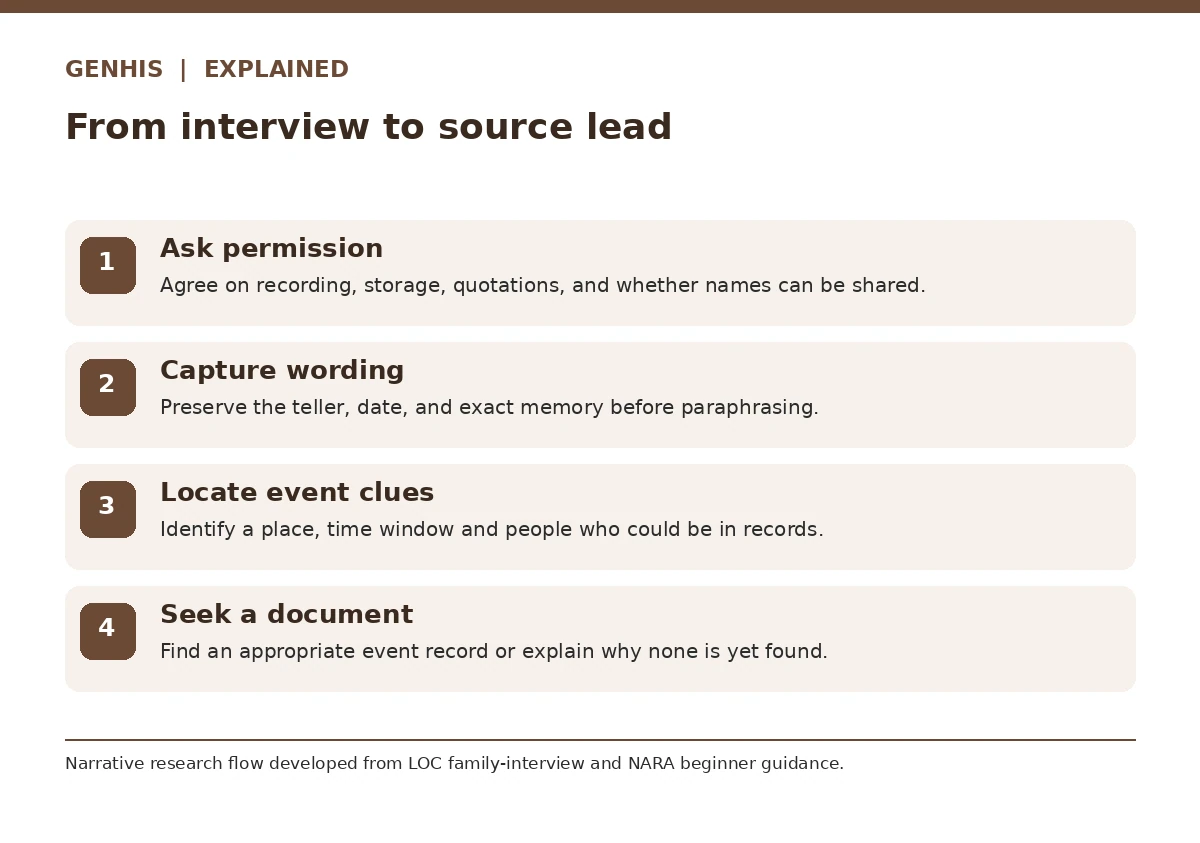
Invite an interview rather than demanding one. Tell the person why you are researching, how you might store their words, and who might hear or read them. Ask permission separately for recording, quoting, photographing objects, and publicly sharing identifying information. Different places have different rules about recording and privacy; do not assume family membership alone gives you permission. If someone declines or sets boundaries, respect the decision and continue with other appropriate sources.
Use open prompts: “What did a typical day look like in that neighborhood?” or “What do you remember about moving house?” Then ask gentle clarifying questions about place names, approximate years, other people present, and which parts they directly remember versus learned from relatives. Avoid coaching them toward a date you already suspect. Record the interviewer, participant, date, setting and any consent restrictions. Preserve the original account before summarizing it, because a polished paraphrase may unintentionally add certainty the speaker never expressed.
Connect Each Recollection to a Time and a Place
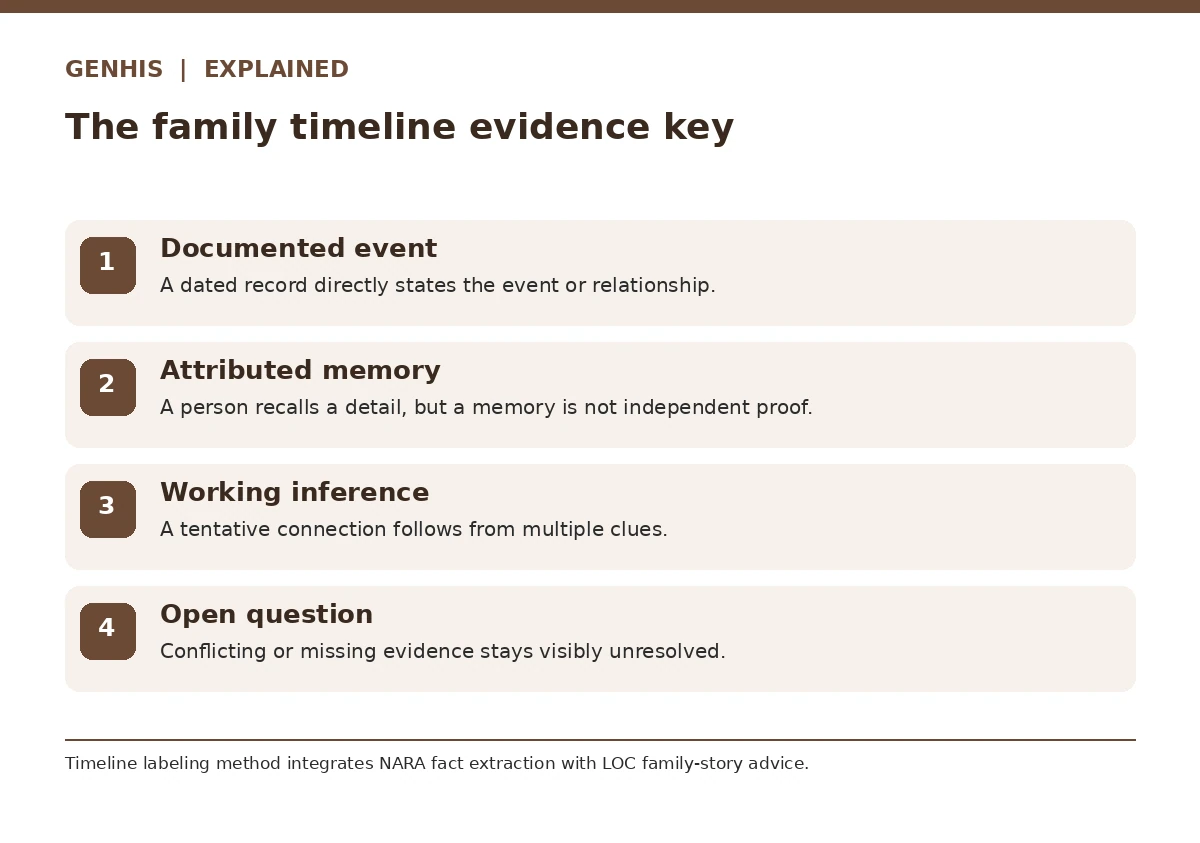
Make a timeline with columns for claimed event, proposed date or date range, location as reported, speaker or document, evidentiary status, and next test. A line such as “moved to the coast as a child” might have no exact year. Keep the interval broad until a dated source narrows it. If a family photograph is labeled later by a descendant, note the label’s author rather than treating the caption as contemporaneous with the image. Contradictions between recollections can themselves be informative, but should remain visible.
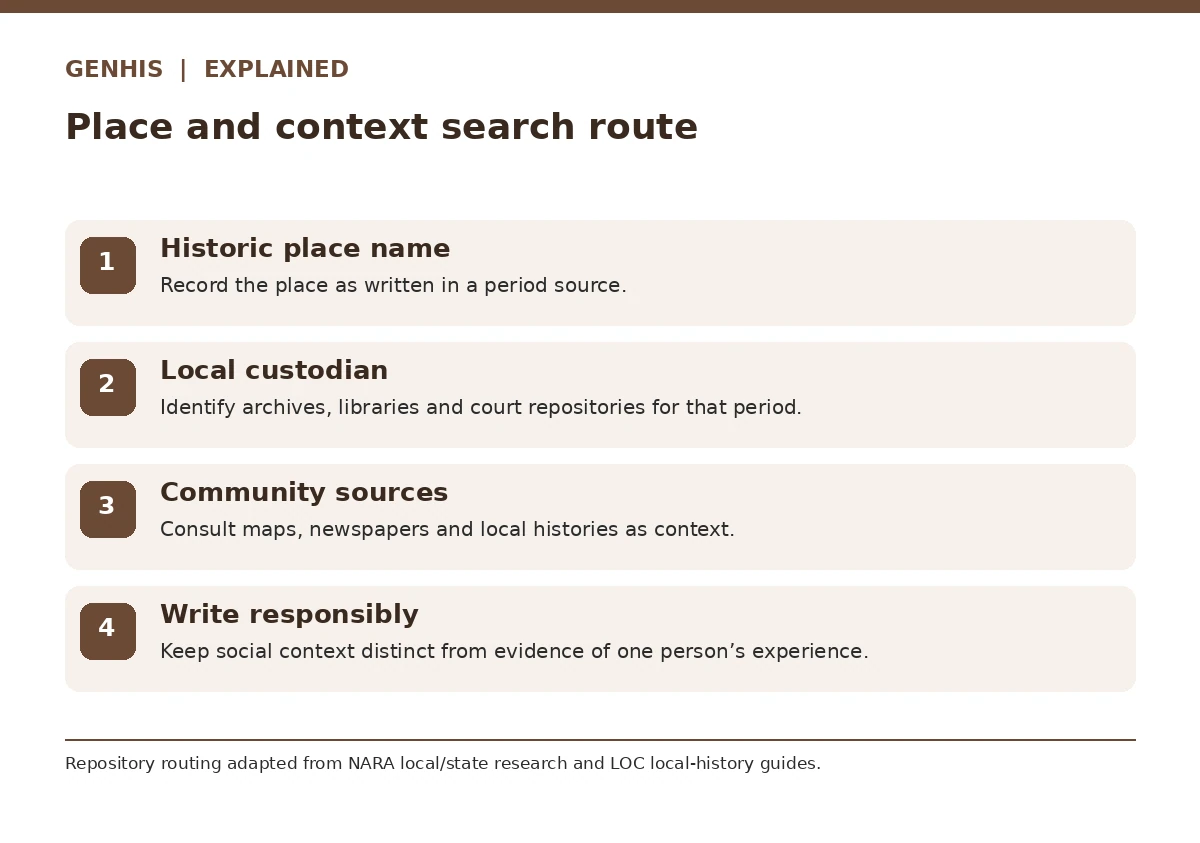
Use the historical name and jurisdiction when searching a record catalog. A family’s place name may refer to a village, district, parish, county or administrative unit whose boundaries changed over time. Modern map proximity is not enough to establish where records for an old event were created or kept. Search a reliable historical gazetteer or custodial guide where appropriate. If no authoritative boundary source has been checked, say the jurisdiction is unverified rather than silently choosing the nearest present-day archive.
Treat a Family Story as a Lead, Not a Verdict
Consider an entirely fictional story: “Our family arrived in Port Vale just before the factory closed.” The account suggests a move and a historical setting, but establishes neither a date nor an individual’s employment. Record the words and the storyteller’s relationship to the events. Then identify whether a historical local newspaper, relevant census, street directory, school register, or privately held letter could narrow the place and time. Not every one of these record types will survive or be accessible for every locality.
You might find a dated newspaper article about an industry downturn, but that does not prove the fictional family worked at that business. Historical context describes conditions around possible events; personal documentary evidence is still required to attribute participation to an individual. If a family member’s recollection says “probably,” do not turn it into “certainly” in the final story. When a source conflicts, quote the competing statements, examine provenance, and consider what different viewpoints could explain the discrepancy.
Place Documents and Objects in Their Original Context
An envelope may retain a mailing address and approximate postal context; a letter may reveal an author, recipient and date; a photograph might show a location or occasion. These are possibilities, not promises about what every surviving item contains. Inspect both sides if handling is safe, note material condition without attempting repairs, and preserve the arrangement of papers in an inherited collection. Keep owner-supplied captions separate from your own guesses. Digital copies should retain a reference to the physical original and its custodian.
For formal records, distinguish the person named in a document from the creator and informant of the information. A census entry, directory listing, marriage record, and newspaper article were produced for different purposes; they can disagree for understandable reasons. The National Archives advises using varied custodians because federal holdings alone will not reconstruct a family’s full story. Local libraries, state archives, private collections and community records may be central, but examine their specific collection descriptions rather than assuming universal coverage.
Build a Narrative That Shows Its Evidence
Draft a short paragraph for each supported event: what happened according to the record, where and when the record locates it, and how that event fits the broader chronology. Follow it with a separate sentence for family testimony if one exists. A well-written passage might say, “In an interview recorded by the family in an unspecified year, a relative remembered living near a station”; it should not silently turn that testimony into a verified address. Where a claim remains speculative, call it a working hypothesis.
A useful source note identifies the document or interview sufficiently for another authorized researcher to find it, while avoiding unnecessary public exposure of living relatives. Credit oral contributors when permission allows; otherwise use a privacy-preserving description. Cite maps, newspapers and local histories when you use them for context, and do not treat generalized community experiences as proof of one ancestor’s actions. This distinction is especially important for displacement, enslavement, Indigenous identity, immigration and other historically sensitive experiences.
Preserve Uncertainty and Guard Living-Person Privacy
Stories about adoption, parentage, trauma, or a living person’s identity require added care. Do not infer a private relationship from a nickname, rumor, resemblance, or genetic ethnicity estimate. Avoid making medical genetic claims or publishing private contact information. A credible family-history account can explain that sources conflict or that someone preferred not to discuss a topic. The goal is not to fill every gap but to preserve a trustworthy account with clearly labeled boundaries.
For photographs and papers, store originals using appropriate archival guidance rather than household cleaning methods. Retain a simple inventory indicating holder, physical format, known creator, approximate period, digital copy location and restrictions. Back up digital research files, but do not assume copying an item gives permission to publish it or override copyright and privacy rules. A narrated family timeline can have more lasting value than a polished but undocumented ancestry chart if the sources remain findable.
Produce a Timeline Another Relative Can Improve
End with a timeline divided into documented events, attributed memories, context, and open questions. Keep a separate source list for each line. Invite family members to correct or supplement information without pressuring anyone to reveal private material. State what you searched and where: a specific archive catalog, a family-held folder, or an interview conducted under permission. Do not claim a comprehensive search if you only checked a broad website index.
Your next task should be a small research decision: one unexplained move, one ambiguous place name, or one story that could be tested against a dated source. The Library of Congress recommends exploring both personal testimony and hometown records; its online resources guide also warns that not all relevant items are available from home. A history grows in quality when each revision makes its evidence and limits clearer, not when every uncertain episode is written as settled fact.
How We Research and What These Sources Establish
Our examples are deliberately fictional teaching cases, not identified historical people. We distinguish what a source reports from a reasonable hypothesis and what is unknown. This guide is informational, not a determination of family identity. Links below lead to the custodians or authors of the methods described; source availability and site interfaces can change. No paid partner relationship is asserted. See the affiliate disclosure policy (verified on GenHis on October 19, 2026).
Ask.Loc.Gov: Loc Start — Library of Congress advises beginning with known family, interviewing relatives, gathering family papers, and independently checking published trees.
Archives.Gov: Nara Begin — NARA explains starting from known relatives and looking for names, dates, places, relationships and multiple local repositories.
Guides.Loc.Gov: Loc Guides — Library of Congress clarifies that not all relevant collections are available from home and identifies digital and nondigital research pathways.
Guides.Loc.Gov: Loc Basic — Library of Congress provides introductory genealogical resources, collection search guidance and local history context.
They are valuable attributed testimony, but treat dates, locations and relationships as claims that may need documentary checking.
Ask the participant for informed permission and agree on intended use, storage and sharing; consider applicable local legal requirements.
Label the story as an attributed memory, explain which repositories or record types were checked, and avoid presenting it as proven.
Use them as a navigation aid, not as proof of a historical boundary. Verify place names and jurisdictions for the relevant date.
Remove unnecessary living-person identifiers, consider affected relatives, and explain uncertainty or restrictions before making it public.